Can Coated Bagasse Tableware Still Be Compostable? What Bakery Buyers
Can Coated Bagasse Tableware Still Be Compostable? What Bakery Buyers Should Verify Before Ordering
Bagasse tableware earns its compostable reputation from the sugarcane fiber, but the coating applied on top can decide whether the finished product still qualifies. This article explains why bagasse bowls, plates, and clamshell boxes get coated in the first place, how different coating approaches…
Summary
Bagasse tableware earns its compostable reputation from the sugarcane fiber, but the coating applied on top can decide whether the finished product still qualifies. This article explains why bagasse bowls, plates, and clamshell boxes get coated in the first place, how different coating approaches change the compostability picture, and why fluorinated grease barriers have become a serious compliance concern for foodservice packaging. It then walks through the whole-product testing logic behind certification systems such as EN 13432, BPI, and OK Compost, and gives bakery and dessert buyers a practical verification checklist: match the certificate to the exact coated SKU, confirm the claim wording for the destination market, and ask how evidence connects to production batches. The core rule is simple — the fiber is not the certification; the finished construction is.
Estimated reading time: 7 minutes
Why Bagasse Bakery Packaging Gets Coated At All
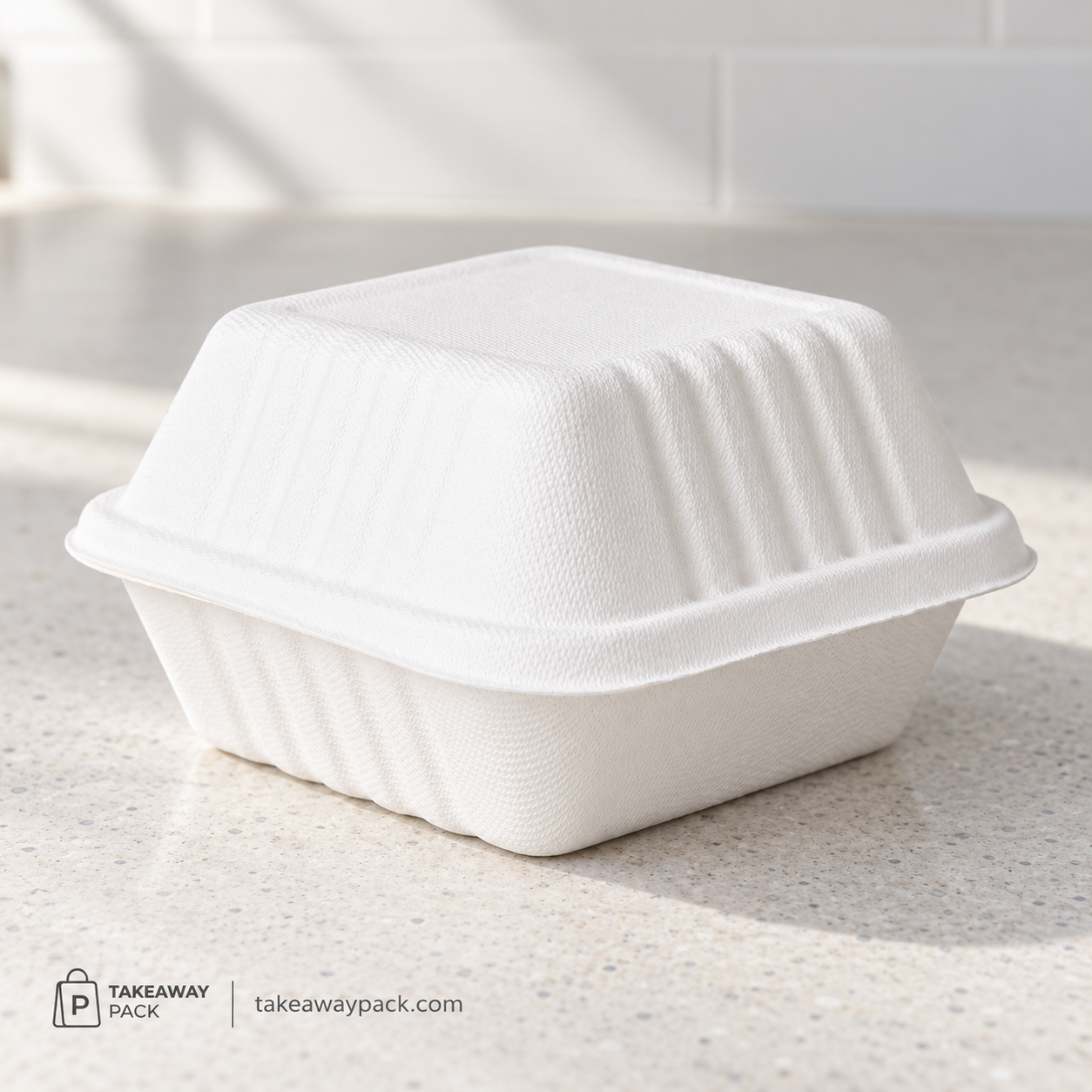
Sugarcane bagasse is the fibrous pulp left after juice extraction, and molded into tableware it handles heat and typical foodservice use well. For dry items — bread rolls, cookies, layered cakes in a display case — an uncoated bagasse bowl or plate often performs exactly as needed.
Problems start with moisture and grease. Cream-filled pastries, glazed donuts, oil-based dressings, and sauced desserts all work against a bare fiber surface over extended holding times. A cake dome covering a chilled dessert tray, or a bowl holding a wet salad for an afternoon, needs a barrier so the structure does not soften or leak before service ends.
That is why manufacturers coat or line part of the range. The trade-off every buyer should understand: the same barrier that protects the dessert also enters the compostability equation. Coating choice is not a production detail — it is a compliance decision.
How a Coating Changes the Compostability Story
A compostability claim is a tested, standards-backed statement about a finished product, not a mood attached to a natural-sounding material. Regulators and certification bodies treat the claim that way, and so should procurement teams.
In broad terms, the market sorts into three families:
Uncoated bagasse — no added barrier, the simplest construction to qualify for composting routes, with the known limitation of weaker wet and oily resistance.
Bio-based polymer coatings, such as PLA-type linings — designed to break down under managed industrial composting conditions, and eligible for certification only when the complete construction passes.
Conventional petroleum-based linings — generally incompatible with compostability claims and increasingly restricted in regulated markets.
Two second-order details also count. Printing inks and adhesives become part of the tested product, so a poorly chosen ink can undermine an otherwise sound construction. And "industrial compostable" is a narrower statement than "home compostable" — the first describes managed facilities with controlled temperature and moisture, the second describes a backyard pile, and passing one does not imply the other.
Fluorinated Grease Barriers: The Problem That Outlasts the Fiber
For years, grease resistance in fiber-based food packaging commonly came from fluorinated chemistry — PFAS-type compounds that repel oil remarkably well and persist in the environment just as remarkably. That persistence is now the center of the problem.
Certification bodies have responded. BPI, the main North American compostability certifier, has tightened its program requirements so that intentionally added fluorinated chemicals disqualify a product. In Europe, restrictions on PFAS use are moving through the regulatory system. A grease-barrier choice that was commercially normal a few years ago can now block a compostability claim outright.
The buyer takeaway is direct: when oil resistance is quoted for bakery packaging, ask what creates it. Request the PFAS-related evidence — a declaration plus supporting test documentation matching the quoted item — alongside the compostability certificate, and never assume one covers the other. In practice, uncoated or non-fluorinated constructions paired with realistic menu choices (absorbent liners, separate sauce cups) often solve the grease problem without endangering the claim.
Certification Tests the Finished Product, Not the Fiber Alone
This is the single most misunderstood point in the category. Certification schemes such as EN 13432 in Europe and the ASTM-standards route behind BPI in North America evaluate the complete construction — fiber, coating, inks, adhesives, and lid if the product ships as a set — against defined thresholds.
Testing generally examines four things:
Biodegradation — microorganisms must convert the organic content to CO2 within the standard's time frame under controlled conditions.
Disintegration — the product must physically break down past a defined fragment size during the composting cycle.
Ecotoxicity — the finished compost must support seed germination and plant growth, proving no toxic residues remain.
Regulated constituents — heavy metals and other restricted elements must stay below the standard's limits.
Each of these tests runs on the product as sold. A certificate earned by an uncoated version therefore says nothing about a coated variant, and certificates are issued within defined construction limits — thickness, grammage, coating type, and printing state. Change the construction and the evidence chain breaks.
Verification is practical, not theoretical. BPI-certified products appear in a public directory that procurement teams can search by company and product family. OK Compost labels from TÜV Austria are issued per licensee and per product scope, with separate labels for industrial and home conditions. In every case, the check is the same: confirm the certificate number, the holder, the covered product family, and the validity dates — then confirm the item you are buying actually sits inside that scope.
Matching the Claim to the Destination Market
A compostability certificate supports a claim; it does not decide where and how the claim may be printed. That decision belongs to each market's own packaging and labeling rules.
In North America, a BPI mark tells you how an item was tested, not where it will be collected. Each municipal program and commercial composter keeps its own acceptance rules for what enters its organics stream, so treat the certification as the opener for a conversation with the local operator — and confirm the actual processing path for each store before the claim goes on the pack.
In the European Union, industrial-compostability claims draw on EN 13432, while labeling and organics-collection rules are shaped by EU-level legislation plus each member state's implementation.
So the sequence matters. Decide which disposal route each destination market actually offers before approving artwork. The same bagasse bowl sold in Germany and in California may need different on-pack wording even when the underlying certification is equivalent. Writing the claim first and asking questions later is how greenwashing complaints and customs delays happen.
What Bakery Buyers Should Verify Before Approving a Coated Item
Treat the certification file as part of the product specification. Before samples are approved or tooling is committed, request:
Certificate evidence per claim — number, holder, issuing body, and validity dates, for each claim you intend to print.
SKU-level scope mapping — which sizes, coatings, printing states, and grammages the certificate actually covers, with your item named.
Finished-construction evidence — confirmation that testing covered the coated, printed product, not the raw fiber alone.
PFAS-related documentation where grease resistance is quoted — declaration plus matching test reports.
Food-contact documents separately — compostability certification is not food-contact approval; each needs its own evidence for your market.
Claim wording per market — how the on-pack statement should read under the destination market's sorting and labeling guidance.
Batch linkage — how the supplier ties certificates and test reports to your production runs, and whether that connection will be confirmed in writing for each order.
A supplier who can answer these seven points per SKU is auditable. One who sends a logo image and a sales sheet is a risk you would be importing.
How Takeawaypack Handles Coated Bagasse Requests
Takeawaypack is a foodservice packaging brand and procurement coordinator that works with multiple packaging manufacturers across categories including cups, bowls, boxes, containers, trays, lids, bags, and cutlery. Bagasse tableware sits inside that molded-fiber range, and coating questions — barrier type, lining options, printability — are part of what gets discussed at the inquiry stage, before structure and artwork are fixed.
Because certification attaches to products and factories rather than to a brand name, the honest answer to "is it certified" is always SKU-specific. Select kraft and molded-pulp lines in the range are covered by compostable or recyclable-related certification, and certification documentation can be provided for the specific SKU, confirmed by order quantity and destination market. On the sourcing side, one supplying mill in the network, Wenzhou Chenglong Paper Plastic Products Co., Ltd., holds FSC Chain of Custody certificate GFA-COC-006105 (valid through February 2027) and GRS 4.0 certificate TE-00121899 (valid through November 2026) — factory-level credentials that support sourcing and recycled-content claims on qualifying products, distinct from any compostability evidence.
Custom coating and printing requests go through a digital proof, confirmed in writing before production starts. That keeps the construction you certified and the construction you receive the same thing.
Next Steps for Bakery and Dessert Packaging Buyers
Whether you run a multi-store bakery chain specifying bagasse cake domes, a dessert brand shipping pastries in compostable mailers, or a distributor reviewing a molded-fiber range for private label, put the evidence step into the sourcing sequence: list every claim you intend to print per market, request the matching documents for each exact SKU with validity dates, and confirm the waste-stream wording before artwork approval.
Send your SKU list, estimated quantities, and destination markets through https://takeawaypack.com, and you will get a document-backed answer on which items can carry the claims you need — with flexible MOQs for stock items and custom MOQs quoted per product and production process.