EPS Boxes for Frozen Meal Delivery: What to Check Before You Commit to
EPS Boxes for Frozen Meal Delivery: What to Check Before You Commit to Foam
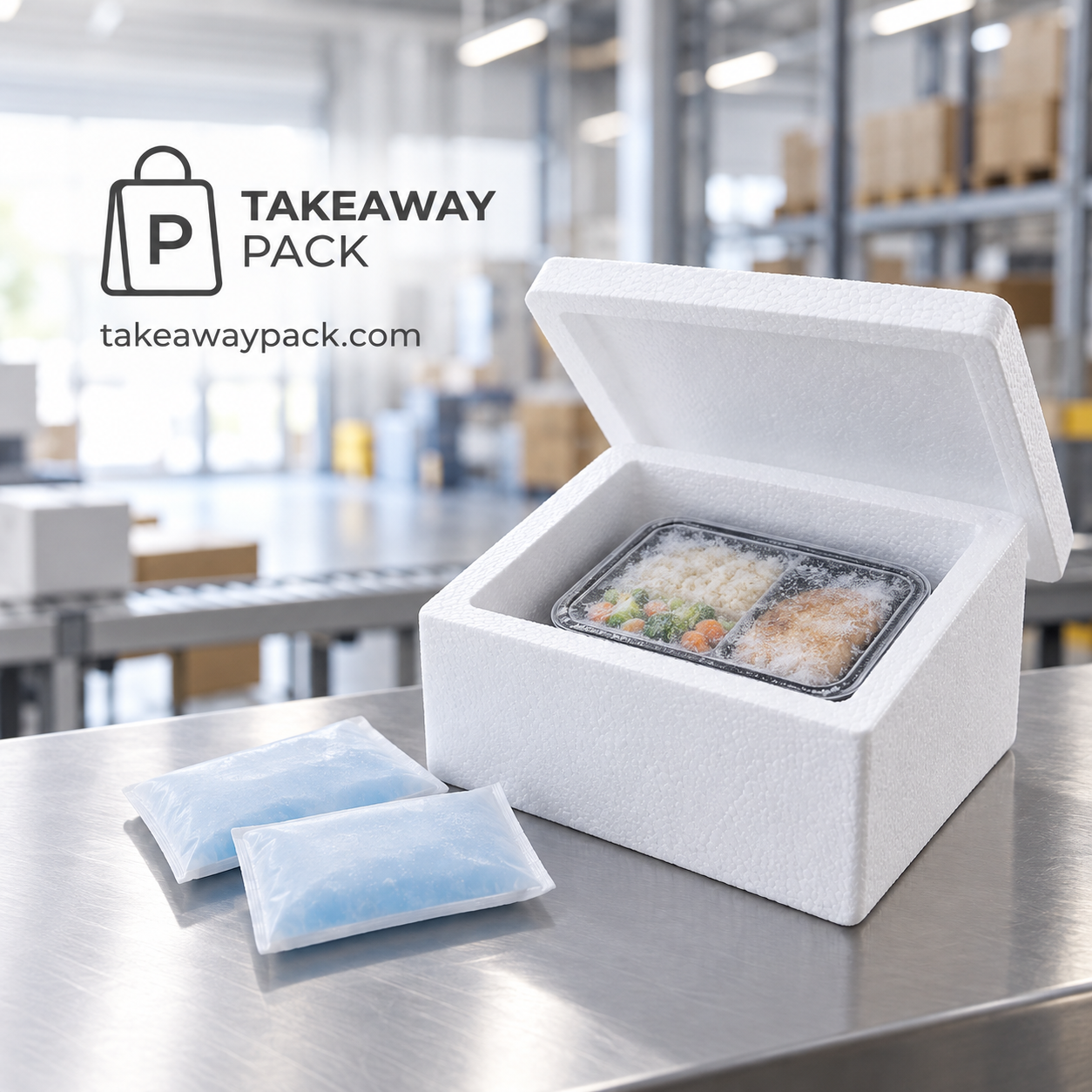
EPS foam boxes remain the economical default for one-way 24–48 hour frozen and chilled food parcels because they insulate well, weigh little, and survive parcel networks. Before committing, check four things: wall thickness against your longest lane, food-contact suitability for your exact menu, warehouse space the cube will consume, and the complete cost including gel packs and freight. Ticking those boxes turns foam from a commodity buy into a packout you can defend to your customers.
Estimated reading time: 4 minutes
Confirm the lane actually calls for foam
EPS is a strong choice when your parcels travel one way, finish within a day or two, and need structure more than premium presentation. That describes most subscription meal-kit and frozen DTC lanes in temperate seasons. It is the wrong tool for multi-day international routes with airport holds, for ultra-low temperature claims, or for customers with stated packaging-waste mandates that rule foam out outright.
Write the lane down before you shop: duration including delays, season, ambient peaks, and what happens if the parcel misses its delivery window. The lane, not the material, decides the box.
Match wall thickness to hold time
Industry practice puts EPS walls in tiers: roughly 0.75–1.1 inch walls for work that finishes within 24 hours, around 1.5 inches for 24–48 hour ground shipments, and 1.75 inches or more for multi-day transit. Carrier guidance for perishables commonly recommends at least 1.5 inch (4 cm) foam walls as a practical reference point.
Treat the tiers as starting points, not promises. Actual hold time shifts with coolant type and mass, how full the box is, how well it closes, and the ambient profile of the route. If your frozen line must survive a summer heat wave plus a missed delivery, buy wall, not hope.
Check the box as food packaging, not just insulation
An EPS shipper touches your brand even though your food never touches the foam. Lids should close without force, corners should survive a squeeze test, and the interior should accept your inner bags, absorbent pads, and dividers without gaps that let payload shift. Loaded EPS can crack at corners when dropped, so a packout that leaves the foam bearing weight on its lid fails quietly.
For the food-contact surface itself, treat material claims the way you treat any packaging claim: confirm suitability for your exact product and use with documentation for the specific SKU, and keep the inner bag or liner between foam and food rather than assuming anything. Ask when the documentation was issued, too — material certifications attach to products and production runs, not to a supplier's whole catalogue, so a claim that was true last season deserves re-verification before this season's purchase order.
Run this checklist before you commit
Lane sheet. Duration, season, destination, doorstep dwell, and returns or refusal handling.
Hold-time evidence. A packout test on your route with your coolant, not a generic data-sheet figure.
Food-contact confirmation. Per-SKU documentation from the supplier for the products that touch the box.
Leak and moisture plan. Inner bags and absorbent pads sized to the menu, because thawing food weeps.
Warehouse math. How many pallet positions the nested cube costs you per week of stock.
Coolant plan. Gel pack count, conditioning temperature, and placement above the payload where chilled menus allow it.
Cost it like a system, not a unit price
The lowest foam quote rarely survives contact with the full picture. Add coolant, packing labor, dimensional-weight freight, warehouse space, and the cost of a spoiled order when a lane runs long. That total, divided by the hours of temperature hold your test proved, is the honest unit.
Foam usually wins that math on frozen and heavy-protein lanes; flat-packed fibre systems usually win it on short chilled lanes where storage and freight cube matter. Both answers are legitimate — the mistake is choosing on sticker price alone. It also shifts over time: coolant prices, seasonal lane performance, and parcel rate changes all move the total, so rerun the comparison at least twice a year or whenever a component changes.
Pair the box with the right food-contact packaging
The insulated shipper is only the outer half of a frozen meal packout. Inside it you still need leakproof containers, lids that match, portion bowls, and any printed elements your unboxing experience relies on — and those pieces are what your packaging supplier should engineer with you.
Takeawaypack supplies foodservice packaging across boxes, containers, bowls, trays, and cups, working with a network of manufacturers while running its own printing plant for custom branding in small batches. In an RFQ you can lay out the product category, material, size or capacity, quantity, logo or color printing, and destination port, then align samples, dielines, and export details before production. The lunch-box line shows the format family most frozen meal programs start from.
Quick answers before you order
How thick should EPS walls be for frozen meal kits?
Start near 1.5 inches for 24–48 hour lanes and go thicker for multi-day or summer routes. Validate with your own coolant on your own lane.
Can EPS boxes touch food directly?
Do not assume it. Confirm food-contact suitability for the specific SKU with documentation, and use an inner bag or liner as your working barrier.
Are EPS boxes recyclable at the kerb?
Usually not. Most kerbside programs do not accept foam because it is bulky and light, so plan disposal messaging accordingly.
How many gel packs do I need?
There is no universal number. It depends on payload mass, start temperature, lane duration, and season — test, then freeze the packout recipe.
For a packaging request built around your menu and destination, visit Takeawaypack.