Hotel Grab-and-Go Breakfast Packaging: Choosing Breakfast Boxes, Paper
Hotel Grab-and-Go Breakfast Packaging: Choosing Breakfast Boxes, Paper Bags, Leak-Proof Lids and Cutlery That Keep Room Service Hot
Converting hotel room service into a grab-and-go breakfast program is less a menu change than a packaging specification exercise: the breakfast box has to insulate and vent correctly, the lid has to seal wet items without trapping steam, the paper bag has to carry the assembled kit without crushing or staining, and the cutlery has to arrive dry and usable. This guide sets out the specifications hotel F&B and procurement teams should compare for a typical 25-minute delivery window — paperboard
Why the 25-Minute Window Shapes Every Decision
A hotel grab-and-go breakfast is a demanding packaging assignment disguised as an easy one. The kit travels a short distance, but it stacks multiple food temperatures in one bag: hot eggs and bacon, porridge or beans in sauce, warm pastries that go soggy from trapped steam, and coffee or juice with their own lids to worry about. Inside that window, four things can go wrong at once — heat loss, condensation sog, grease breakthrough, and leaks between components.
Each failure maps to a specific packaging choice. Heat loss is governed by the box's paperboard weight and construction. Sogginess is governed by ventilation. Grease stains on the bag or the guest's table are governed by the coating. Leaks are governed by the closure. Specifying these four elements as one coordinated kit — rather than buying a box, a bag, a lid and cutlery from four separate decisions — is what keeps a 25-minute delivery consistent.
The Breakfast Box: Getting the Structure Right
Paperboard Weight
Hot-food boxes are commonly specified in the 300–450 GSM range. Heavier paperboard slows heat transfer through the box wall and resists crushing when boxes stack inside a delivery bag or room-service cart, which matters when a tray carries several kits at once. A lighter construction can be adequate for pastry-dominant or dry breakfast items with a short hold; heavier grades suit porridge, hot sauces and longer hold times. Ask suppliers to state the GSM per SKU and to confirm it on the certificate that accompanies production — weight tolerance is one of the easiest specifications to verify and one of the most common places where samples and production units drift apart.
Coating and Grease Resistance
Interior coatings create the oil and moisture barrier, and breakfast exposes them hard: bacon, sausage, fried eggs and butter-rich pastries all carry grease that migrates through untreated paper fibers and eventually shows as stains on the outside of the box. Polyethylene (PE) coating is the industry baseline for grease and moisture resistance. Polylactic acid (PLA) coating offers a bio-based alternative with a lower softening point, so it suits moderately hot items rather than the hottest ones. Water-based dispersion coatings paired with a reduced PE barrier lower the plastic content while retaining most of the barrier performance.
Grease resistance is measurable, so buy it as a number rather than a promise. The TAPPI T559 "Kit test" grades resistance from 1 (lowest) to 12 (highest); dry items tolerate a mid grade, while greasy breakfast proteins justify specifying the upper grades. Ask each supplier which grade their construction achieves and what evidence supports it.
Ventilation: The Steam Trade-Off
Seal hot food in a closed box and steam condenses on the lid, drips back, and softens pastries and fried items. Vent the box too aggressively and the food cools before it reaches the room. Micro-vents — small, few, placed away from direct food contact — release excess steam at a modest cost in heat. Match the vent count to the menu: crisp and fried items want more ventilation, wet items such as porridge want less, and mixed breakfasts may be better served by separating the pastry into its own compartment or box rather than compromising on a single chamber.
Sizes and Compartments for Breakfast Menus
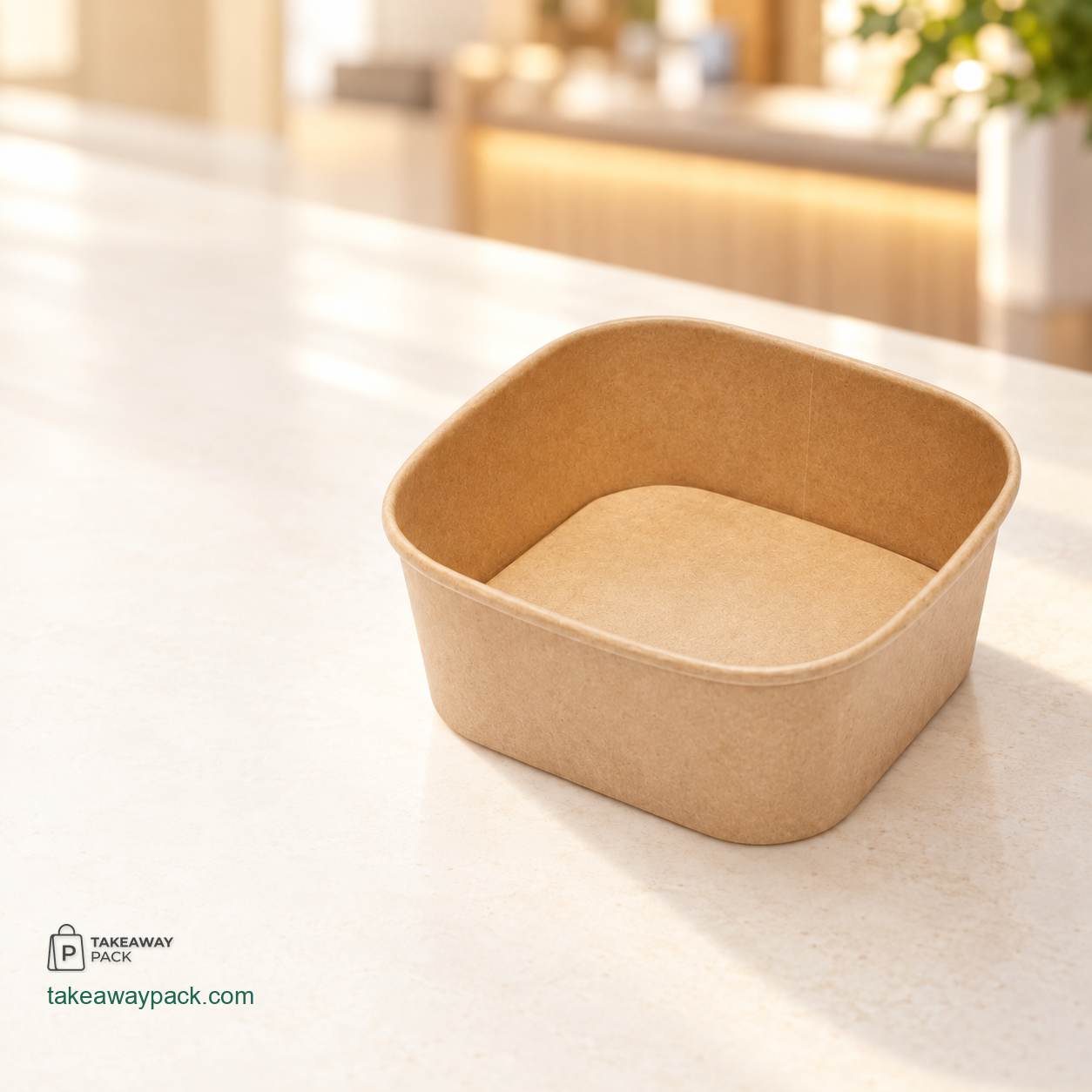
Individual hotel breakfasts generally fall in the 200–600 ml range: small square or round boxes for pastries and sides, mid-size menu boxes for a full plate, and the larger end of that range for heartier appetites. Wire-handle formats make a single-kit carry easier for guests walking from a lobby station to their room. Compartments keep wet items away from dry ones, which protects both texture and presentation. TakeawayPack's boxes catalog, for example, spans kraft and white square boxes from 200 ml, round food boxes, menu boxes, wire-handle formats and a 600 ml doner-style box — enough range to map most breakfast menus without changing suppliers mid-line.
Lids and Closures: Matching the Seal to the Menu
Closure choice should follow the wettest item in the box. A tuck-in flap suits dry pastries and wrapped sandwiches but is not a leak barrier. A friction-fit lid holds through normal carrying. Snap-lock and hinged lockable closures hold against tilting and rough handling, which is what actually happens when a bag rides a luggage cart.
Beverages are the other half of the leak question. Coffee cups need matched lids in the correct diameter, and paper or PLA lids are available for common soup-cup diameters — 90 mm and 96 mm are typical examples. Lid matching is a standard topic at the inquiry stage, so confirm diameter, material and fit as part of the kit quotation rather than assuming compatibility after delivery. For any cup-and-lid pairing, ask the supplier to confirm the fit on samples before production.
Paper Bags: Carrier, Protector and Brand Surface
The bag does three jobs in a grab-and-go program. It carries the kit stably enough to survive a luggage cart and an elevator. It protects the guest: the bag's interior should resist grease migration from the box exterior, because a stained bag reads as a failed delivery even when the food is perfect. And it is the largest printable surface in the kit, which makes it the natural home for the hotel's brand mark, breakfast menu callouts or sorting instructions.
Specify the bag against the loaded weight and dimensions of the assembled kit — box plus cup plus cutlery — and confirm that the kit stands upright and does not crush the box. A bag that fits the kit's footprint neatly also preserves the box's ventilation and insulation logic, because a crushed or tilted box pools condensation and sauce.
Cutlery and Napkin Kits
Cutlery arrives in the same bag as hot, steamy food, so the kit design should keep it dry: sealed paper wraps or a separate small pocket prevent condensation from softening wooden or paper cutlery before the guest opens it. Material options each carry trade-offs in rigidity, cost and end-of-life handling — wooden (bamboo) cutlery, CPLA, paperboard cutlery and plant-fiber pulp formats are all established foodservice options, and TakeawayPack's catalog covers cutlery across these material types. Rather than accepting a generic "eco" label, ask what each material supports for your destination market and request the documentation per SKU.
Assembling the Kit: A Compatibility Checklist
Before requesting quotes, lock the kit logic on paper:
Box: GSM, coating, grease-resistance grade, ventilation plan and compartments matched to your actual menu items and the 25-minute window.
Lid/closure: closure type per box; matched beverage lids confirmed by diameter and fit.
Bag: sized to the loaded kit, grease-resistant interior, printable area reserved for branding.
Cutlery: material chosen, wrapped or pocketed to stay dry, napkin paired.
Branding: consistent print across box, bag and wrap.
Working with one supplier across all components shortens this loop. TakeawayPack, for instance, operates its own printing facility alongside partner factories and treats the kit as a single quotation: at inquiry stage its team discusses structure, coating, capacity, printing, lid matching and carton packing, and custom artwork proceeds through a digital proof that is produced only after written customer confirmation. Standard catalog items may support trial orders, while custom-printed MOQs depend on the product and production method — worth confirming per SKU rather than assuming.
Cost Logic: Price the Failure, Not Just the Box
The visible cost of a breakfast kit is the sum of four unit prices. The real cost includes every failed delivery: a remade dish, a second trip to the room, a refund or credit, and the review a disappointed guest leaves. A sturdier box, a better closure or a grease-resistant bag typically adds cents to the unit cost, while a single failure can erase the margin on dozens of deliveries.
Compare vendors on comparable numbers, not totals. A useful RFQ asks each supplier to quote per SKU: unit price, MOQ, tooling or plate charges, sampling charges, packing method, shipping terms and possible surcharges. That structure exposes where one vendor's cheaper box is offset by a dearer lid, and it makes the total kit cost — and the cost of upgrading any single component — visible before contract.
Supplier Verification for Hotel Procurement
Before shortlisting, put the same evidence requests to every candidate:
Material specification per SKU: stated GSM and coating type, with documentation that matches production, not just samples.
Grease-resistance evidence: the test method and achieved grade for the actual construction.
Food-contact documentation: appropriate to your destination market, covering the paperboard, coatings, inks and adhesives — not a single generic statement.
Samples that match production: confirm the samples use the same material layers, coating, lid configuration and printing process as future production units.
Environmental claims, scoped: kraft and molded-fiber lines may support recyclability or compostability claims, but the claim depends on the specific SKU's coating and on local collection and processing infrastructure. Request the per-SKU certificate rather than accepting a company-level statement. Where relevant, certificates held within a supplier's network can be cited — for example, TakeawayPack's supplier network includes an FSC Chain-of-Custody certificate (GFA-COC-006105, valid to 2027-02-09) and a GRS 4.0 certificate (TE-00121899, valid to 2026-11-18) held by its paper-products partner — always with per-SKU confirmation for the items you actually buy.
Treat vagueness as data: a supplier who will not state GSM, coating type or MOQ upfront is telling you where the compromise lives.
Frequently Asked Questions
What box size suits a hotel grab-and-go breakfast?
Most individual breakfasts fit 200–600 ml boxes: small square or round boxes for pastries and sides, 400–450 ml menu or wire-handle boxes for a full plate, and the top of that range for heartier orders. Match the fill level so contents do not press against the lid, and use compartments to keep wet items away from pastries.
How do I stop pastries and fried items turning soggy in transit?
Condensation, not heat loss, is usually the culprit. Choose boxes with micro-ventilation for crisp items, give wet items fewer vents or a separate compartment, and avoid overfilling. Validate with your actual menu: pack a sample kit, hold it for the length of your delivery window, and check the pastry before and after.
How much grease resistance does a breakfast box need?
Specify it by test grade rather than description. The TAPPI T559 Kit test grades grease resistance from 1 to 12; dry bakery items tolerate mid grades, while bacon, sausage and fried eggs justify the upper grades. Ask suppliers for the achieved grade and the supporting test evidence for the exact construction quoted.
Should the paper bag insulate, or does the box do that job?
Treat the box as the insulator and the bag as the carrier and protector. Bags add little insulation, but they must carry the kit upright, resist grease migration from the box exterior, and fit the kit's footprint so the box is not crushed — a crushed box pools condensation and leaks.
Can boxes, bags, lids and cutlery carry the same hotel branding?
Yes, and coordinating them with one supplier keeps colors and placement consistent across components. TakeawayPack, for example, runs custom printing through its own facility: you submit artwork, receive a digital proof, and production starts only after your written confirmation — a sequence that protects brand consistency across the whole kit.
What should an RFQ for a complete breakfast kit include?
Specify per component: product or category, material, size or capacity, estimated quantity, printing requirements including colors and logo, and destination port or country. Adding tooling and sampling charges, packing method and shipping terms to the template makes vendor quotes directly comparable.
Ready to Specify Your Breakfast Kit
A grab-and-go breakfast succeeds when the box, lid, bag and cutlery are specified as one system against your menu and your delivery window — and when the documentation behind each component arrives before the first order, not after the first complaint. TakeawayPack supplies boxes, lids, bags and cutlery to hotel, restaurant and foodservice buyers across North America, Europe, Australia, the Middle East and Japan/Korea, with custom printing, flexible MOQs and sample support from a single coordinated team.
Send your breakfast menu, delivery window and destination market to info@takeawaypack.com or request a quote at https://takeawaypack.com — and put the kit to the test with samples before your next service redesign.