How to Pair Greaseproof Liners With Leak-Resistant Sauce Cups in One
How to Pair Greaseproof Liners With Leak-Resistant Sauce Cups in One Order
Greaseproof liners and leak-resistant sauce cups answer two different failures, which is why neither one alone fixes an order. The liner's job is to slow the oil that renders out of fried food into the box or bag; the sauce cup's job is to keep free liquid from finding a lid gap in transit. Spec the liner against your fattest menu item and longest hold, spec the cup against closure quality and fill level, then confirm both in a single trial order. Treat the pair as one kit — one RFQ, one sample
Estimated reading time: 4 minutes
Two Failures, One Order
Oil and sauce escape differently. Grease is rendered slowly out of fried or oily food and wicks into whatever fiber it touches, so it stains boxes, softens bags, and ends up on customers' hands. Sauce is already free liquid; it moves the moment a container tilts and exits through the weakest point of a lid.
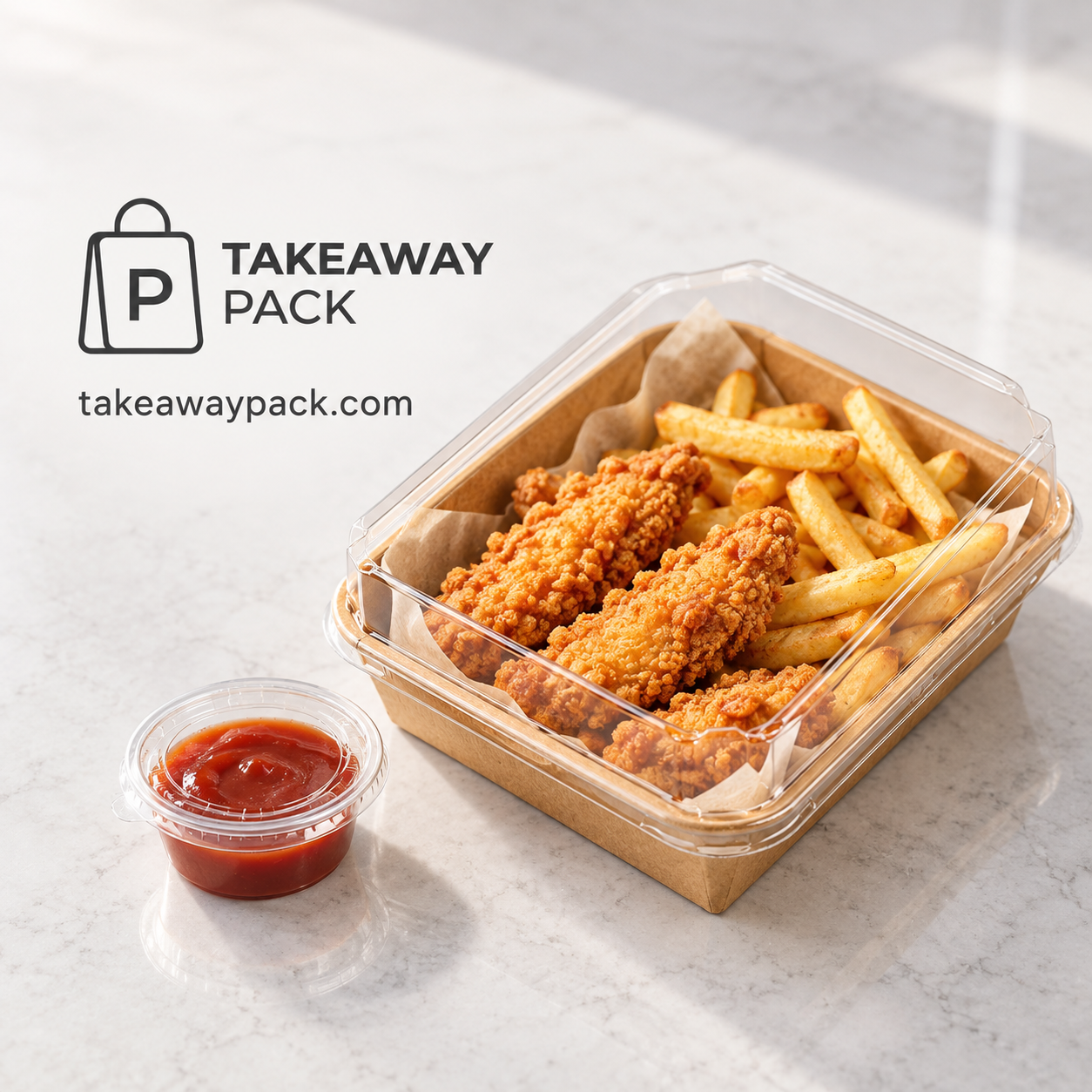
That difference is why a liner by itself still leaks and cups by themselves still stain. A food truck serving loaded fries with dip needs the liner to protect the package and the cup to protect the sauce — and because both face the same menu and the same route, they belong in the same order rather than patched in separately after complaints.
Match the Liner to Your Fattest Item
Grease resistance comes from the barrier treatment, not from paper weight. A thick liner with no grease barrier simply gives oil more fiber to soak through, while a lighter greaseproof grade can outperform it. Treat your greasiest item — fried chicken, loaded fries, anything with rendered oil pooling at the base — as the benchmark the liner has to survive.
Hold time matters as much as fat load. A liner that holds up through a counter handoff can still saturate during a long delivery queue, because heat and time keep driving oil into the fibers. If your trucks do both walk-up service and delivery runs, spec for the longer hold. Coverage counts too: the liner has to sit where oil actually pools — under the food — not just line the walls.
Match the Sauce Cup to Closure and Fill
The cup's leak resistance lives in the lid. A snap-lock or tight-fitting lid that engages around the full rim stays closed when a bag tips; a loose-fitting cover can back off in transit. Ask how lid and cup are designed to fit as a set rather than assuming similar-looking sizes interchange. When you compare options, a dedicated range such as Takeawaypack's soup tubs and sauce cups shows what closure styles are actually available.
Fill level does the rest. Leave headspace below the rim so pressure in a full cup doesn't push sauce into the closure, and keep the sealing rim clean and dry before the lid goes on — sauce smeared across it is a classic way a good seal fails. For hot sauces, a brief settling period before sealing avoids steam pressure lifting the lid later.
Size Both Pieces Around the Menu
The two products only work as a pair when their sizes match the food. A liner should fit the box base without folding up at the corners, so grease meets the barrier flat instead of channeling along creases; cup capacity should match your actual portion so staff are never tempted to top a small cup to the brim. Write the sizes into your order: liner footprint, box size, cup capacity in milliliters or ounces, and lid style.
Mobile kitchens change menus seasonally, so treat sizes as a standing line item you revisit. A new fried item or a thicker dip can shift which grade or capacity the pair needs — a two-minute check against the current menu keeps the kit honest.
Assemble the Order So Both Pieces Do Their Job
Lay the liner flat under fried items so grease meets the barrier first, not the box wall. Sauce cups ride upright, caps engaged, on the top layer of the bag — never under a heavy box that loads the lid. Keep total fill sensible: a cup filled to the rim plus a bumpy ride is a failure waiting for a pothole.
For a truck window handoff, keep the layout consistent so packers repeat it at speed: one bag, lined food boxes as the base layer, cups upright on top or in a side compartment. If staff ever double-stack onto a lid, the layout — not the lid — is what needs fixing.
Put Both Items in One RFQ
Because liners and cups face the same menu and the same route, source them together. A single request can list liner sizes and grades, cup capacities and lid styles, materials, estimated quantities per item, print or logo needs, and destination country or port. At inquiry stage you can also discuss structure, coating, lid matching, and carton packing, so the two products protect each other in the case as well as in the bag — and one consolidated order is simpler to receive, count, and restock on a truck than two shipments from two suppliers.
Ask for samples of both, run one full service with them, and only then scale up. Trial quantities keep the first order small; production volumes follow once the pair survives your actual rush. Custom print, where wanted, is produced against a digital proof you confirm in writing.
Quick answers
Can a greaseproof liner stop sauce leaks too?
No. A liner slows oil wicking into paper; free liquid like sauce needs a closed container. The two failures need the two products, which is why pairing them is what lets one order solve both.
Where should sauce cups sit inside the bag?
Upright, on the top layer or in their own compartment, caps fully engaged. Keep them off the bag floor and never under heavier items that press on the lid.
Can we print our logo on liners and cups?
Custom printing is available against your artwork, with a digital proof confirmed in writing before production starts. Include print requirements in the same RFQ as sizes and quantities so both items ship branded together.
How do we test a liner and cup combo before committing?
Fill cups to your normal portion, pack lined boxes exactly as your truck packs them, then tilt, stack, and hold the bag for your longest typical wait. Inspect the liner, the box, and the bag exterior before scaling the order.
For a packaging request built around your menu and destination, visit Takeawaypack.