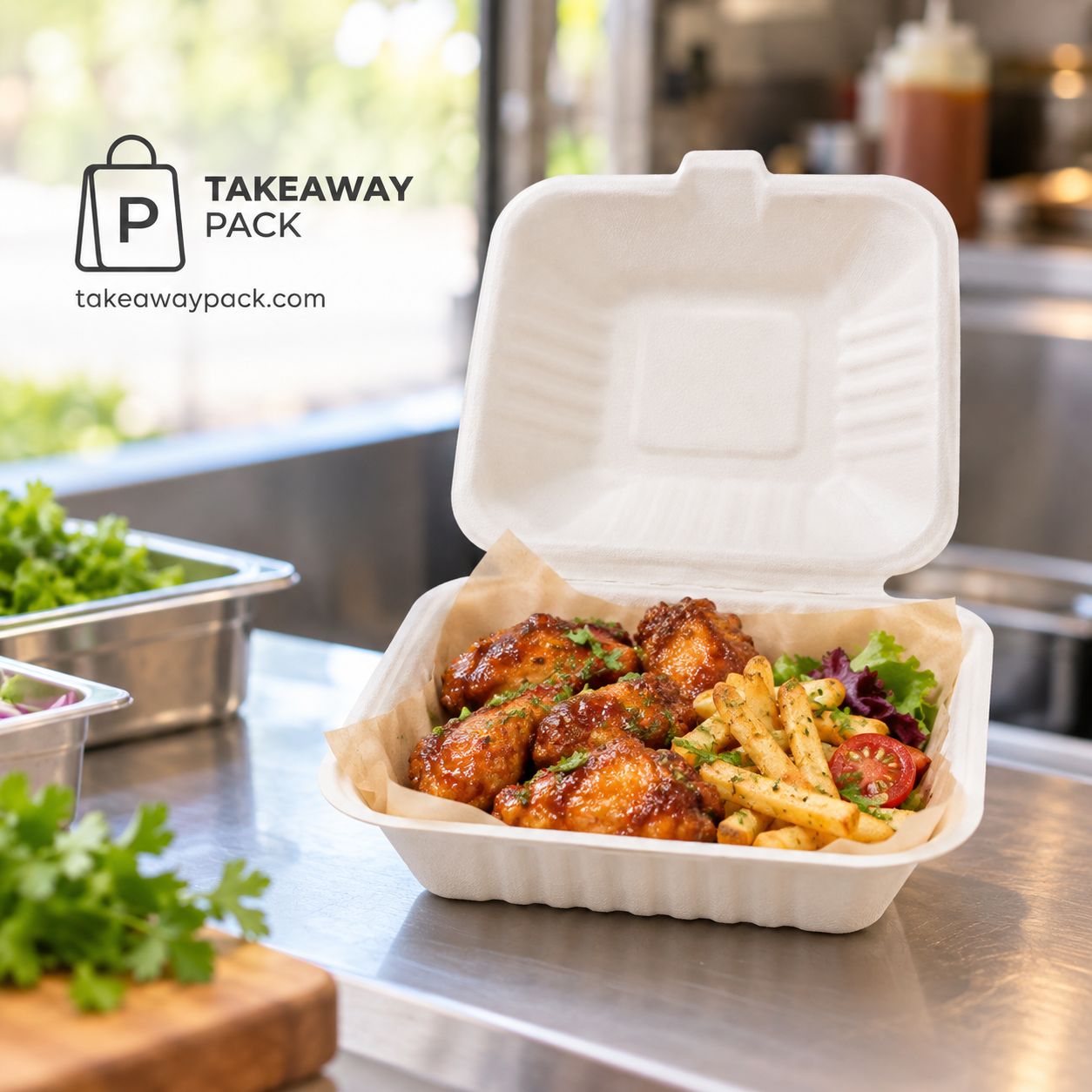
Is Bagasse Safe for Greasy Food? A Verification Checklist for Mobile
Is Bagasse Safe for Greasy Food? A Verification Checklist for Mobile Kitchens
Bagasse packaging can safely serve greasy food, but safety and grease performance come from three separate things: clean food-contact material, controlled fiber density and barrier treatment, and structural design that keeps oil away from the edges where failures start. None of these are visible in a product photo, so buyers need a verification habit: confirm food-contact compliance, ask which grease-control system a SKU uses, and test the real dish before committing to volume. Certifications
Estimated reading time: 4 minutes
Why Fiber Density Is the First Line of Defense
Bagasse starts as sugarcane residue, and its natural fiber network is porous. Untreated, it would absorb oil by capillary action like any paper product. Molded under high pressure, the pores shrink and the wall densifies, which slows oil migration to a crawl for foods with moderate oil content.
This is why two bagasse containers that look identical can behave completely differently. Forming pressure, board weight and wall thickness are set in the mold, not in the material name, and a supplier who controls those variables consistently will ship the same performance every batch.
What Barrier Treatments Add, and What They Cost You
For heavy grease loads such as fried chicken or oil-pooled noodles, raw fiber alone is not enough, so manufacturers add barrier systems. Water-based dispersion coatings, plant-derived starch modifiers and biopolymer layers are the common families, and the shift away from fluorinated treatments has pushed development toward these grease-control approaches without persistent chemicals.
The practical buying lesson is that barrier performance depends on application uniformity more than on chemistry alone. Coating must reach corners and fold lines, because that is where oil finds its way through first. When you evaluate samples, look specifically at the base corners and the hinge area after a hold test, not just the flat bottom in the middle.
Where Greasy Containers Actually Fail
Oil plus heat is a combined stress. Heat softens the fiber wall while oil lowers the resistance of every surface it touches, so failure follows a predictable pattern: edges before flats, corners before walls, seams before surfaces. A container can pass a flat-surface test and still weep at a folded rim within half an hour of service. Reheating cycles raise the risk again, because each warm spell re-softens the barrier zone and re-mobilises oil that had already settled.
Moisture in the air matters too. Humid storage softens fiber walls before filling even starts, and condensation under a closed lid adds internal stress during holding. Storage and closure discipline therefore belong in the same conversation as material choice, because a container softened in a humid storeroom starts service with its margin already spent.
Production consistency closes the loop. Coating viscosity can drift on long runs, curing temperatures fluctuate, and fiber moisture varies before molding, so buyers re-testing a running SKU every few months protect themselves against quiet batch drift as much as against design flaws.
A Safety Checklist Before Volume Orders
Grease resistance means nothing if the material is not clean. Food-contact compliance for the destination market is the entry ticket, and the shift away from persistent grease-proofing chemicals is now written into packaging rules across major markets, so ask directly whether the grease-control system is fluorine-free.
Then work down the list: confirm food-contact documentation for the destination market, ask which barrier system the SKU uses and whether it is fluorine-free, and request the certificates attached to that specific product rather than a supplier-level claims sheet. Treat "certified" as incomplete until you know which product carries it.
Testing With the Real Menu, Not Water
Water tests flatter fiber containers, because oil behaves differently from water in fiber. Run hold tests with the actual dishes at actual fill temperature: fried items checked at intervals through a normal service window, saucy items carried through a simulated delivery route in a real delivery bag.
Grade results as separate observations. Staining on the outside base, seepage at a corner, lid shift under stacking and texture loss in the food are four different outcomes, and collapsing them into pass or fail hides the detail that matters for your menu.
Quick answers
Is bagasse packaging safe for direct contact with hot, oily food?
Yes, when the product has food-contact compliance for your market and a controlled grease-barrier system. Safety comes from documented material compliance, not from the fiber being natural.
How many minutes can a bagasse box hold fried chicken?
It depends on coating quality, wall density and oil load, which is exactly why suppliers test rather than quote a single figure. Well-made molded containers hold greasy food through a typical takeaway window; verify with your own dish.
What is the single biggest failure point?
Edges and corners. Oil concentrates at fold lines and rim seams where pressure and coating thinning coincide, so inspect those zones first in every test.
Do certifications transfer across a supplier's range?
No. Certification attaches to specific products. Select kraft and molded-pulp lines carry compostable or recyclable certification direction, and buyers should request the documentation for each SKU they intend to order.
TakeawayPack works with a network of foodservice packaging factories and runs its own printing facility, which makes sample-based verification and small batch trials a realistic way to qualify greasy-menu packaging. For a packaging request built around your menu and destination, visit TakeawayPack.