Premium Takeaway Packaging for Resorts: Which Materials and Finishes
Premium Takeaway Packaging for Resorts: Which Materials and Finishes Justify the Price Point?
For hotels and resorts, takeaway packaging is a guest-facing brand surface, and a premium impression is built from verifiable decisions rather than decoration alone: substrate weight and rigidity, coating behaviour, restrained design, carefully chosen finishes, and packaging specified for real service conditions. This article sets out which material and finish choices typically support a higher price point, what procurement teams should verify with suppliers before specifying them, and how to
Why premium perception is a procurement decision
In a resort, takeaway packaging rarely stays private. Room-service trays move through corridors, poolside boxes sit beside lounge chairs, and branded bags cross lobbies where new guests form first impressions. That visibility is why F&B directors and procurement teams increasingly treat takeaway packaging as brand infrastructure rather than a disposable consumable.
A higher price point is easier to justify when the packaging visibly carries more care: heavier material, a considered finish, and a clean layout all read as intention. The practical question for a buying team is which of those cues are real, repeatable at production scale, and compatible with food service — and which are decoration that will not survive a delivery cycle.
Start with substrate weight and rigidity
Touch comes before reading. A box that holds its shape and a cup wall with some substance are commonly read as quality cues before a guest notices any print. For foodservice packaging, that usually means:
rigid paperboard constructions for boxes and carriers;
substantial cup and bowl walls with confident rims;
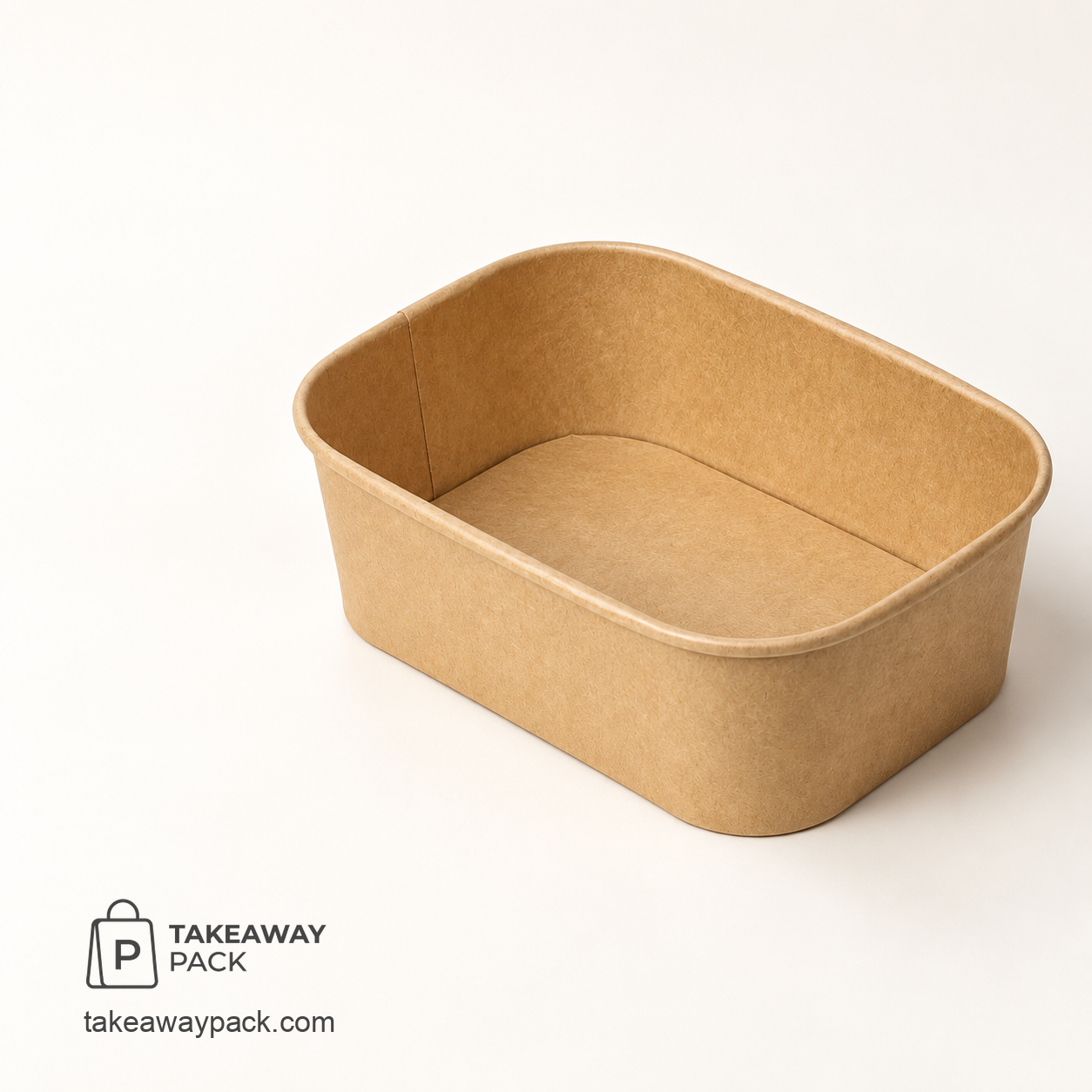
unbleached kraft, whose natural texture supports an artisanal or organic positioning.
Specify the substrate, not just the look. Ask each supplier to state the board or paper grade, the wall construction (single or double wall), and any coating for each SKU, because two products that look similar in photographs can feel very different in the hand.
This is also where form follows the menu. A 750 ml kraft paper salad bowl, a rectangular kraft container for a main course, and a matched lid for a soup cup serve different dishes, and each needs its own specification. Takeawaypack's catalogue is organised the same way — cups, bowls, boxes, containers, trays, lids, bags, and cutlery — so a resort programme can carry one material story across every format the kitchen actually uses.
Coatings: matte versus gloss is a design and a function decision
Finish changes perception quickly. Matte surfaces diffuse light and read as understated; gloss and bright metallic films intensify colour and draw the eye. Neither is universally "premium" — the right choice depends on the brand, the venue's lighting, and the dish.
On takeaway packaging, a coating is never only visual. Coatings also serve grease resistance, moisture control, and heat management, so the design decision and the food-suitability decision have to be made together. Raise both at inquiry stage: structure, coating, capacity, printing, and lid matching are exactly the parameters a packaging supplier should be prepared to discuss per SKU.
There is also a middle path between plain kraft and full-colour gloss. Square PP cup sets, for example, are offered in both bright and matte silver film finishes, which shows how the same geometry can carry two brand moods — one celebratory, one muted — simply by changing the surface.
Embossing, foil stamping, and photo-quality print: verify before specifying
Embossing, foil stamping, and photographic full-colour printing are staples of luxury packaging in general, but foodservice substrates impose real constraints: food-contact requirements, coating systems, small or curved print areas, and unit-cost targets all limit which finishes are practical on a takeaway cup or box.
Treat every finish as a per-SKU question for the supplier:
Is this finish achievable on this exact substrate and shape?
What proof or sample will confirm the result before production?
How does the finish interact with the food-contact layer or coating?
The approval process matters as much as the effect. Takeawaypack works as its own printing factory together with multiple disposable foodservice packaging factories, prepares a digital proof from the customer's own artwork files, and starts production only after that proof is confirmed in writing; samples, drawings, and print-file alignment are part of the project engagement. A resort team can therefore review placement, scale, and colour on the actual product before committing budget.
Restraint: one finish, few colours
Across premium categories, the consistent design pattern is restraint: generous empty space, a limited palette, and one deliberate finish rather than several competing effects. The same logic suits takeaway packaging, where print areas are small and handling is rough.
Practical rules that survive production:
one accent colour or metallic tone, not a full palette;
the logo and one or two lines of text on the largest visible panel, with detailed information on the back or base;
a single signature finish repeated across formats, so a cup, bowl, box, and bag read as one family.
Consistency across SKUs does more for a premium impression than complexity on any single item.
Design for the guest moment, not only the shelf
At a resort, the opening happens in public: a lid that seats securely, a box that opens cleanly, a wire-handle carrier that is comfortable to carry across a pool deck. Function is part of the premium signal, and a failed closure undoes any design investment — which is why a wire-handle kraft box, for instance, is a different specification decision from a flat-fold carton.
Because delivery distance, stacking, food temperature, and humidity differ at every property, validate candidates as physical samples under your own menu conditions before rollout. Some suppliers can support this at small scale: Takeawaypack notes that certain stocked products may support trial orders, while custom-print quantities depend on the product and production method and are confirmed in each quotation. Keep the two tracks separate when you plan a launch.
Sustainability, stated carefully
Natural materials carry their own premium signal: unbleached kraft and moulded fibre read as authentic and considered, and many guests notice. But environmental claims are also a compliance surface, so scope them precisely.
The defensible position is that certifications belong to products, not to a supplier catalogue. Select kraft and moulded-pulp lines can carry compostable or recyclable certification; ask for the certificate that matches each SKU rather than accepting a catalogue-level statement. Within Takeawaypack's supplier network, for example, Wenzhou Chenglong Paper Plastic Products Co., Ltd. holds an FSC Chain of Custody certificate (GFA-COC-006105, valid to 9 February 2027) and a GRS 4.0 certificate (TE-00121899, valid to 18 November 2026). Those are factory-level credentials — useful context, not proof that every item is certified, and not a substitute for per-SKU documentation in your markets.
Frequently asked questions
Which materials make takeaway packaging look premium?
Heavy, rigid constructions are the fastest cue: thick paperboard boxes, substantial cup and bowl walls, and unbleached kraft with visible texture. Ask suppliers to state board grades, wall construction, and coatings per SKU so the premium feel is specified rather than assumed.
Is a matte or a gloss finish better for a resort brand?
Neither is universally better. Matte reads as understated and contemporary; gloss and bright films read as vivid and celebratory. Because coatings also affect grease and moisture performance, confirm both the look and the food suitability for the exact SKU.
Can embossing or foil stamping be used on takeaway packaging?
It depends on the substrate, coating system, food-contact construction, and quantity. Treat the finish as a per-SKU question, request a proof or sample on the actual product, and do not assume that a finish common in retail packaging transfers directly to foodservice items.
What should a resort send to get an accurate custom-printed quote?
Product or category, material, size or capacity, expected quantity, printing or logo requirements, and destination country or port. With those fields, a supplier can quote each SKU on its own terms instead of estimating.
How does sample approval work for custom printing?
Takeawaypack prepares a digital proof from the customer's artwork files and begins production only after that proof is confirmed in writing; samples, drawings, and print-file alignment are handled during project engagement. Ask any supplier whether sample construction matches production construction exactly.
Can premium takeaway packaging also be sustainable?
Often, yes — select kraft and moulded-pulp lines can carry compostable or recyclable certification. Keep claims SKU-specific: request certificates per product, and treat factory-level credentials as context rather than blanket proof.
Compare materials and finishes on real specifications
Premium is a specification you can audit: substrate weight, coating behaviour, restrained design, one signature finish, and packaging validated under your own service conditions. When you are ready to compare options for a resort or hotel programme, explore the product categories and submit your requirements at Takeawaypack.