Printing Thank-You Notes, QR Codes and Heating Instructions Directly on Meal-Kit Box Walls: Is It Worth It?
Yes — thank-you copy, QR codes and heating instructions can be printed directly onto the inside walls or dividers of meal-kit and DTC food-delivery boxes, and for content that never changes it usually removes a separate insert and its picking step from every order. The trade-offs concentrate in…
Summary
Yes — thank-you copy, QR codes and heating instructions can be printed directly onto the inside walls or dividers of meal-kit and DTC food-delivery boxes, and for content that never changes it usually removes a separate insert and its picking step from every order. The trade-offs concentrate in three places: interior printing must use a food-contact-appropriate ink system or a barrier, fixed artwork gives up the per-customer personalization and easy A/B testing that inserts allow, and plate or setup costs only pay back at stable volumes. QR codes carry their own print constraints — code size, quiet zone and panel choice decide whether customers can actually scan them. Most brands land on a hybrid: durable instructions and one scannable link on the structure, campaign and customer-specific content on paper.
Estimated reading time: 5 minutes
Why Brands Move Insert Content Onto the Box
Every paper insert is a part. It has to be designed, printed, delivered to the packing site, stored, picked and placed — and it can run out at the worst moment. Printing the same message on the box wall or a divider removes that whole chain from the order, cutting both the per-unit card cost and one handling step per fulfillment checklist.
The direct savings look small at first. Insert cards typically cost a fraction of a dollar each — commonly estimated between roughly $0.15 and $0.75 per order depending on stock, finish and quantity — and weigh only a few grams. The stronger argument is operational: a message printed on the structure is never out of stock and never forgotten by a new packer.
For subscription meal kits, the most valuable inside messages are operational anyway: how to heat, how to store, how to recycle the box. That content is identical on every order, which makes it a natural candidate for the structure rather than the card.
What Inside Printing Actually Requires
The inside of a meal-kit box is the food-contact side, so the ink system has to suit that role — either inks approved for the intended contact situation or a functional barrier between print and food. Grease-resistant and moisture-barrier coatings also change how ink anchors to the surface, which is why inside print should be proven on the actual structure, not assumed from an outside-print sample.
Material matters as much as ink. The inner liner of a corrugated box is often uncoated and absorbent, which softens fine type and reduces contrast; dividers add scores, ribs and die-cut edges that interrupt the printable area. Copy should sit on flat panels away from fold lines, and legibility should be judged on a production-quality print, not a smooth office printout.
The Cost Trade-Offs, Per Order
Inserts are a variable cost: a card is printed and handled on every single order, and it is easy to change or drop. Printed walls invert that equation — most of the new cost is fixed (plates, setup, proofing cycles) and is amortized across the run, with a small per-unit premium on the box or divider itself.
At stable volumes and stable artwork, the printed structure usually wins, because the same message repeats on every order at close to zero marginal cost. For scale: a fully custom-printed box commonly runs a few dollars per unit, while adding an inside message to a structure you already order is a much smaller increment. At low volumes, or whenever artwork changes with campaigns, the insert remains the cheaper and more flexible instrument.
One detail protects either path: print the QR code as a dynamic redirect rather than a final destination URL. If the code encodes a short redirect link, the printed artwork survives destination changes, seasonal campaigns and tracking updates without a reprint.
Flexibility and Personalization: What You Give Up
A card can differ per customer: a first-order welcome, a win-back offer, a VIP note. Printed structure cannot — every box in the run carries the same message, so per-customer targeting disappears from the physical layer.
Testing works differently too. Insert variants can be swapped and compared order by order; comparing printed walls requires a separate production run. Printed discount codes are visible to everyone, so unique per-customer codes cannot live on the box itself.
A single well-placed QR code partially restores what is lost: one printed link can route any customer to segment-specific content, unique offers or an updated instruction video, with scan attribution measurable in analytics.
Food-Contact Rules to Settle Before Artwork
In the United States, inks and components used on paper and paperboard food packaging are regulated as indirect food additives under 21 CFR 176, and the conventional route is printing the non-food-contact side or placing a functional barrier between print and food. In the European Union, Framework Regulation (EC) No 1935/2004 requires that the material not transfer constituents to food or change its composition or organoleptic properties, and there is no harmonized EU measure specific to printing inks — so converters document compliance per structure and food type.
One failure mode deserves a name: set-off, where ink transfers from a printed outer face to the food-contact face when sheets are stacked or the box is folded. Asking a supplier how they control set-off, which ink system they propose for your food type, and what documentation they provide per SKU and destination market will settle most compliance questions early.
TakeawayPack treats structure, coatings, printing and documentation as topics to confirm per SKU, quantity and destination market during the RFQ stage, and outlines these scopes on its certifications and materials page.
A Practical Hybrid: Wall or Insert?
A workable split for meal-kit and DTC food brands:
-
On the structure: heating and storage instructions, recycling and after-use copy, a short brand line, and one durable QR code linking to a dynamic page.
-
On the insert: time-limited offers, seasonal campaigns, segment-specific thank-you notes and unique codes.
The decision test is simple. If the message is identical on every order, print it on the wall or divider; if it changes per customer, per campaign or per season, keep it on a card — or behind a QR redirect.
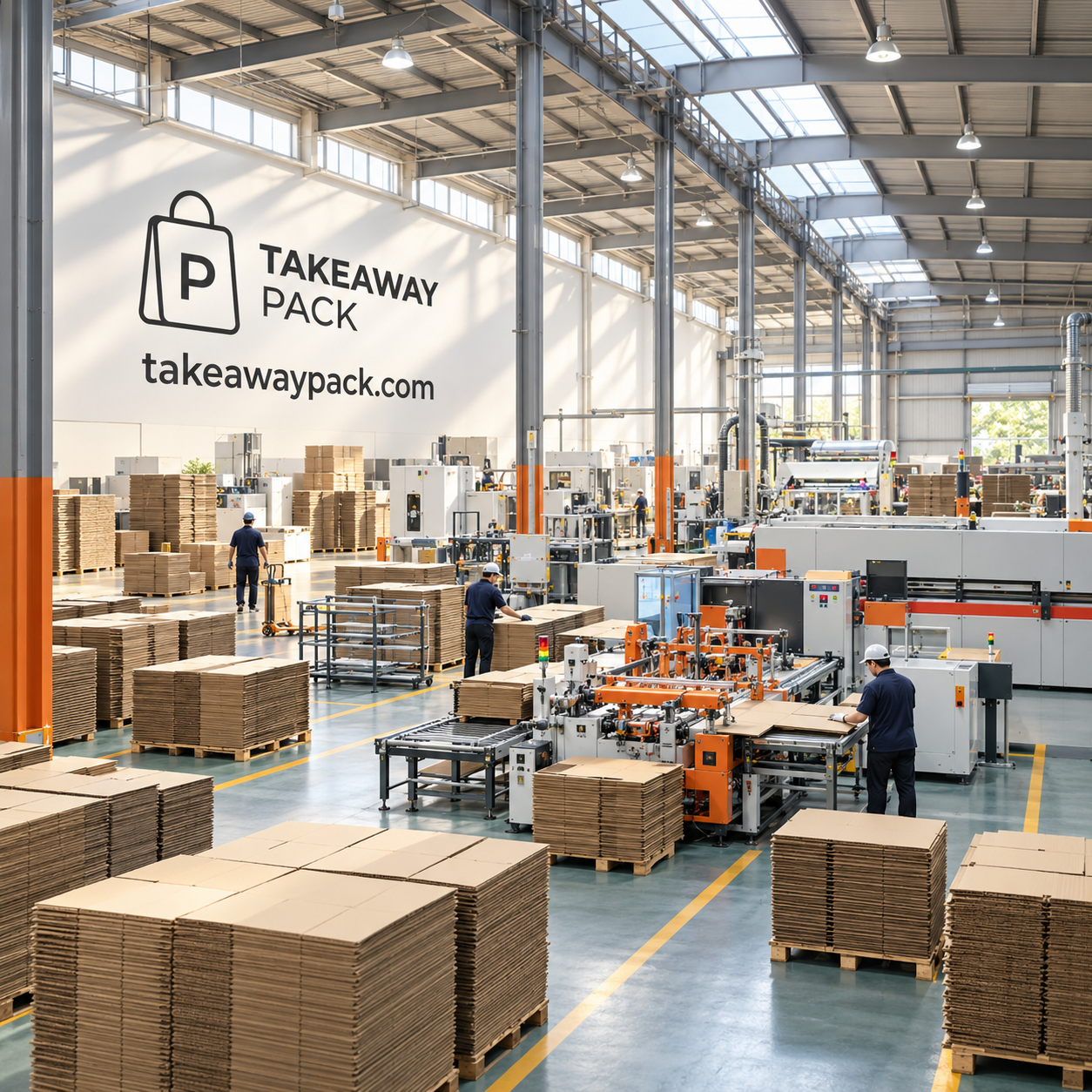
Because minimums for printed dividers depend on the product and the production method, confirm them by quotation early rather than assuming a single number for the whole project. A supplier that runs its own printing operation can quote inside print as part of the original structure: TakeawayPack operates its own printing facility alongside partner packaging factories, turns customer artwork into a digital dieline proof, starts production only after the proof is approved in writing, and uses samples and drawings to align requirements before mass production.
Quick Answers
Is it food-safe to print inside a meal-kit box?
Only with an ink system and structure suited to the intended food contact — typically printing the non-food-contact side or using a barrier — confirmed with documentation for the specific SKU and destination market.
How big should a QR code be on a box wall?
Follow the widely used 10:1 rule of thumb: code side length roughly equals scan distance divided by ten. At an arm's-length unboxing distance of about 25–30 cm, that means a 2.5–3 cm code, kept above a 2 cm floor, on a flat panel with a clear quiet zone.
Does removing inserts really cut packaging cost per order?
It removes the per-card print and pick-and-place cost, but adds fixed print cost to the structure. It pays back when the content is evergreen and volumes are stable; frequent artwork changes or short runs favor inserts.
What should stay on a separate insert?
Anything per-customer or per-campaign: welcome or win-back notes, unique discount codes, seasonal promotions and anything you want to A/B test.
For a packaging request built around your menu and destination, visit Takeawaypack.