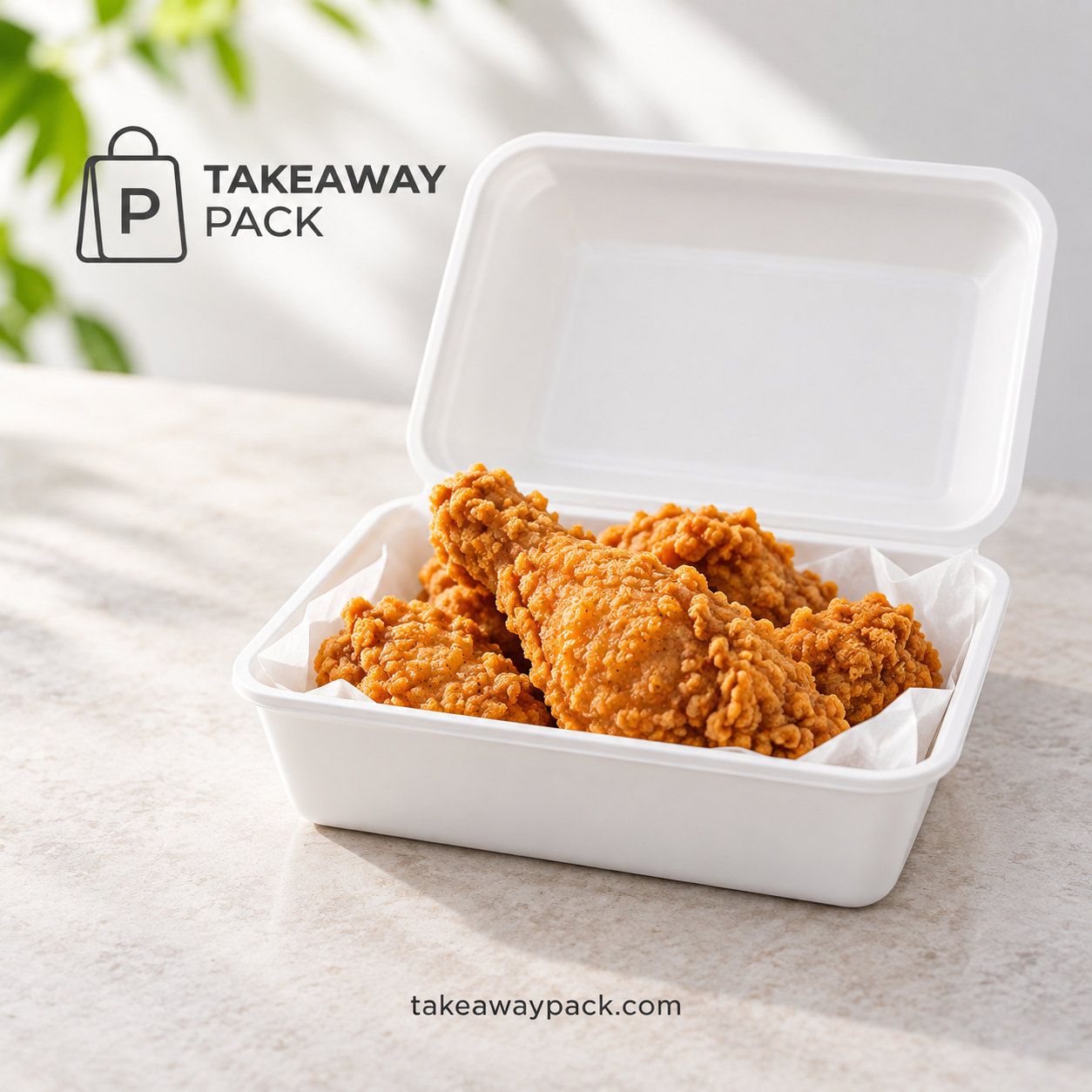
Sugarcane Fiber Boxes for Fried Food: Steam, Oil and Venting Rules
Sugarcane Fiber Boxes for Fried Food: Steam, Oil and Venting Rules That Keep Coatings Crisp
Fried food goes soggy when trapped steam condenses back onto the coating, and any sealed, unvented container creates that trap, whatever the material. Molded sugarcane fibre boxes are built from plant fibre whose structure lets excess vapour escape while holding heat, which protects the crisp layer through a holding window when portions, lids and hold times are matched to the dish. The same molded density slows oil penetration, which is how many fried-food SKUs balance breathability against
Estimated reading time: 4 minutes
The Sogginess Mechanism Starts With Trapped Steam
Put hot fried food into a sealed, unvented container and physics takes over. Steam cannot escape, so it condenses on the lid and inner walls, and that moisture settles back onto the surface of the food. The crisp layer softens within minutes, which is why delivery fries can arrive limp even when the kitchen did everything right and the container was structurally sound.
The container itself never failed a structural test. It failed a texture test, and customers notice texture first. Any material comparison should therefore start with vapour behaviour, not with load ratings, because a box that survives the road can still ruin the meal it carries.
How the Fibre Structure Breathes
Sugarcane fibre is full of microscopic channels that allow air and vapour to move through the wall of a molded container. Excess steam escapes while most of the heat stays in, which is a self-regulating balance: no engineered valve, no coating trick, just the structure of the material.
This is the opposite of the two failure patterns buyers see most. Thin paper absorbs moisture and weakens; fully sealed, unvented formats trap moisture and drown the food. Molded fibre sits between them, releasing just enough vapour to protect the crunch without letting the meal go cold.
There is a thermal bonus to the same structure. The dense fibre wall insulates, so crews can pack and hand over a full portion without the box becoming a burn hazard, and customers can reheat leftovers in the same box without transferring food to a plate.
Oil Resistance Without a Plastic Lining
Bagasse is formed under heat and pressure, which packs the fibre into a dense, rigid wall. That density slows oil migration, so surface grease from fried chicken or chips stays on the food rather than soaking through to the outside of the box. Because the resistance comes from the fibre itself, there is no separate lining to crack, peel or separate in service.
For mixed orders, compartments do quiet work. Keeping sauce-dipped items and slaws in a separate section stops wet food from leaning on dry food, so one part of the meal does not steam another. Fleet buyers standardising on two or three molded-fibre formats usually find the compartment box covers the busiest combo meals, while single-cavity clamshells handle straightforward fried portions.
Heat Behaviour on a Mobile Line
Molded plant fibre is pressed into shape at high temperature, so hot food straight from the fryer is well inside its working range. Industry guidance generally places molded bagasse stable across normal holding temperatures, with deformation risk only rising well above the range a service counter produces. Thin-wall formats of any material should be checked against fill temperature on the specific SKU, because wall thickness and forming quality, not the material label, decide how a wall behaves at holding heat.
The same heat stability protects texture on the second minute and the tenth. A box that neither deforms under a heavy portion nor softens at the hinge keeps its internal volume, and internal volume is what keeps vapour moving instead of pressing moist air against the food.
Making It Work on a Truck Menu
Venting is a discipline, not a product feature. Fried items should be closed loosely or boxed in a naturally breathing clamshell, while saucy mains get the matched lid and a bowl format. Sauce belongs in its own cup, never poured over fries that have five more delivery minutes ahead of them.
Portion discipline matters as much. An overfilled box presses food against the closure and blocks the vapour path; a standard fill line protects both the seal and the texture.
Brief the crew on one more habit: let fried items sit for a few seconds after the fryer so the most violent steam release happens in open air, not against the lid. Those seconds cost nothing and visibly extend the time a coating stays crisp.
Fleet operators moving away from all-plastic line-ups usually phase the change by dish: fried items first, where a vented fibre format is most often trialed, then saucy lines once bowl systems are tested on the real route. TakeawayPack supports exactly this kind of phased trial from its range of boxes, bowls and containers, with small batch orders and custom print runs handled through a single supply point.
Quick answers
Do vented fibre boxes keep fries crisper than sealed containers?
A sealed, unvented box holds heat but steams the coating, so fries can arrive warm and soft regardless of what it is made of. A breathable sugarcane fibre clamshell trades a little heat for texture, which is why fried-menu trials so often favour the vented format — confirm it on your own route before standardising.
How can the same box resist oil and still breathe?
Density and porosity are engineered against each other during molding. A dense wall slows oil penetration, while the fibre's natural micro-channels still allow vapour to pass. For typical fried menus, many molded-fibre SKUs achieve this without a separate plastic lining — a point to confirm per SKU when you shortlist.
What about saucy or soupy items?
Move them to a deep bowl with a lid made for that rim. Breathable clamshells protect crunch, not free liquid, and broth will find gaps that thick curry never reaches.
What should a fleet check before switching?
Run a hold test per dish, then ask each supplier which specific SKUs carry compostable or recyclable certification direction and request the documentation for those products. Select molded-pulp lines qualify; a supplier's general catalogue does not.
For a packaging request built around your menu and destination, visit TakeawayPack.