To-Go Containers for Restaurants: A Five-Step Framework Before You
To-Go Containers for Restaurants: A Five-Step Framework Before You Order
Choosing to-go containers is an application-matching exercise, not a materials quiz. A workable framework sorts the menu into hot, saucy, fried and cold lines, assigns a material to each zone, and then verifies lid fit, stacking strength and delivery durability with real dishes on real routes. Run the framework top to bottom and the result is fewer SKUs, fewer leak complaints and a packaging specification you can defend to auditors and customers alike.
Estimated reading time: 5 minutes
Start With the Menu, Not the Material
The most common sourcing mistake is buying one container for everything. A fried-chicken box, a noodle soup and a cold slaw impose different stresses, so begin by sorting every menu item into zones: hot and dry, hot and saucy, fried and crisp, cold and dressed.
Each zone points to a different winner. Hot lines favor molded fiber; saucy lines need depth and matched lids; fried lines need vapour control; cold lines tolerate clear bioplastics that would fail at any fryer. The framework pays for itself the moment a supplier asks "what are you packing?" and you can answer per line instead of per brochure.
Match Materials to Each Zone
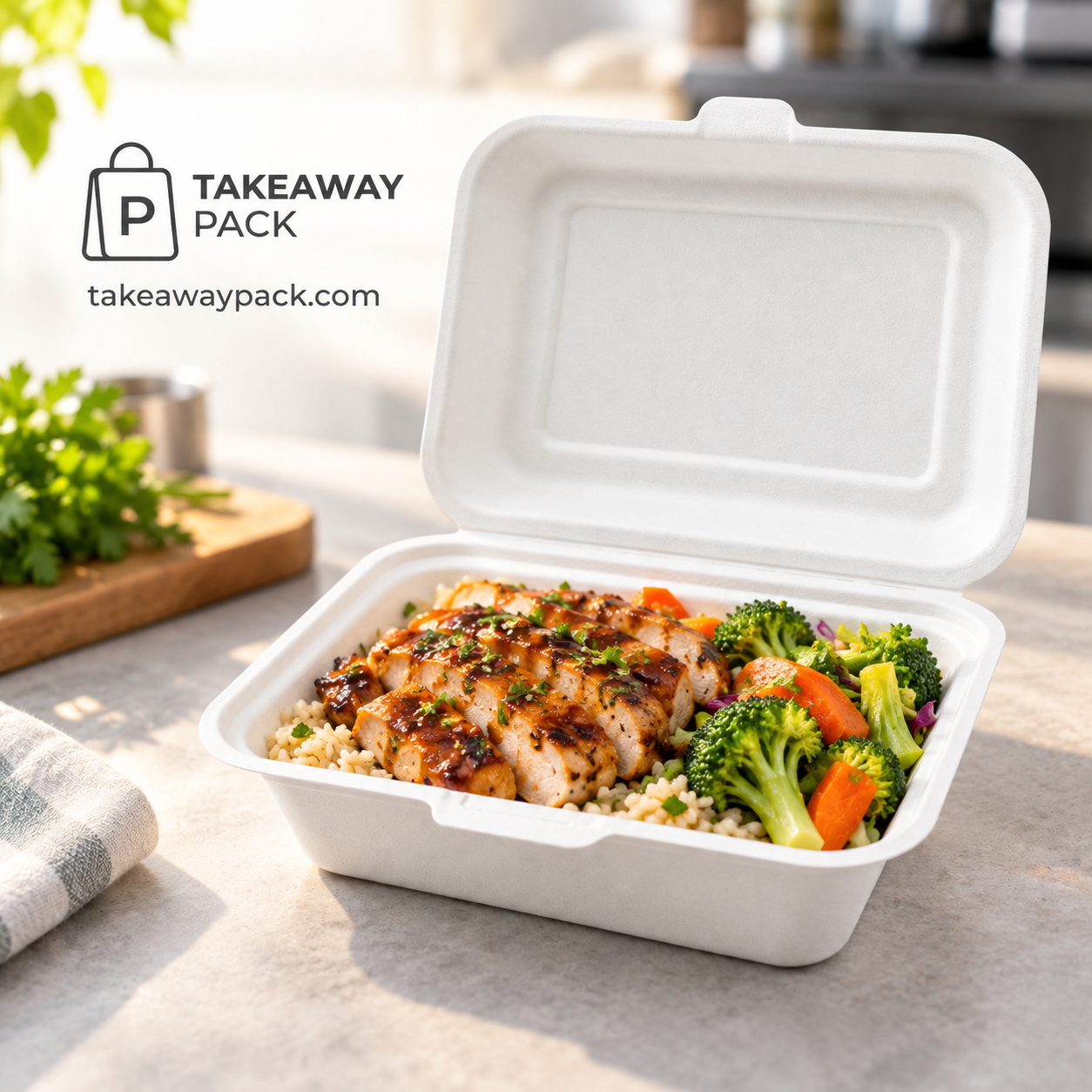
Molded sugarcane fiber is the structural workhorse for hot lines. It is formed under heat and pressure, tolerates fryer-fresh fill temperatures, insulates well enough to carry comfortably, and its dense-but-breathing wall manages both surface grease and trapped steam. This is the default for trucks and kitchens built around the fryer.
Paperboard with a barrier lining serves moderate-heat positions and carries print beautifully for brand-led concepts, with performance decided by the lining system rather than the paper. Cornstarch-based formats cover compartment and cutlery positions. Clear bioplastic belongs on cold lines only, where display justifies its low heat tolerance. Treat any "biodegradable" label without a standard behind it as marketing until proven otherwise.
Judge Delivery Durability, Not the Bench
Delivery is the harshest environment your packaging will face: thirty to sixty minutes of vibration, braking, tilt inside a backpack, stacking under heavier orders and condensation cycling the whole way. Containers that only pass a kitchen-counter test routinely fail this journey.
Texture is part of durability too. A container can arrive intact while the food inside has steamed itself soft, and customers score the meal, not the box, so vapour behaviour belongs in the same test protocol as leak resistance.
Test the way couriers actually work. Pack the real dish at fill temperature, close it, bag it, stack it and simulate the route with turns and stops, then inspect lid, rim, corners and base. Loose lids are the leading cause of delivery complaints, so a lid that engages with one confident motion and stays seated under heat is worth more than a marginal saving per unit.
Make Specifications Concrete per SKU
Vague specs produce vague performance. For every container position, write the dish, fill temperature, hold time, capacity, lid pairing and stacking expectation, and size portions to formats: standard bowls for grain and rice lines, deeper bowls for noodles, compartment boxes for combos.
Consolidate while you are at it. Every extra size adds storage pressure, stock-out risk and ordering overhead, and mobile operators feel this more than anyone. Standardized footprints also speed up the packing line at peak: lids close in one motion, boxes stack without thought, and new staff reach competence in a shift rather than a month. Most kitchens run well on a small set of proven formats plus one specialist piece for an outlier dish.
Verify Compliance and Documentation per SKU
Packaging rules are tightening across every major market: plastic bans keep widening, fluorinated grease-proofing chemistry is being phased out, and single-use rules keep adding categories. Building the compliance check into selection, not after it, spares a restaurant the cost of re-qualifying a format it already printed.
Ask each supplier which specific SKUs carry compostable or recyclable certification direction and request the documentation per product. Select kraft and molded-pulp lines qualify in a well-run supply network; a catalogue-level claim does not substitute for a certificate attached to the item you are ordering. Food-contact compliance for the destination market belongs in the same file.
Quick answers
What is the first step in choosing to-go containers?
Sort the menu into hot, saucy, fried and cold zones, then assign a material per zone. Container selection that starts from the menu avoids the single-material trap that produces leaks and soggy textures.
Which containers work best for fried items on a food truck?
Molded fiber clamshells and trays, which breathe out steam while resisting surface grease. Sealed plastic keeps the heat but condenses it back onto the coating, and fried texture is what customers actually score.
How many container types does a restaurant really need?
A small set: one or two hot-line formats, a bowl system for saucy and liquid dishes, a fried-line box and a cold-line option. Consolidation cuts cost and stock-outs without hurting performance.
What documents should be collected before signing with a supplier?
Certification documents per SKU, food-contact compliance for the destination market, and written confirmation of grease-barrier and lid specifications for each container position on the menu.
TakeawayPack is positioned as a converter with its own printing facility and a cooperative network of foodservice packaging factories, supporting small batch orders and custom printing across cups, bowls, boxes, containers and trays for international buyers. For a packaging request built around your menu and destination, visit TakeawayPack.