What Is EPS, and When Does It Stop Making Sense for Food Delivery?
What Is EPS, and When Does It Stop Making Sense for Food Delivery?
EPS is a rigid foam that is mostly trapped air — that is the whole trick behind its insulation. It is cheap, light, and adequate on every measure that matters for short chilled food lanes, which is why it dominates meal kits and next-day delivery. It stops making sense on three boundaries: lanes that outlast its hold time, parcels priced by volume that cannot spare the cube, and customers with packaging-waste mandates that rule it out regardless of performance. Knowing which side of those
Estimated reading time: 4 minutes
Why trapped air insulates
EPS starts as small polystyrene beads that steam expands until they fuse inside a mould. The finished panel is mostly air held in place by a thin skeleton of plastic cell walls, and the air does nearly all the insulating work, because still air conducts heat far more slowly than solid material.
That structure explains both the strengths and the limits. The foam is light enough that its own weight barely dents a parcel allowance, yet it can crack at the corners when a loaded box drops, and rough handling can shed beads. Neither failure is common enough to disqualify it on short lanes, but both explain why it is rarely specified for the longest, most delicate shipments.
How density and wall thickness set performance
Two levers shape an EPS pack. Density — typically 15 to 30 kilograms per cubic metre for shipping-grade foam — trades a little extra insulation and crush resistance against cost and weight, and most packaging engineers stay toward the lower end. Wall thickness does more of the practical work: roughly 25 millimetres holds a temperature band for hours, while 50 millimetres or more stretches it to a day or two longer.
The lever you actually pull is thickness, lane by lane, because density is fixed by the foam supplier. The cost of more thickness is internal volume — every extra millimetre of wall comes straight out of the space your meals occupy.
Where EPS fits a food delivery operation
Short and medium parcel lanes are its natural territory: next-day meal kits, chilled grocery, and frozen boxes whose journey ends within a day or two. It wins there for compounding reasons — low unit cost, moulded shapes on tooling that already exists in every packaging market, minimal freight weight, and dependable rigidity that protects the payload.
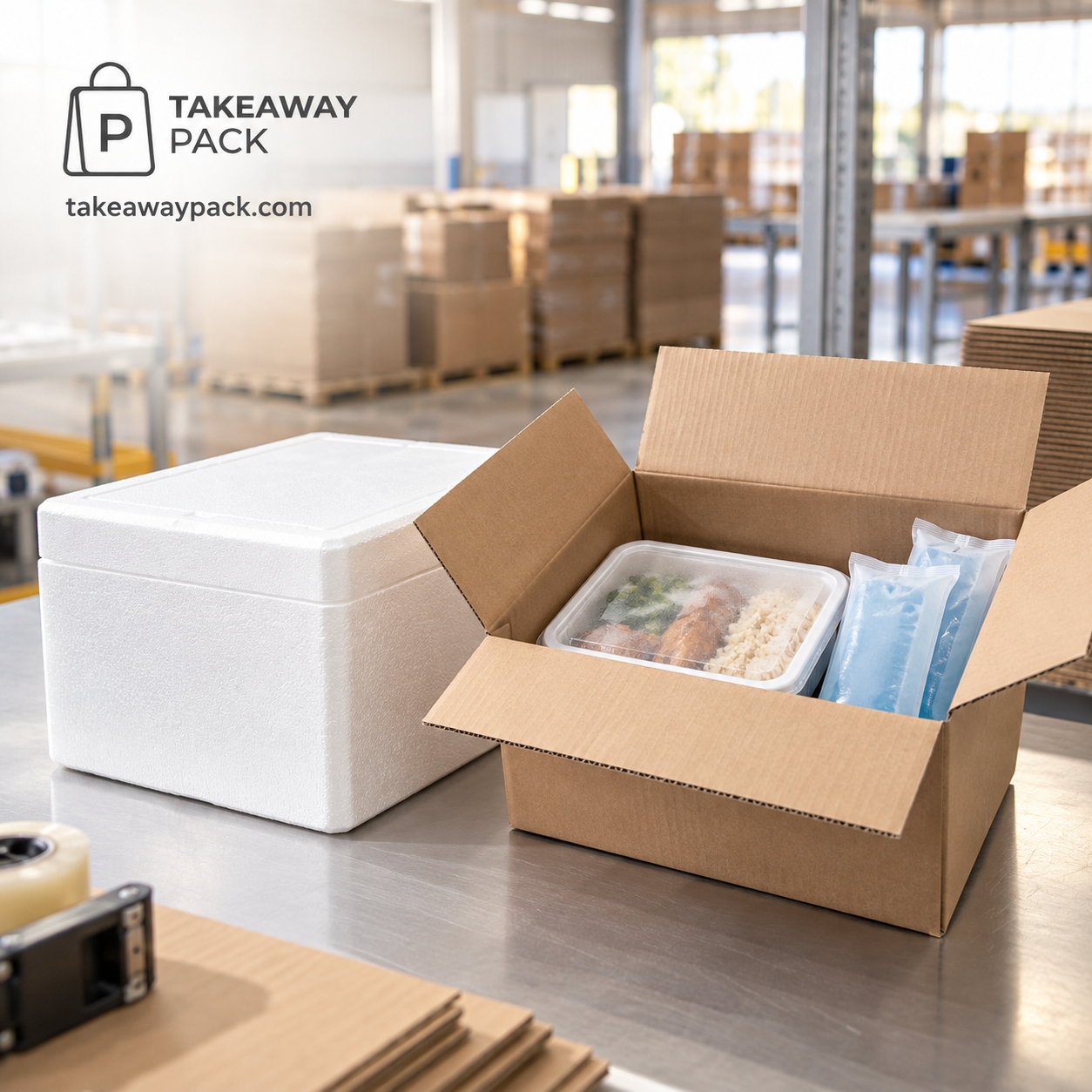
Inside the box, though, EPS is only the outer half of the system. Your meals sit in food-contact containers and bowls, with gel packs placed to hold the cold, inner bags catching any weep, and an outer carton when the foam itself needs one. The insulation choice does not replace those decisions.
The three boundaries where it stops making sense
The first boundary is duration and tightness. Long-haul or deep-frozen lanes that run three days or more across variable conditions need performance an EPS wall cannot deliver without becoming impractically thick.
The second is cube. On air freight billed by volume, or parcel networks under strict dimensional-weight rules, a thick foam wall competes with your product for paid space and loses money quietly.
The third is your customers' own rules. A buyer with a stated packaging-waste target may reject foam outright regardless of its thermal or cost performance. In all three cases the honest answer is a different insulation system, not stretching EPS past the lane it was built for.
Reading the eco claim without getting fooled
EPS is technically recyclable — it can be densified and reprocessed into products like insulation board — but most kerbside programs do not accept it because collecting something so bulky and light costs more than the material returns. Most post-consumer EPS therefore lands in landfill or incineration.
That gap between technical and practical recyclability is what buyers are really probing when they ask packaging questions. The same discipline applies to every material claim on your pack: compostable, recyclable, or otherwise, ask which certification system applies and request documentation for the specific SKU, because certifications attach to products, not to a supplier's catalogue.
Choosing the pieces around the insulation
Whether your lane keeps EPS in or pushes it out, the food-contact layer underneath follows the same logic: match the container to the menu, test it cold, and buy it from a partner who can hold the spec across reorder cycles.
Takeawaypack is a foodservice packaging supplier with its own printing plant and a network of partner factories, working with international food businesses across North America, Europe, Australia, the Middle East, and East Asia. An RFQ that states product category, material, size or capacity, quantity, printing needs, and destination port lets the packaging side of your cold-chain packout be engineered alongside the insulation decision. The kraft and molded-pulp lines include certified-compostable and recyclable options you can request documentation for per SKU — see takeawaypack.com/certifications-materials.
Quick answers
Why is EPS used for meal kit boxes?
Because it is adequate on every measure that matters on short chilled lanes — insulation, weight, rigidity, and unit cost — at a price no competing material matches.
How long does EPS keep food cold?
Depends on wall thickness, coolant, and season. Thin walls work in hours, thick walls in days; only a tested packout on your lane gives a defensible number.
Is EPS actually recyclable?
Technically yes, practically often no. Most kerbside programs reject it, so treat kerbside claims with care and give customers honest disposal guidance.
What should I use instead on long lanes?
Thicker walls, higher-performance insulation systems, or hybrid packouts — and for a longer journey, size the whole box around the payload to cut wasted cube.
For a packaging request built around your menu and destination, visit Takeawaypack.