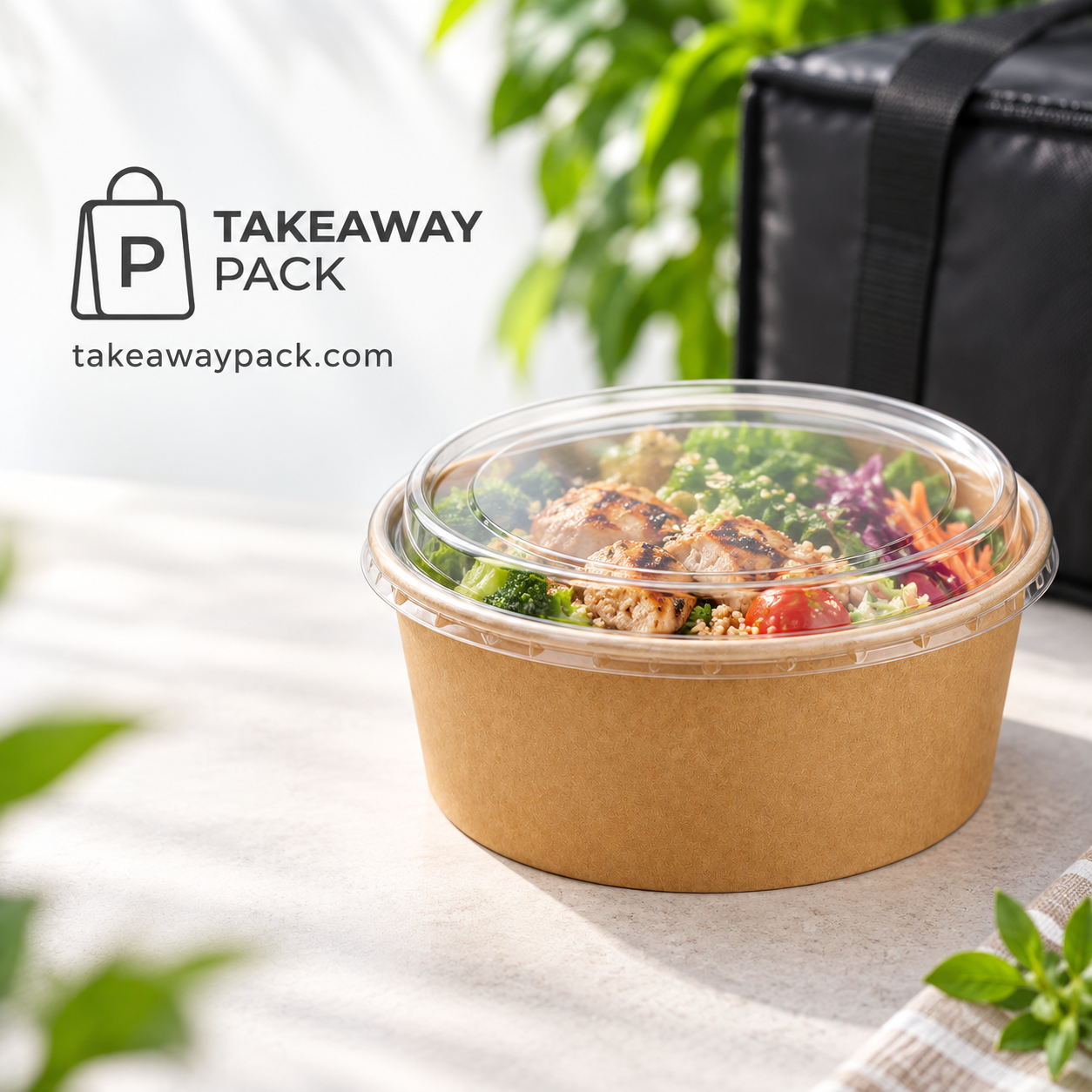
Which Containers Keep Delivery Orders Leak-Free From Kitchen to
Which Containers Keep Delivery Orders Leak-Free From Kitchen to Doorstep?
Delivery is the most punishing test a food package faces: the order is tilted, stacked, and sealed for the whole ride, with nobody able to catch a problem partway. Leak-free performance comes from two decisions made together — a container body that blocks moisture and grease, and a closure that stays engaged under stacking and steam. Choose both against your longest route rather than the counter, verify with a filled, sealed, tilted trial before ordering in volume, and pack to a fixed layout so
Estimated reading time: 4 minutes
Why Delivery Breaks Packaging That Works In-Store
A container that sits still on a counter faces nothing like a delivery run. It gets tilted at odd angles, stacked under other orders, and sealed far longer than a pickup customer would ever wait — twenty minutes or more is normal. Grease and moisture use that extra time to work against whatever barrier the package offers.
The stakes are shared, too: one soft leak inside an insulated bag can stain every order riding with it. And the cost is asymmetric — packaging is a small share of an order's value, but one ruined delivery can cost the customer entirely. That is why delivery packaging has to be chosen as a system, not picked shelf-style by looks — and why the choice should reflect your longest route, not your best case at the window.
Material First: Match the Body to the Food
Start with what the food is. Liquid-heavy dishes — soups, curries, saucy noodles — need a rigid body that keeps its shape when handled, which is why certain food-grade plastics have long served this role: they resist moisture and hold up to heat. Molded plant fiber, such as sugarcane-based material, naturally resists grease and wet foods without a plastic film, which is why it appears across containers and clamshells for wet dishes.
Coated paperboard sits between the two: a thin lining gives plain paper the moisture and grease performance it lacks on its own, keeping a paper feel for items that are saucy but not soupy. Match the body to the food's risk level rather than to whichever option looks premium — dry items rarely need the strongest barrier, and reserving it keeps cost sane. Cold items deserve a thought as well: condensation from temperature swings can weaken paper bodies and make lids slippery, so keep cold and hot orders separated where you can. Browsing a broad range like Takeawaypack's food containers helps you shortlist shapes before sampling.
The Closure Decides the Last Mile
Material alone never finishes the job; the lid is where most deliveries are lost. A lid that locks or snaps around the full rim stays put when the bag tips, while a loose cover drifts and one that merely rests catches the first hard brake. Fit matters as much as style: lids and containers designed as one set close consistently, whereas mixing similar-looking sizes leaves gaps.
Heat adds pressure. A steaming dish sealed immediately builds vapor that can lift a lid or push sauce through a weak seal, so give hot food a brief settling moment when food-safety rules allow, and keep the sealing rim clean and dry. A lid can look closed from above while one corner stays raised, so train packers to check the whole edge, not just press the center.
Pack to Protect the Lid, Not Just Fill the Bag
Fill lines beat guesswork: leave headspace so movement in transit has somewhere to go. Liquid items ride upright from the moment they are filled, on a flat base, never on top of soft items that let them tip. Heavier, more stable packages form the bottom layer, and nothing loads directly onto a lid — if stacking is unavoidable, flatter and lighter items go above rigid containers.
Bag choice completes the layout. A bag too small squeezes containers and disturbs closures; one too large lets everything slide. Before handoff, lift the bag level and watch for shifting — the two seconds that catch a loose lid before the courier does.
Spec the Whole System in One Order
Order the parts as one system so they arrive matching. A single request can cover container and lid combinations, materials, capacities, estimated quantities per item, print or logo needs, and destination port or country — with structure, coating, lid matching, and carton packing discussed at inquiry stage so the cases protect the goods as well. Sample first, run the filled tilt-and-hold test on your real menu, then scale; flexible minimums keep the trial affordable, and custom print runs against a proof you confirm in writing. Ask how lids and bodies are packed in the export carton as well — lids crushed under weight in transit can arrive warped, and a warped lid leaks before it is ever filled.
Quick answers
Which material handles saucy delivery dishes best?
For liquid-heavy dishes, a rigid moisture-resistant body paired with a locking lid is the dependable combination, while molded plant fiber handles wet and greasy foods without a plastic film. Match the grade to how much free liquid the dish actually releases.
Why do lids leak when the container itself is fine?
The closure, not the body, is usually at fault: loose-fitting covers slide or pop under stacking, and sauce on the sealing rim breaks the seal. Snap or lock closures that engage around the full rim, checked by hand, solve most of it.
How do we test a container before ordering in volume?
Fill it to your normal portion, seal it, tilt it, stack it under a similar order, and hold it for your longest typical delivery time. Open, inspect, and repeat with the dish at real serving temperature.
Are certified compostable options available for leak-prone items?
Some lines — certain kraft and molded-pulp products — carry compostable or recyclable certification directions, but certification belongs to specific products rather than a catalog in general. Ask for the certificate against the exact SKU and size before you commit.
For a packaging request built around your menu and destination, visit Takeawaypack.