
Which Print Processes Are Food-Contact Safe and Recyclable for Lid Interiors, Liners and Dividers?
All four processes on a DTC brand's shortlist — digital, flexo, spot UV and lamination — can physically be applied to lid interiors, liners and dividers, but only two of them routinely deliver food-contact safety and recyclability together on paper fiber. Flexo printed with water-based inks is the…
Summary
All four processes on a DTC brand's shortlist — digital, flexo, spot UV and lamination — can physically be applied to lid interiors, liners and dividers, but only two of them routinely deliver food-contact safety and recyclability together on paper fiber. Flexo printed with water-based inks is the established interior choice: the ink system is made for absorbent paper, carries very low migration risk, and leaves the board compatible with normal paper recycling. Digital printing matches that pairing when its ink set is selected for food-contact use, which is what makes short-run personalization inside the box realistic. Spot UV and film lamination belong on outer, non-food-contact panels — one puts UV-cured varnish chemistry near the food, and the other bonds plastic to paper in a way many recycling streams reject.
Estimated reading time: 4 minutes
Why printing inside the box is a different safety question
Decorating the outside of a carton keeps ink behind a wall of board. Move the decoration to a lid interior, a liner or a divider, and the print can sit millimeters from the food — or directly beneath it. The assessment quietly shifts from indirect food contact toward direct.
Chemistry reaches food by three routes, and all three get easier as the distance shrinks: ink penetrates through thin paper, printed surfaces touch the food-contact side of the part stacked or nested above them (set-off), and volatile compounds migrate through the air inside a closed box. Process selection is therefore never just a print-quality decision — it is an ink-system, curing and placement decision made together.
Flexo with water-based inks: the interior workhorse
Flexo is the default print process for corrugated and paperboard foodservice packaging, and water-based ink systems are its standard pairing on absorbent substrates. Their migration risk is very low, which is why printed surfaces under or near food — the classic example is the box a pizza ships in — are routinely produced this way. Brand marks, portion icons and reheating icons on dividers land crisply enough for the job.
The recycling story holds for the same reason. Paper printed with water-based inks at typical logo-and-label coverage stays compatible with standard paper repulping, so a printed divider usually recycles like an unprinted one. Final acceptance is decided by the mill that receives the board, and that mill sits in your destination market — so confirm there, not on a supplier's catalog page.
Digital printing: decided by the ink set
Digital presses print lid interiors, sleeves and dividers without plates, which turns variable data — customer names, order codes, QR codes — into an economical feature at meal-kit volumes rather than a luxury. For subscription brands whose unboxing is the brand, that is often the deciding capability.
The ink set makes or breaks food-contact safety. Formulations intended for food-contact paper exist, and dry-toner and inkjet systems differ in what documentation backs them; UV-curable digital inks bring photoinitiator chemistry whose safety depends on complete cure and low-migration design. Ask which ink system a given interior job would run on, and ask for the food-contact documentation for that system — not for printing as a generic capability.
Spot UV and lamination: keep them on the outside
Spot UV lays down a high-build varnish cured by UV light, and on a lid exterior it is a striking accent. Inside the box it is the wrong tool: the safety case rests on the varnish curing completely, and stacked or nested parts can transfer uncured chemistry onto the food-contact surface before that happens. Reserve spot UV for outer panels that food never touches.
Film lamination presents the mirror-image trade-off. A sealed plastic layer is an effective functional barrier — it blocks migration convincingly on an exterior lid panel — but bonding plastic to paper turns the component into a composite, and many curbside programs decline composites. Laminating an interior divider trades recyclability for a barrier the structure usually does not need.
Design discipline that protects both properties
Keep print off the zones where food actually rests. An unprinted landing area, or a grease-resistant liner sheet acting as a functional barrier between ink and food, resolves most exposure questions before ink chemistry enters the conversation.
Then hold your supplier to food-work discipline: washed ink systems between standard and food jobs, food-appropriate cleaning solvents, and segregation so standard ink never drifts into a food job. Where any UV-cured element is used, stable curing equipment matters — LED-UV lamps hold their output level over time, where ageing lamps undercut cure completeness. And treat every determination as specific: food-contact suitability and recyclability attach to a product, a material, an ink system, an intended use and a destination market, never to a supplier's catalog as a whole.
Sourcing interior-printed components
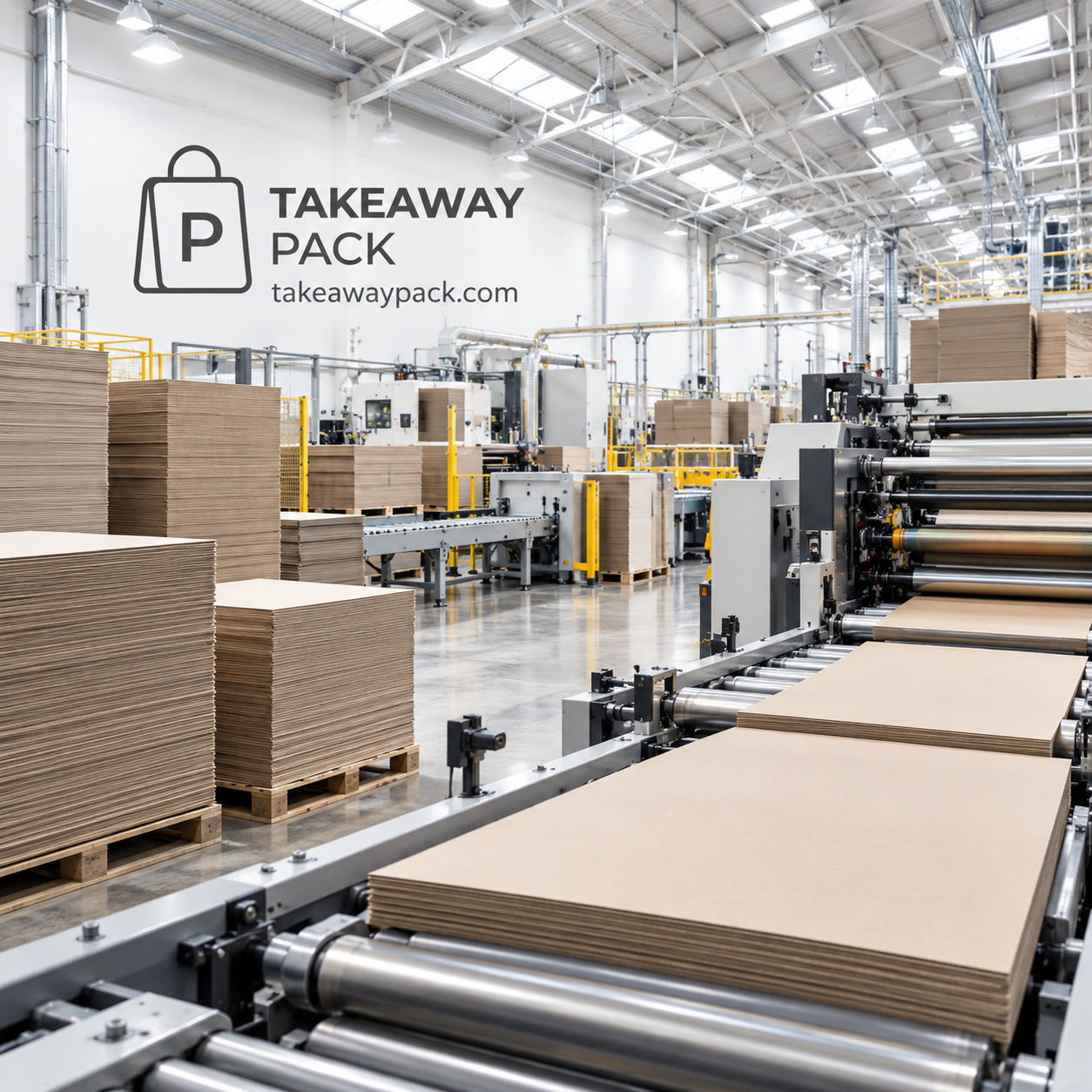
TakeawayPack operates a self-owned printing plant alongside a network of packaging factories and serves international foodservice buyers across North America, Europe, Australia, the Middle East, and Japan/Korea, with boxes, containers, trays and lids among its categories. Interior-printing decisions fit its inquiry flow directly: structure, coatings, printing, lid matching and carton packing are discussed at RFQ stage, and production starts only after a digital proof is approved in writing.
Because certification attaches to the product rather than the catalog, food-contact, FSC or GRS documentation is confirmed per SKU and destination market, and select kraft and molded-pulp lines carry compostable or recyclable certification in that same SKU-by-SKU sense. Ask for the documents that match the exact item you plan to order, via the certifications and materials page.
Quick answers
Can print sit on the surface that touches food directly?
Only when the ink system is formulated and documented for that intended use. Most brands remove print from direct-contact zones or interpose a barrier liner — simpler, cheaper and easier to defend in an audit.
Does printing a paper liner stop it being recycled?
Not inherently. Water-based inks at typical coverage repulp with the paper; heavy varnish builds, plastic laminates and foils are what push a component out of ordinary recycling streams, and the destination mill has the final say.
Is spot UV safe inside a meal-kit box?
Treat it as an outside finish. UV-cured varnish near food demands complete cure and low-migration control, and set-off between nested parts can move varnish chemistry onto food-contact surfaces.
Does a laminated lid recycle?
Usually not in ordinary curbside streams, because the plastic film makes the board a composite. If barrier performance matters, a functional liner or a coating chosen per SKU and destination is the more recycling-friendly route.
For a packaging request built around your menu, components, and destination market, visit Takeawaypack.