Bagasse or PLA for Hot Food? Splitting a Compostable Order by
Bagasse or PLA for Hot Food? Splitting a Compostable Order by Application
Standard PLA has a low glass transition temperature, which makes hot fills a known stress point where deformation and lid-seal failures are commonly reported. Molded bagasse is formed under heat and pressure, giving it the thermal headroom that hot-line positions usually demand. The reliable sourcing rule is therefore not "which material wins" but "which material per application": after testing each packaging position at its real fill temperature, hold time and delivery window, most teams
Estimated reading time: 4 minutes
The Failure Pattern When PLA Meets Heat
Standard PLA is a plant-derived bioplastic with glass-like clarity, and at room temperature it behaves much like PET. Its weak point is thermal: the polymer softens as food temperatures climb toward and past its glass transition zone, so a hot fill can relax the material into a buckled base or a broken lid seal.
The scene repeats itself somewhere in every market: an operator commits to compostable packaging, orders PLA across the board, and then packs boiling broth or fryer-fresh chicken into it. Where that mismatch happens, containers can deform on the way to the customer and the delivery bag carries the evidence. Refunds and one-star reviews follow, and the platform rarely absorbs the cost quietly. The material was not defective; it was deployed against an application its thermal profile does not list. That distinction matters for sourcing teams, because the fix is usually not a different supplier of the same resin but a material matched to the hot positions after a proper fill-temperature test.
Why Bagasse Holds Its Shape Under Heat
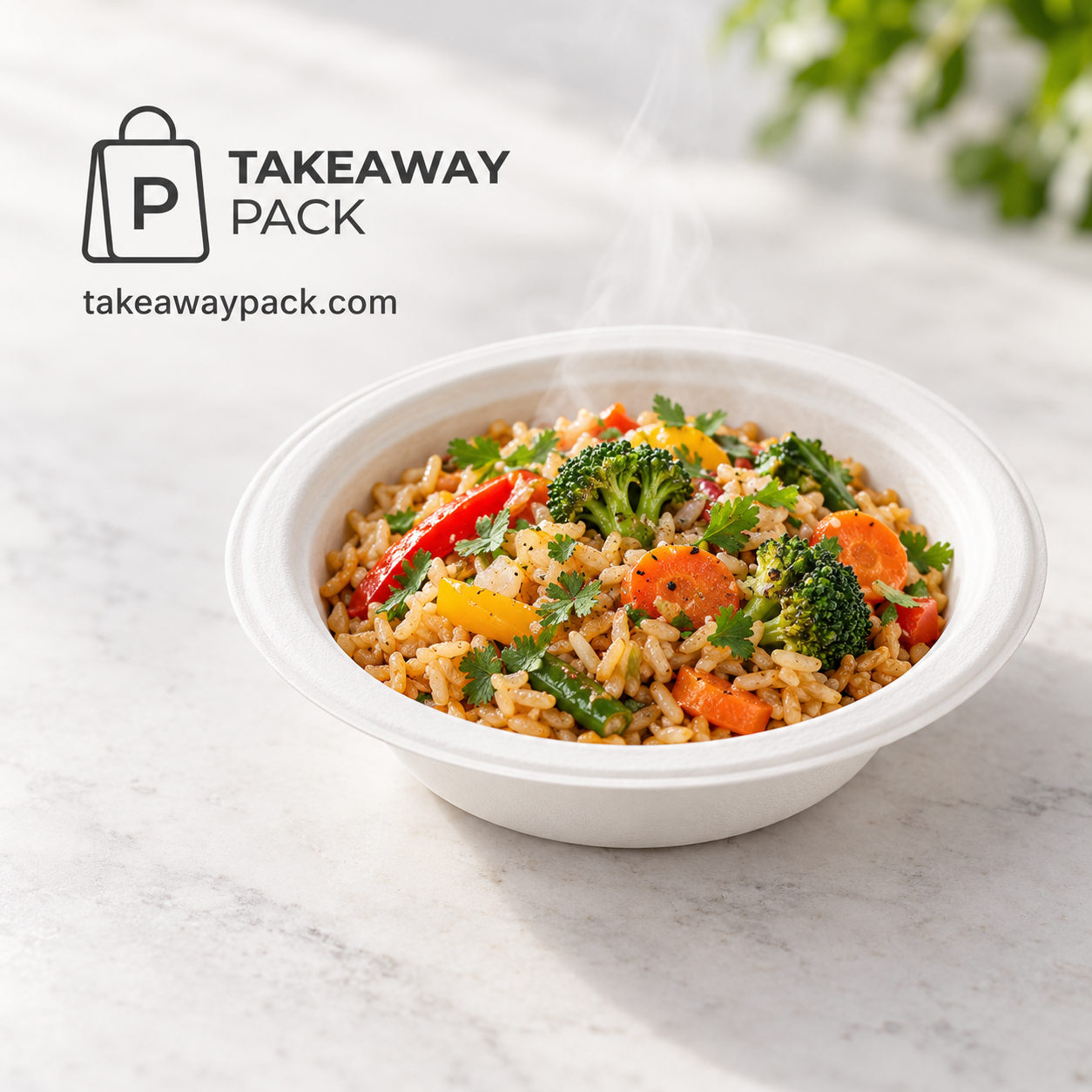
Bagasse is sugarcane fiber molded under high temperature and pressure, so the finished container has already survived more heat than a kitchen will apply. Hot fills, short microwave reheats and holding-cabinet warmth sit inside the working range its manufacturers cite, which is why molded fibre has become a common structural choice for hot foodservice lines.
The same fiber structure carries two more advantages that matter on hot menus. Dense walls insulate, keeping the outside of a full container comfortable to carry, which protects crews during a rush and customers at handoff — a comfort margin clear plastic wall constructions rarely reach. And the fiber breathes modestly, releasing the steam that would otherwise condense and drag down fried textures. For a truck or delivery menu built around the fryer, that combination of thermal headroom and vapour control is often what separates crisp arrivals from steamed ones.
The Mix-and-Match Sourcing Rule
One material will rarely cover a full menu, so build a simple eco-matrix instead. In the splits that work, hot lines are specified in molded fiber: fried foods, rice mains, curries and anything destined for a microwave reheat — once the SKU passes a hold test at the line's real fill temperature. Cold lines are where PLA is commonly specified: salads, cut fruit, chilled desserts and drinks, where its clarity does genuine merchandising work.
Between the two sits the hybrid case: hot food with free liquid that needs a secure seal. Best practice here is a deep bagasse bowl paired with a lid specified for heat, because the bowl carries the temperature and the lid system carries the leak.
Cold lines are where PLA earns its place. Clarity close to PET puts salads, cut fruit and chilled desserts on display without apology, and at cold temperatures the material is dimensionally stable. The failure pattern appears when hot food crosses into a cold-line container, which is why the matrix works only if the line between hot and cold is enforced at the packing station, not just in the procurement spreadsheet.
What This Means for Your 2026 RFQ
Write applications into the RFQ instead of asking suppliers to guess. List the dish, fill temperature, hold time and delivery duration for each packaging position, then ask which material and SKU the supplier recommends per line. A supplier who answers with application-matched products is a supplier worth sampling. RFQs that collect category, material, size or capacity, estimated quantity, print customization and destination port let the supplier quote per application instead of per catalogue page, and they expose vendors who only have one answer for every dish.
Ask for samples against the two hardest positions on the menu, not the easiest. If the container survives your hottest, wettest, longest-hold dish, the rest of the range is low risk. Insist on production-representative samples rather than lab pieces, and run them through the actual packing station so closure speed and stacking behaviour are observed, not assumed. Confirm at SKU level which lines carry compostable or recyclable certification direction, and file the documentation per product rather than per catalogue.
Quick answers
Can PLA containers go in the microwave?
Generally not. Standard PLA softens near food-hot temperatures and can warp or fuse to food, so microwave use is not a listed application for it. Molded bagasse and CPLA are the microwave-suitable options among compostable materials — confirm the heating claim on the specific SKU before you print reheating instructions.
Is bagasse leak-proof for thin soups?
Well-made bagasse bowls hold soup through a normal delivery window; for extended holding, fiber bowls with a barrier treatment are the appropriate specification. Free liquid belongs in a bowl-and-lid system, not a hinged clamshell.
Does bagasse change the taste of food?
Properly processed bagasse is neutral. It is washed, refined and formed under high heat, and it carries no taste or odour into food.
Which material should a mixed hot-and-cold menu order?
Both, mapped by application after line-by-line testing. Molded fibre for hot positions that pass its hold test, PLA for cold display and drinks, and a deep bowl-and-lid hybrid for hot liquid lines. Match SKUs to applications in the RFQ and verify certifications per product.
TakeawayPack is positioned as a converter with its own printing facility and a network of foodservice packaging factories, so application-matched sourcing across cups, bowls, boxes and containers can be consolidated with one supplier. For a packaging request built around your menu and destination, visit TakeawayPack.