Batch Traceability for Private-Label Food Packaging Across Multiple Stores
A private-label foodservice programme needs more than a compatible cup or lid. It needs a practical way to connect the product specification, the batch or lot reference, packing details, and the receiving location—without making store teams manage an unworkable amount of data. This article explains a usable traceability framework for regional convenience-store and forecourt foodservice networks, and shows how order-specific packaging details can be aligned before dispatch.
2026-08-20 - 7 min read
Summary
A private-label foodservice programme needs more than a compatible cup or lid. It needs a practical way to connect the product specification, the batch or lot reference, packing details, and the receiving location—without making store teams manage an unworkable amount of data. This article explains a usable traceability framework for regional convenience-store and forecourt foodservice networks, and shows how order-specific packaging details can be aligned before dispatch.
Regional foodservice operators often work to a repeatable delivery rhythm: stores replenish, teams prepare hot food, and customers expect the same packaging experience in every location. The challenge becomes sharper when the packaging carries a private label, when several product formats travel together, or when a question later needs to be tied back to a particular delivery.
The answer is not necessarily to record every item individually. A better starting point is to decide what needs to be identified at product level, batch level, shipment level, and store-receipt level.
Start With a Clear Product Specification
Traceability works only when people are referring to the same product. Before an order is placed, keep the agreed specification together in one order record: product category, material, size or capacity, lid requirement, print or colour requirement, and the intended destination.
For a hot-food range, this may include a specific soup-cup format alongside its matched lid and outer-carton description. For example, a Natural Kraft Soup Cup 350ml can be treated as one clearly named item in the programme rather than as a generic “paper cup.” That distinction helps purchasing, packing, warehouse handling, and store receiving teams ask the same question about the same item.
Where a private-label print is involved, the artwork file and the approved digital proof should be connected to the applicable order. TakeawayPack states that custom-print orders are produced after the customer’s digital proof is confirmed in writing. This makes the approved proof a useful handover point: it records which artwork version belongs with the agreed item before production begins.
Use Batch-Level References Where They Add Value
A batch or lot reference is useful when a business needs to narrow a follow-up question to a defined group of products. The goal is practical containment and retrieval, not an unnecessarily complex data project.
For each relevant batch, keep a small set of consistent fields:
- the product description or internal SKU;
- the batch or lot reference used for that order;
- the packing or carton reference where applicable;
- the dispatch or handover reference;
- the receiving warehouse, route, or store group; and
- the date and time recorded at each relevant handover.
The value comes from the relationship between these fields. A store team should be able to report the product and the reference shown on the packaging or delivery documents. The central team can then connect that reference to the order, the packing information, and the destinations that received the same group.
Not every item needs the same level of detail. A network can choose a higher level of precision for a product or process that presents a greater operational need, while retaining a simpler record for standard supporting items. What matters is that the chosen approach is consistently understood by the teams that receive, store, and use the packaging.
Design the Handover Around Real Store Work
Multi-store traceability often breaks down at handover points, not because people lack data but because the data is not easy to use. A practical handover can answer five simple questions: what moved, which batch or order reference it belongs to, when it moved, where it went, and who recorded the receipt.
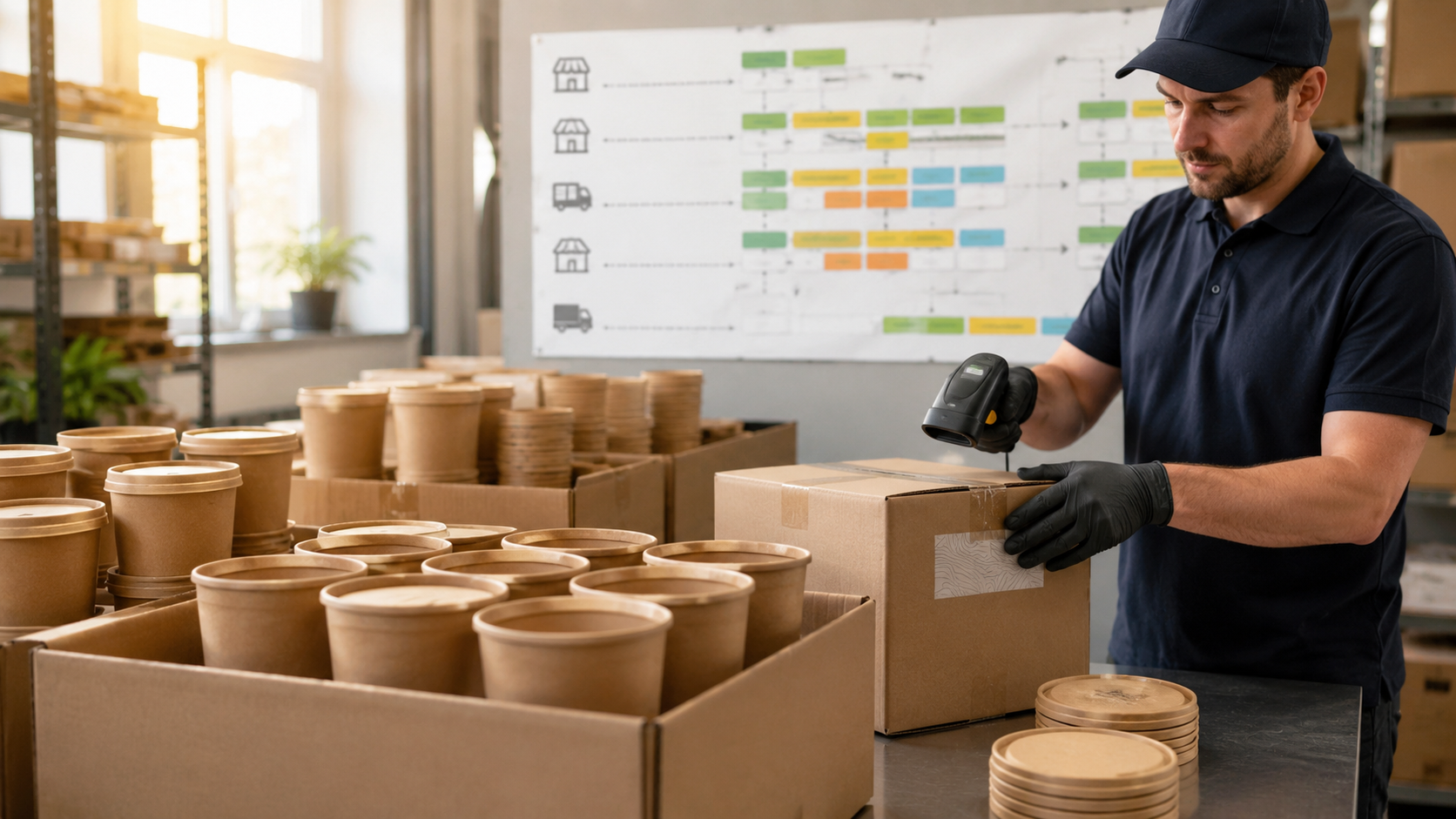
For a two-week replenishment rhythm, create a repeatable receiving check that fits into the normal delivery routine. The receiving record can link a delivery document or carton reference to the destination store or store group. If cases are later split between locations, record the split at the point it happens rather than trying to reconstruct it from memory.
This is also where carton information matters. TakeawayPack’s public process describes confirming carton, packaging, and export-handover details before quotation, samples, or bulk-order handover. For a regional network, those details can be used as the bridge between the order plan and the physical cases that arrive at a warehouse or store.
Keep the Data Useful Across Partners
A traceability record becomes more useful when each party can interpret it without relying on a particular spreadsheet or person. Use stable product names, unambiguous references, and a shared meaning for each field. Avoid putting an artwork version, a carton count, and a delivery reference into one free-text note where they cannot be searched separately.
A simple operating model can separate information into four connected layers:
- Product master record: the agreed item name, size or capacity, material description, and lid relationship.
- Order record: quantity, destination, required customisation, and the documents approved for that order.
- Batch and packing record: the batch or lot reference, relevant carton information, and the dispatch or export-handover reference.
- Receipt record: the warehouse, route, store, or store group that received the cases and the time of receipt.
This structure is intentionally flexible. It can support a small regional programme using shared operational records, then be expanded if more locations, product formats, or supply partners join the process.
Make Delivery Planning Order-Specific
A private-label foodservice programme may need to coordinate standard products, bespoke printing, alternative packaging formats, and several destinations. These are commercial and operational decisions that should be confirmed for the individual order, rather than assumed from a previous purchase.
When preparing an RFQ with TakeawayPack, buyers can provide the product category, material, size or capacity, estimated quantity, print or colour requirements, and destination country or port. The company also states that discussions may cover structure, coating, capacity, printing, lid matching, and carton packing. This gives procurement teams a clear checklist for aligning the packaging request with the traceability record from the beginning.
For planning purposes, avoid treating an indicative schedule as a fixed delivery promise. TakeawayPack notes that production timing is described in its shipping policy and confirmed in the quotation; the final order terms remain the right place to establish the applicable details. The same principle applies to minimum order quantities, customisation availability, and any particular logistics arrangement.
A Practical Review Before Each Replenishment Cycle
Before the next cycle is released, review the programme as a connected chain rather than a list of isolated purchase orders. Confirm the product specification, artwork or proof status when relevant, batch-reference convention, carton and handover details, planned destinations, and the receiving record owners.
If a store reports a problem or needs an answer about a particular case, this structure provides a route back through the immediate delivery record, the relevant batch, and the original order information. It also reduces the risk of treating all visually similar cups, lids, or cartons as interchangeable when they were ordered under different specifications.
Build the Next Private-Label Packaging Request With Traceability in Mind
Traceability begins with a disciplined product and order conversation. TakeawayPack offers foodservice packaging categories including cups, bowls, boxes, containers, trays, lids, bags, and cutlery, and works with international buyers on packaging requirements. For an order-specific discussion of a private-label packaging programme—whether it includes a 350ml soup-cup format, matched lids, carton details, or delivery destinations—start with the product and destination information at takeawaypack.com.