Custom-Printed Bowls, Boxes & Bags: The First-Order Playbook for New Takeout Kitchens
This guide shows how to map a rice-bowl, wok-dish and appetizer menu onto a small starter SKU list, how many of each to buy for a first order, and how to use low-MOQ custom printing (as low as 500–1,000 units with a supplier like [takeawaypack.com](https://takeawaypack.com)) to test branded packagin…
2026-09-07 - 8 min read
Summary: This guide shows how to map a rice-bowl, wok-dish and appetizer menu onto a small starter SKU list, how many of each to buy for a first order, and how to use low-MOQ custom printing (as low as 500–1,000 units with a supplier like takeawaypack.com) to test branded packaging without burying cash in a stockroom. Read it once, build your list, then reorder based on real ticket data instead of guesses.
Start With Your Ticket Mix, Not With a Catalog
Most first packaging orders go wrong the same way: the owner browses a catalog, likes twelve products, and orders a case of each. Three months later half the shelf has not moved and the two items that actually matter are out of stock on a Friday night.
Work in the opposite direction. Pull your last 100 delivery and pickup tickets — or if you are brand new, your last 100 dine-in tickets — and sort every dish into one of four physical categories:
- Hot food with rice or noodles under it (rice plates, combination plates, lo mein, fried rice)
- Wet wok dishes with sauce (kung pao, mapo tofu, braised items, anything that will slosh)
- Crispy or dry appetizers (egg rolls, wings, crab rangoon, fried dumplings)
- Liquids and extras (soup, sauces, chili oil, dressing)
That is it. Four categories, and each maps to one packaging shape. A menu with 60 items usually needs fewer than eight packaging SKUs because dishes share containers. The mistake is treating menu variety as packaging variety.
Also count how many of your tickets are single-entrée orders versus family-style orders of three or more dishes. That ratio decides your bag sizes and whether you need carriers — and it is the number most first-time buyers never check.
The Seven-SKU Starter List for a Chinese Takeout Menu
Here is a starting list that covers a rice-plate, wok-dish and appetizer menu without redundancy. Adjust sizes to your portions, but keep the count tight.
| # | SKU | What it carries | Why it earns a slot |
|---|---|---|---|
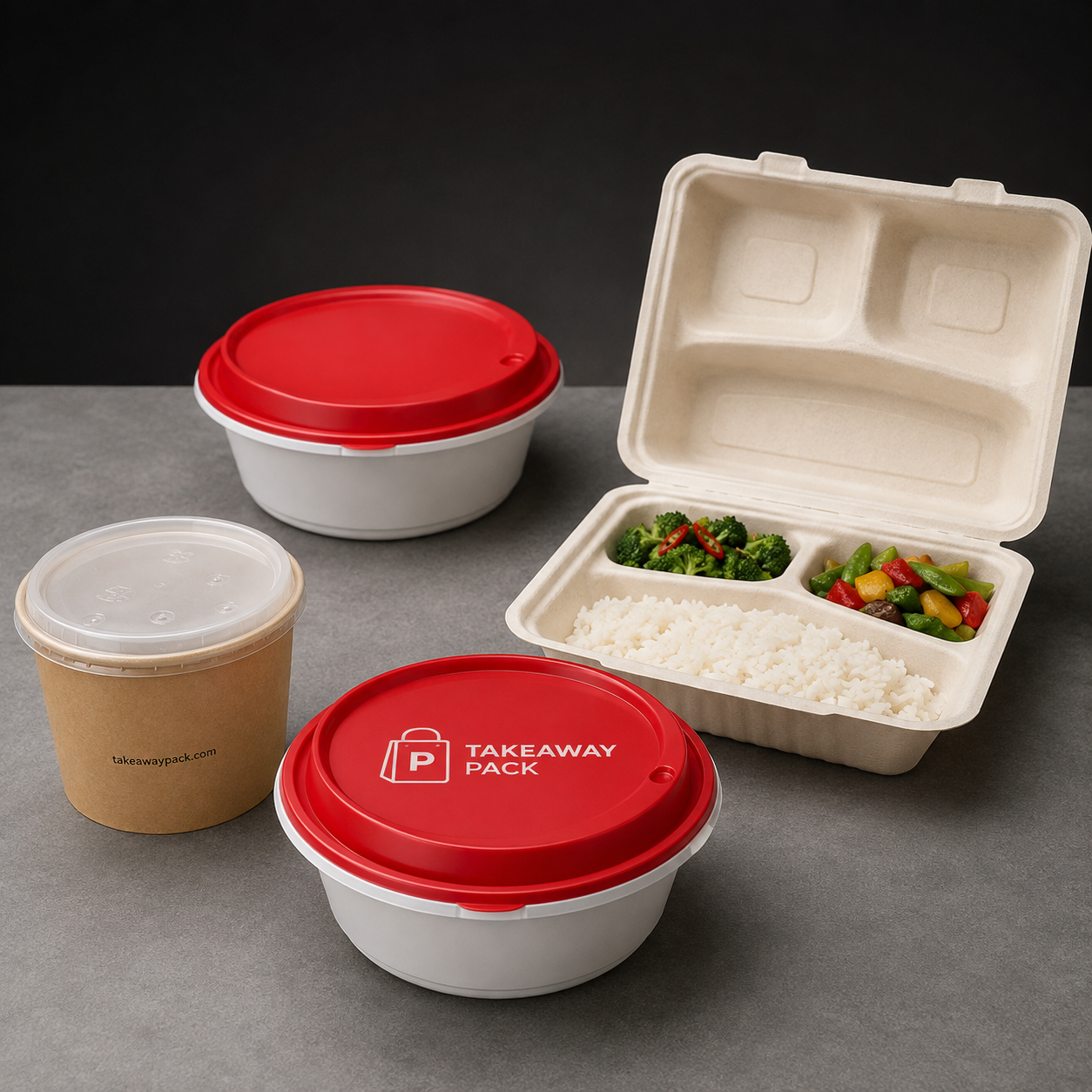
| 1 | Lock-lid PP bowl, mid size (approx. 750–1,000 ml) | Single rice plates, noodle entrées, lunch specials | Your highest-volume item. Snap lid survives a delivery bag on its side. |
| 2 | Lock-lid PP bowl, large (approx. 1,500–2,000 ml) | Family-size wok dishes, party portions, large noodle orders | Lets you upsell portion size without a second container family. |
| 3 | Compartment tray | Combo plates: entrée + rice + egg roll in one lid | Kills three-container combos. Fewer pieces, faster line, cleaner presentation. |
| 4 | Kraft soup tub with PP lid | Hot & sour soup, wonton soup, congee, broth noodles | Paper-walled tubs handle heat better in a customer's hand than a thin cup. |
| 5 | Window box or clamshell | Egg rolls, wings, fried dumplings, crispy appetizers | Vented paper board keeps fried food from steaming itself soft. |
| 6 | Sauce cups with lids (2 oz / 4 oz) | Soy, chili oil, sweet and sour, dressing | Cheapest SKU on the list and the one that generates the most complaints when missing. |
| 7 | Custom-printed paper bag, medium | Outbound packing for every order | The only piece the customer sees before they see food. Highest branding return per dollar. |
Two optional add-ons, only if your data says so:
- Cup carriers (single or double) — add these if bubble tea, iced coffee or fountain drinks appear on more than roughly one in five tickets.
- Tamper-evident bowls — add these if you are on third-party delivery platforms and want a visible seal, or if you have already had a "the bag was open" refund claim.
A supplier with a broad catalog matters here more than it looks. If your soup tub, your bowls and your trays all come from the same source, you consolidate freight, you match lid families, and you are not chasing four vendors when one runs short. Takeawaypack, for example, carries lock-lid PP bowls from roughly 750 ml up to 2,000 ml, kraft soup tubs with PP lids, compartment trays, tamper-evident bowls, window boxes, clear PET containers, molded pulp and clamshell boxes, sushi trays, cake, pizza and bakery boxes, sauce cups, paper bags, plus stickers and seals — across a catalog of 950+ items. That breadth is what lets you start with seven SKUs and grow into the eighth without switching suppliers.
How Much of Each: A Quantity Formula That Survives Unstable Volume
Do not buy by intuition. Buy by weeks of cover.
Step 1 — Estimate daily use per SKU. Take your average daily takeout tickets. Multiply by the share of tickets that use that container.
Example: 40 takeout tickets a day, and 70% of them include a rice plate → 28 mid-size bowls a day. Sauce cups usually run 1.5–2.5 per ticket, so 40 tickets = 60–100 sauce cups a day. Bags run about 1 per ticket, sometimes 1.2 for large orders.
Step 2 — Pick a cover window by volatility.
- Stable, predictable volume: 4–6 weeks of cover
- New or swinging volume (your situation): 3–4 weeks of cover for core items, 2–3 weeks for anything unproven
Step 3 — Multiply, then round to case size. 28 bowls/day × 26 operating days × 3 weeks ÷ 4… simpler: 28/day × 21 days ≈ 590 units → round up to the nearest full case.
Step 4 — Set a reorder trigger, not a reorder date. Write the trigger on the shelf label: "reorder at 1.5 weeks remaining." For imported or printed items, extend that to cover production and transit time — ask your supplier to confirm the current lead time in writing before you set the number.
Rough first-order shape for a 40-ticket-per-day operation, three weeks of cover:
| SKU | Est. daily use | ~3-week first order |
|---|---|---|
| Mid bowl (750–1,000 ml) | 28 | 600 |
| Large bowl (1,500–2,000 ml) | 8 | 200 |
| Compartment tray | 10 | 250 |
| Soup tub | 6 | 150 |
| Window box / clamshell | 12 | 250 |
| Sauce cups | 80 | 1,500–2,000 |
| Paper bag (medium) | 42 | 1,000 |
Two rules make these numbers safe. First, stock plain stock deep and printed stock shallow while you are learning. Second, never let one SKU exceed 35–40% of your packaging spend until it has proven its volume over at least six weeks.
Using Low MOQ as a Test, Not a Discount
The reason MOQ matters to a new takeout operation is not price per piece. It is the cost of being wrong.
If custom printing requires 10,000 bags, your first branding decision is a five-figure bet on a logo placement you have never seen in a customer's hand. If the same design can be printed at 500–1,000 units — the range available on custom print work at takeawaypack.com — the same decision costs a few hundred dollars and one week of service to validate.
Use that low MOQ deliberately:
Print the outer layer first. Bags and lid stickers are the pieces customers photograph and remember. Printed bags plus printed seals on plain containers reads as a fully branded order at a fraction of the cost of printing every container.
Run one printed SKU at a time. Order printed bags at minimum quantity. Keep containers plain. Watch what happens over three weeks: reorder rate, review mentions, whether staff actually use the bag or default to the cheap one under the counter.
Use stickers and seals as your variable layer. A printed seal can carry your logo, a QR code to your direct-ordering page, a "spice level" mark, or a seasonal promo. When the message changes, you reprint a sticker, not 5,000 containers. Seals also close a lid visibly, which does the tamper-evidence job on ordinary bowls.
Keep artwork production-ready from day one. Vector logo, CMYK build, and one-color and two-color versions. Reprints get cheap when the file never changes; they get expensive when you redesign every round.
Ask for samples before the print run. Fill the bowl with your actual hottest, oiliest dish. Snap the lid. Put it in a delivery bag, drive fifteen minutes, then open it. Sample testing catches lid failures and warping that no spec sheet reveals.
Spec Checklist Before You Approve Any Order
Ask for these eight lines on every quote. If a supplier cannot answer them plainly, that is your answer.
| Item | What to confirm |
|---|---|
| Material | PP for microwavable lock-lid bowls; kraft paper board for soup tubs and window boxes; molded pulp where you want a fiber look; PET only for cold items |
| Sizes | Actual fill volume, not nominal — measure against your real portion |
| Heat and oil tolerance | Whether it holds hot wok dishes and oily sauces without warping or leaking |
| Lid fit | Snap-tight, leak-resistant, and confirmed on the same product family you are buying |
| Printing | Logo area, color count, one-color vs full-color pricing, artwork file format |
| MOQ | Per SKU, per color, per size — MOQ is usually quoted per variant, not per order |
| Case pack | Units per case, cases per pallet, so you can plan shelf space |
| Lead time | Production plus transit, counted from artwork approval, in writing |
Two field notes worth more than any spec sheet. Stack the container full and closed — if it does not stack, your prep line loses time on every ticket. And test the lid with cold hands and gloves on, because your closer at 9:40 p.m. is not going to fight a lid twice.
Where First-Time Buyers Lose Money
- Buying every size of everything. Two bowl sizes beat five. Portion clarity is a menu decision, not a packaging decision.
- Under-ordering sauce cups. They are the cheapest item and the most common shortage. Order generously; they never expire.
- Printing containers before printing bags. Wrong order of operations. The bag is seen first and costs less to print.
- Ignoring lead time on printed goods. Plain stock can be reordered fast. Printed stock takes production time. Keep plain backup stock for any printed SKU.
- Guessing lid compatibility across families. Lids are not universal. Confirm the exact bowl-and-lid pairing before you commit.
- Overcommitting to a design you have not held. Sample first, print second.
- Forgetting storage. Packaging is bulky. Before ordering, measure your shelf. A pallet of bowls does not fit in a hallway.
A Realistic 90-Day Rollout
Weeks 1–2 — Map and sample. Build your four-category list, define your seven SKUs, request samples, and run the hot-and-oily test on your three best-selling dishes.
Weeks 3–4 — First order: plain deep, printed shallow. Full three-week cover on plain containers. One printed SKU (bags) at minimum quantity, plus printed seals or stickers.
Weeks 5–8 — Measure. Track per-ticket packaging cost, out-of-stock incidents, leak or damage complaints, and which SKUs move faster than projected. Adjust the cover window per SKU, not across the board.
Weeks 9–12 — Expand deliberately. Add printed bowls or trays only for SKUs with eight weeks of stable volume. Add cup carriers if drinks crossed 20% of tickets. Add tamper-evident bowls if you are on delivery platforms. Then negotiate volume pricing on the two or three SKUs that have proven themselves.
By day 90 you should know your packaging cost per ticket to the cent, and your reorder decisions become arithmetic instead of anxiety.
Build Your Starter List With Someone Who Sells All of It
The advantage of consolidating this into one supplier is not just freight. It is that lid families match, sizes are consistent across reorders, and low-MOQ printing lets you test branding on the pieces that matter before scaling.
Takeawaypack supplies custom disposable food packaging to restaurants, food trucks, cafés, ghost kitchens, bakeries and caterers across the US — lock-lid PP bowls, kraft soup tubs, compartment trays, tamper-evident bowls, window boxes, clear PET containers, molded pulp and clamshell boxes, sushi trays, cake and pizza boxes, sauce cups, paper bags and custom-printed bags, plus stickers and seals — with custom printing available from as low as 500–1,000 units.
Send your menu and your average daily ticket count, and get a starter SKU list with quantities mapped to your real volume instead of a catalog dump.
Get your first-order list built:takeawaypack.com/contact · info@takeawaypack.com · +1 636-298-3606 · Casper, WY