Choosing Custom Takeout Packaging for a Barbecue Skewer Shop: Heat, Grease, and Group Orders
A grilled skewer order is three packaging problems in one box — hot food that must not steam itself soggy, rendered fat that will find any weak seam, and a mixed platter that four people need to share without unpacking five separate lids.
2026-09-03 - 15 min read
Summary: A grilled skewer order is three packaging problems in one box — hot food that must not steam itself soggy, rendered fat that will find any weak seam, and a mixed platter that four people need to share without unpacking five separate lids. This article works through the decisions a skewer or BBQ shop actually has to make when placing a packaging order: which container shape suits a 30 cm bamboo skewer, where aluminium foil earns its cost and where kraft paper is the better answer, how to separate crisp items from steamy ones, and how to keep sauce out of the bag. Every product referenced below is a real catalogue item quoted at its recorded dimensions and material.
Why Skewers Break Standard Takeout Boxes
Most takeout containers are designed around a footprint, not a length. A 1000 ml rectangular box measuring 172×120 mm internally is generous by volume and useless for a skewer, because a standard bamboo skewer runs roughly 25–35 cm. Force it in and you either snap the stick, bend the food off it, or stand the skewers upright where they lean against the lid and slide during transit.
The second problem is heat behaviour. Grilled meat leaves the fire dry-surfaced and crisp. Seal it in a deep, tall container and the moisture it gives off has nowhere to go: it condenses on the lid, runs back down, and the crust you spent money on turns to wet skin. Shallow beats deep for grilled food, which is the opposite of the instinct most operators have.
Third is grease. Lamb, chicken thigh, pork belly, and beef short rib all render fat continuously as they cool. Uncoated paperboard will darken and eventually soften. That failure shows up not in the kitchen but on the customer's table, and on the outside of the carrier bag.
Fourth is the sharing case. A group order is not four individual orders. If a table of four gets four identical sealed clamshells, they open all four to find out what's in them. A single tray with visible divided sections solves the same order with less packaging and a better handover.
Worth keeping in mind while you plan: WHO guidance for cooked food is to hold it piping hot, above 60 °C, prior to serving, and not to leave cooked food at room temperature for more than two hours (WHO Europe, Public health advice on food safety during summer). Packaging slows heat loss; it does not hold temperature. Your real control levers are how fast the order leaves the kitchen and how tightly the box is matched to the food.
Long Foil Containers: The Answer to Skewer Length
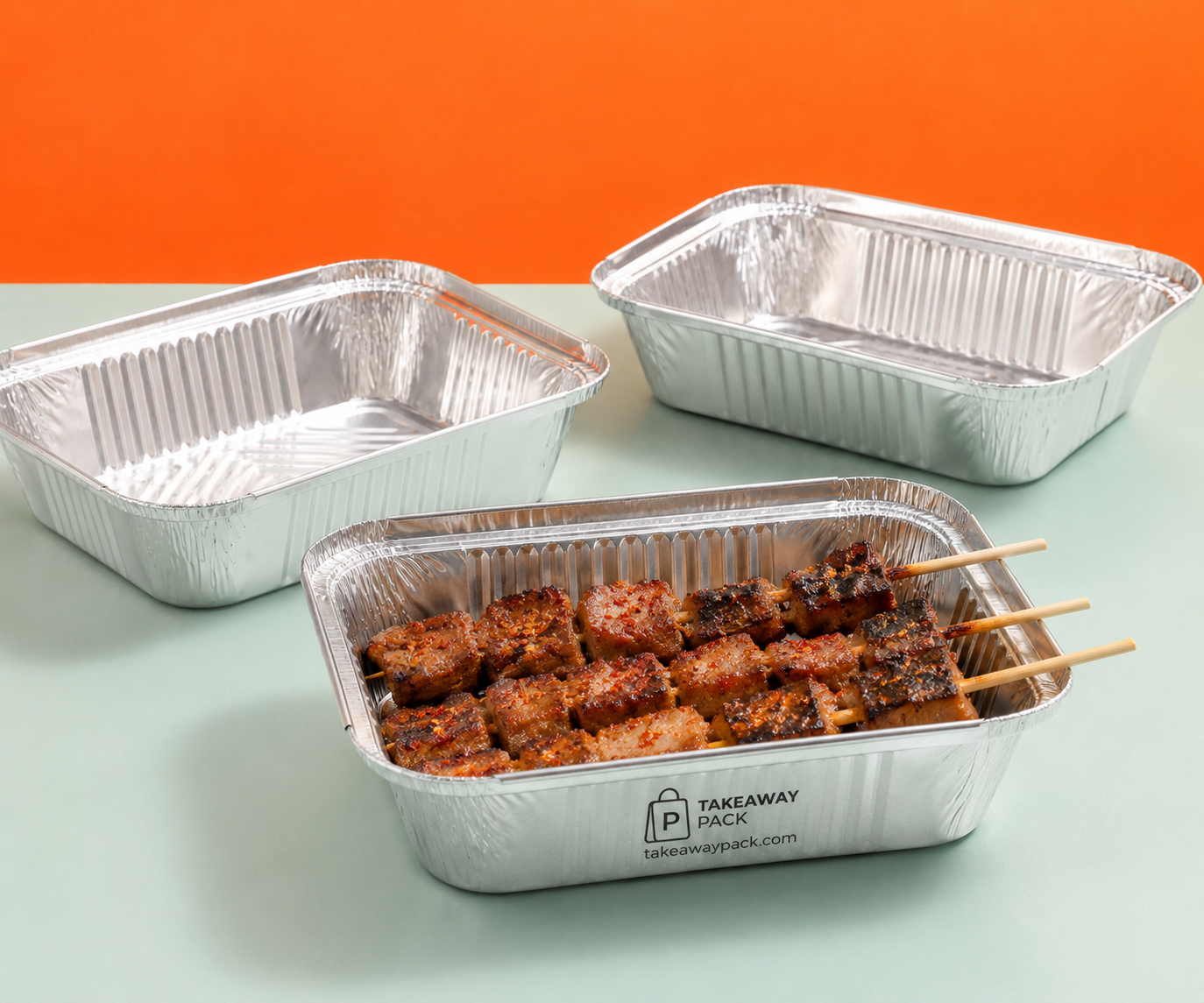
Aluminium foil is the material that solves skewer packing most directly, for a plain structural reason — foil containers are pressed, so they are available in long, narrow footprints that folded paperboard boxes rarely offer. Foil is also fully impermeable to grease, so there is no coating to fail.
The catalogue includes foil containers built on a 350 mm and 405 mm footprint, which is where skewer packing gets easy:
| Container | Dimensions | Depth | Foil gauge | Fits |
|---|---|---|---|---|
| Foil container 350, 1350 ml | 350×138 mm (base 310×90 mm) | 50 mm | 0.05 mm | A row of skewers up to ~34 cm, single layer |
| Deep foil container 350, 1900 ml | 350×135 mm (base 305×85 mm) | 75 mm | 0.065 mm | Same length, thicker cuts — wings, chops, koftas |
| Foil container 400, 2400 ml | 405×150 mm (base 354×104 mm) | 67 mm | 0.069 mm | Long skewers to ~40 cm, or a mixed 10–12 stick order |
| Foil container 315, 2250 ml | 315×215 mm (base 270×170 mm) | 50/45 mm | 0.07 mm | Wide platter format, skewers laid side by side |
| Foil container 255, 1750 ml | 255×190 mm (base 210×143 mm) | 58/50 mm | 0.07 mm | Shorter skewers, chicken pieces, sharing side |
Two things to read off that table when you choose. Length first, volume second — the 1350 ml and the 1900 ml containers have almost the same footprint, so pick between them on how thick your food is, not on how much it weighs. And prefer the shallower option for anything crisp: the 50 mm depth of the 1350 ml container keeps skewers in a single layer where steam can disperse when opened, while the 75 mm deep version is really for stacked or bulky items where you have accepted some softening.
These containers are recorded in the catalogue as oven-safe and are described for barbecue takeaway, roasting, and oven-to-table service. That has a practical operational value beyond delivery: the same container can go into the hot hold and out the door without a transfer step, which is one less place for grease to end up on a staff member's glove.
Lids and venting
The 350, 315, and 255 formats are all available three ways: with no lid, with a foil-laminated paper lid, or with a clear plastic lid. For skewers the choice matters more than it looks.
- Foil-laminated paper lid — better insulation, and printable. The downside is that it seals well, which means condensation. If you use this, ask for a small number of vent perforations in the lid panel so moisture can leave. This is a normal print-and-die request, not a custom tool.
- Clear plastic lid — the customer sees the order before opening it, which is worth real money on a mixed platter. Less insulating than foil-laminated paper.
- No lid — only viable if the container goes inside a closed box or a rigid bag, and only for short runs to the door.
Foil-lined bowls for saucy grill items
If part of your menu is wet — grilled items in marinade, buttered corn, spiced potato — a flat foil tray is the wrong shape. Aluminium foil laminated paper bowls handle that case, and are recorded as microwave-safe with a foil lining that holds heat and resists grease and moisture:
- 1000 ml — rim Ø 150 mm, base Ø 128 mm, 75 mm deep
- 1500 ml — rim Ø 185 mm, base Ø 160 mm, 65 mm deep
Both are available with an OPS lid or a PP lid, and both take offset printing, so this is one of the easier places to put your brand on a hot item.
Kraft and Paperboard: For Everything That Must Stay Crisp
Do not put fries in the same compartment as grilled vegetables. Fried and grilled items have opposite moisture needs, and a shared compartment resolves the conflict in favour of the wetter item every time.
Kraft paperboard boxes are the right vehicle for the dry half of the order. They breathe slightly, they stack, and kraft takes offset printing cleanly.
- Kraft rectangular takeaway box 500 ml — top 172×120 mm, base 148×97 mm, 47 mm high
- 650 ml — same footprint, 51 mm high
- 750 ml — same footprint, 57 mm high
- 850 ml — same footprint, 63 mm high
- 1000 ml — same footprint, 78 mm high
The shared footprint across five capacities is the useful part. One box size on the shelf, five depths, and lids that behave consistently — that keeps your SKU count down while still letting you size a portion honestly. The 1000 ml box is recorded as microwave-safe and as a sturdy, leak-resistant container for hot and cold meals. The same sizes exist in a white card version if you want a brighter print surface than natural kraft.
Where you want a coated board rather than plain kraft, the PE-coated white cardboard lunch boxes cover a wide range on the same principle: 500 ml (125×100 mm, 45 mm high), 750 ml (128×108 mm, 65 mm), 1050 ml (185×108 mm, 60 mm), 1400 ml (175×140 mm, 65 mm), 1500 ml (215×155 mm, 48 mm), 2000 ml (215×160 mm, 65 mm), and 3000 ml (225×165 mm, 90 mm). The 1500 ml and 2000 ml sizes are wide and shallow, which makes them workable as a sharing base for shorter skewers or for skewers pulled off the stick.
Open trays for the hand-off
For counter service, or as a liner inside a closed carrier, kraft paper trays are cheap and read as generous:
- No. 1 — 750 ml, top 250×175 mm, base 199×124 mm, 20 mm high
- No. 3 — 850 ml, top 205×135 mm, base 155×85 mm, 44 mm high
- No. 2 — 450 ml, top 208×167 mm, base 155×117 mm, 21 mm high
The No. 1 tray at 250 mm long is the one to look at for skewers, since a shorter skewer sits inside it and a longer one overhangs deliberately, which some operators actually want for presentation. Kraft trays are available with full-colour printing.
Coated kraft boat boxes in six sizes (from 123×88×19 mm up to 253×170×45 mm) are the right unit for a small side — three skewers, a portion of pickles, a bread roll. The No. 6 boat at 253×170 mm is large enough to serve as a standalone snack portion.
Compartment Formats for Group Sharing
This is where a skewer shop can differentiate. A group order presented in one divided tray beats the same food in five sealed tubs, and it usually costs less.
Molded fibre compartment trays
- 5-compartment tray — 267.5×211 mm, 28 mm deep, 24 g
- 6-compartment tray — 319×219 mm, 28 mm deep, 38 g
Both are molded plant-fibre pulp and take inkjet printing. The 28 mm depth is the point: it is a serving depth, not a storage depth, so the food is visible and reachable rather than piled. A workable layout for the 6-compartment tray is two meat sections, one vegetable section, one fried side, one bread or rice section, and one well for a sauce cup.
For lighter division, the 3-compartment tray (232×198 mm, 39 mm deep) and 4-compartment tray (232×198 mm, 41 mm deep) share a footprint, so you can run both off one shelf position.
The same principle exists in molded fibre plates if you want a rounder presentation: 9" 3-compartment round plate (Ø 225 mm, 20 mm high) and 10" 3-compartment round plate (Ø 258 mm, 20 mm high).
Bagasse locking boxes
If the order needs to travel sealed rather than open, sugarcane bagasse lock boxes give you division plus a closure that stays shut:
- Double-compartment lock box — 250×165 mm. Meat one side, vegetables the other.
- Single-compartment lock box — 250×165 mm, for an undivided order.
- 9-inch three-compartment lock box — 230×230 mm, three sections.
- 9-inch single-compartment lock box — 230×230 mm.
- 8-inch three-compartment lock box — 200×200 mm.
The lock-lid design is recorded as keeping food contained and travel-ready — that is the reason to choose it over an open tray for anything that goes on a scooter. Bagasse takes screen printing and laser marking. Note that the 250×165 mm format is shorter than a full-length skewer, so this family suits skewers pulled off the stick, shorter sticks, or grilled pieces.
There is also a dual-layer bagasse container at 250×165 mm with a 46/70 mm stepped depth, which is a useful way to keep a crisp item physically above a saucy one in a single unit.
Elongated compartment containers
For a narrow shared format that still divides, the 500 ml elongated Japanese-style containers run 225×85×44 mm in one compartment, and 223×83×43.5 mm in two- and three-compartment versions, in PP. The 225 mm length and 85 mm width is close to a skewer-friendly ratio and reads as a premium presentation. They are available in white, clear, ivory, and black, and take silkscreen printing.
Large-Volume Sealing for Family Orders
A twenty-skewer family order with rice, salad, and multiple sauces needs at least one high-volume sealed unit. Thickened PP round bowls with lock lids cover this, all on a Ø 172 mm rim so lids and stacking stay consistent:
| Capacity | Height | Base |
|---|---|---|
| 750 ml | 60 mm | Ø 130 mm |
| 1000 ml | 70 mm | Ø 130 mm |
| 1250 ml | 70 mm | Ø 130 mm |
| 1500 ml | 110 mm | Ø 130 mm |
| 1750 ml | 125 mm | Ø 118 mm |
| 2000 ml | 140 mm | Ø 118 mm |
These are food-grade PP, BPA-free, with a leak-resistant lock-lid closure, and the catalogue describes them for large family meals, multi-person takeaway servings, and catering. They come in black, yellow, white with a red lid, and white with a yellow lid — which is a cheap way to colour-code menu categories without printing anything. Screen printing is available when you do want branding.
If you prefer a rectangular sealed format, tamper-evident containers at 222×147×56 mm (1000 ml) and 223×147×70 mm (1350 ml) and latch-lock containers at 223×147×40 mm (750 ml) all share a 223×147 mm footprint. The tamper-evident version is worth the small premium on delivery platforms where the customer needs to see the order was not opened.
Sauce: The Component That Ruins Bags
Sauce is the cheapest item in the order and the most expensive failure. A tipped cup contaminates every other container in the bag and generates a refund.
Use hinged sauce cups with the lid attached to the body. There is no separate lid to mismatch, misplace, or fit badly under pressure:
| Size | Capacity | Top Ø | Base Ø | Height |
|---|---|---|---|---|
| 1 oz | 25 ml | 42 mm | 30 mm | 29 mm |
| 1.5 oz | 45 ml | 55 mm | 43 mm | 24 mm |
| 2 oz | 62 ml | 60 mm | 50 mm | 28 mm |
| 3 oz (tall) | 80 ml | 60 mm | 45 mm | 39 mm |
| 4 oz | 130 ml | 70 mm | 56 mm | 35 mm |
All are food-grade PP with a secure lid closure, and all accept screen printing.
The practical selection rule is base-to-height ratio. The 2 oz cup has a 50 mm base and is only 28 mm tall, so it is hard to tip; the 3 oz tall cup at 39 mm high on a 45 mm base is noticeably less stable in a moving bag. For individual dips, the 2 oz cup is the safer default. For a shared sauce across a group order, use the 4 oz — one stable cup beats four small ones scattered through the tray.
Separate-lid versions exist at 2 oz (70 ml) and 4 oz (150 ml) if you need a deeper fill, but the hinged design is the better operational choice in a busy kitchen.
Wherever your main container has a divided section, put the sauce cup in a compartment rather than loose in the bag. The 5- and 6-compartment trays and the three-compartment lock boxes all have a section that fits a 2 oz cup.
Carrier Bags: Specify to Your Loaded Weight
The bag is the component most operators underspecify, and it is the one the customer touches first. A loaded skewer order of two foil containers, a kraft side box, and sauce runs heavier and more top-loaded than a typical meal order, and grease on the outside of a foil container will find its way onto plain paper.
What to specify, rather than what to hope for:
- A flat, gusseted base wide enough for your largest container. If you have committed to the 350 mm foil container, your bag base needs to accept 350 mm without diagonal loading. Diagonal loading is what tips lids. Measure your chosen container and give that figure to your supplier as a base dimension, not a bag "size".
- Reinforced or twisted handles rated for the loaded weight. Weigh a real full order. That number, not a nominal bag capacity, is what to quote.
- A grease barrier if the bag will contact foil or fried items. Laminated or coated kraft resists staining that plain kraft does not.
- A bag that stands open on the pass. In a rush, kitchen staff should be able to load one-handed. Floppy bags cost seconds on every order.
Carrier bags are the part of a skewer packaging system most often built to order rather than pulled from stock, because base dimension is driven entirely by which container you chose above. Settle the container first, then specify the bag around it. The catalogue does hold stock bag formats — including printed kraft-paper bag designs at 15×15 cm and 18×18 cm for small snack portions, and PE handled bags such as the double-cup bag at 285×310 mm with a 205 mm handle — but for a full skewer order, treat the carrier as a specified item.
A Worked Packaging System
Rather than sizing each item independently, build a small matrix and stop. Four order types is usually enough:
| Order type | Main unit | Side | Sauce | Notes |
|---|---|---|---|---|
| Single, 6–8 skewers | Foil container 350×138 mm, 50 mm deep, vented lid | Kraft box 500 ml | 2 oz hinged | Shallow foil keeps the crust |
| Mixed, meat + vegetable | Double-compartment bagasse lock box 250×165 mm | Kraft boat No. 5 or No. 6 | 2 oz hinged ×2 | Sealed for scooter delivery |
| Group of four | 5-compartment fibre tray 267.5×211 mm | Foil container 350×138 mm for overflow skewers | 4 oz hinged ×2 | One shared sauce, not four |
| Family, six plus | 6-compartment fibre tray 319×219 mm + PP lock bowl 1500 ml | Foil container 400×150 mm for long skewers | 4 oz hinged ×3 | Lock bowl takes rice or salad |
Note what this matrix does to your inventory. Four order types, but only three container families — foil, fibre tray, kraft box — plus one bowl and two sauce cup sizes. Every kraft box shares a footprint. Every lock bowl shares a rim diameter. That is the difference between a packaging system and a packaging cupboard.
Test Before You Commit to a Print Run
Custom printing is produced from a digital proof that you confirm in writing before production starts, which means the proof stage is your last cheap chance to catch a structural mistake. Use plain stock of the same format to test first:
Heat and moisture. Pack your actual busiest skewer at your actual hot-hold temperature. Leave it for the length of your longest normal delivery. Then open it and look at the underside of the food, not the top — condensation collects where the food meets the container. If the underside is wet, you need a shallower container, a vent, or both.
Grease. Use the fattiest item on the menu. Leave it in the container for an hour, then check the container base, the seam, and the exterior of whatever the container sat inside. This is the test that decides between plain kraft and a coated board.
Transport. Load the bag as a real order, put it on a car seat, and drive a route with turns and a speed bump. Then check whether lids stayed on and sauce cups stayed upright. Do this with the bag at its heaviest, not with a sample order.
Handover. Give a packed group order to four people and watch them open it without instructions. If someone has to lift out a container to reach something, the layout is wrong.
Sourcing the System
Takeawaypack works as a foodservice packaging supply chain partner across North America, Europe, Australia, and the Middle East, operating its own printing facility alongside multiple partner factories. For a skewer operation, that structure matters in a specific way: the foil containers, molded fibre trays, kraft boxes, bagasse lock boxes, PP bowls, and sauce cups referenced above come from different manufacturing processes, and consolidating them means your foil order and your tray order do not have to be two separate supplier relationships.
Custom printing runs from a digital proof you confirm in writing before production begins. Food contact documentation is confirmed per SKU, per order, and per destination market — relevant if you are selling into more than one market, since the requirements are not identical. MOQ is flexible, with the final figure confirmed on quotation, so the sensible move on a first order is to ask for the quantity that matches your real monthly volume rather than sizing up to hit a threshold.
A reasonable first order for a skewer shop looks like: one foil container size printed or plain with a vented lid, one kraft box depth, one compartment tray, one sauce cup size, and a carrier bag specified to the foil container's footprint. Five line items. Add the family-order bowl and the second tray size once you know which order types actually recur.
To specify a skewer packaging system against real dimensions and get a quotation with your own volumes, start at takeawaypack.com.