How Dumpling Takeout Shops Use Custom Packaging to Protect Texture and Stop Dipping Sauce From Going Missing
Soggy dumplings and forgotten dipping sauce are packaging problems, not kitchen problems. Freshly cooked dumplings release steam; a fully sealed container turns that steam into condensation that softens wrappers and kills the crisp base of pan-fried pieces.
2026-09-03 - 11 min read
Summary: Soggy dumplings and forgotten dipping sauce are packaging problems, not kitchen problems. Freshly cooked dumplings release steam; a fully sealed container turns that steam into condensation that softens wrappers and kills the crisp base of pan-fried pieces. Missing sauce is almost always a workflow problem, and the fix is to give the sauce cup one fixed physical location the packer cannot skip. This article walks through how to choose a main container by cooking method, how to pick a sauce cup capacity and lid type that survives a delivery bag, how to size the box to your actual portion, and how to get your shop name printed without committing to a large first order. It uses real container and sauce cup dimensions from the Takeawaypack catalog so you can compare against your own menu.
Why dumplings lose texture between your kitchen and the customer's door
A dumpling leaves the steamer or the pan hot and wet. Inside a closed container that water vapour has nowhere to go, so it reaches the cooler lid, condenses, and drips back onto the food. Steamed wrappers go slack. Pan-fried bases lose the crust you spent the shift building.
This matters commercially because texture is a large part of why people order dumplings at all. A consumer study in Food Science and Biotechnology tested commercially available frozen dumplings cooked four different ways and found that chewy, soft, crisp and sticky characteristics all positively influenced acceptability, and that the cooking method significantly affected measured skin crispness (Park, An & Lee, 2023). If crispness is what your pan-fried order is selling, condensation is directly attacking the thing the customer is paying for.
There is a food-safety dimension too. USDA FSIS guidance on take-out food states that cooked food should be held hot at an internal temperature of 140 °F or above, and that perishable food left at room temperature longer than two hours — one hour above 90 °F — should be discarded (FSIS, Safe Handling of Take-Out Foods). FSIS also notes that bacteria grow most rapidly between 40 °F and 140 °F, doubling in number in as little as 20 minutes (FSIS, "Danger Zone" 40 °F – 140 °F).
That creates the real design tension. Venting releases steam, which protects texture. Venting also releases heat, which works against holding temperature. So the goal is not maximum airflow — it is controlled airflow, matched to how the dumpling was cooked and how long your delivery radius actually takes.
Choosing the main container by cooking method
Treat steamed and pan-fried as two different packaging problems. Shops that use one container for both end up compromising on the one that sells better.
Pan-fried dumplings need the steam out
Crisp bases fail in two ways: trapped steam softens them from above, and condensation pooling in the bottom of the container re-wets them from below. You want a lid that lets vapour escape and a base the dumpling is not sitting in a puddle on.
In the Takeawaypack catalog the closest match is a food-grade white cardboard lunch box with a vented lid, laminated for grease and moisture resistance. Two sizes are stocked: a 1400 ml box measuring 175 × 140 mm at the top, 153 × 120 mm at the base, with 65 mm of container height; and a 3000 ml box at 225 × 165 mm top, 198 × 140 mm base, 90 mm height. The 65 mm depth on the smaller box is the useful number here — it gives a single layer of dumplings clear headspace so the top row never touches a condensing lid surface.
A second option worth testing is a moulded bagasse clamshell. Sugarcane pulp is a fibrous material rather than a film-lined one, so it behaves differently against wet food than a laminated board box. The catalog carries these in 4-inch, 5-inch and 6-inch footprints — the 6-inch is 10 × 10 cm at the top with an internal height around 4 cm and roughly 8.3 cm overall closed. For six to eight pieces laid flat, that footprint is realistic.
Steamed dumplings need the steam managed, not removed
Thin steamed wrappers have the opposite failure mode. Too much airflow and the exposed edges dry out and turn leathery before the order arrives. Keep venting minimal and rely on the container's moisture-resistant surface to handle the condensation that does form.
Handled paperboard boxes in the oyster-pail style work well here because the tall, narrow form keeps warmth in and the folded top gives you a slow, imperfect seal rather than an airtight one. Catalog sizes run 240 ml (75 × 60 mm top, 65 mm high), 480 ml (93 × 75 mm top, 85 mm high), 760 ml (103 × 90 mm top, 103 mm high) and 960 ml, all in 300 gsm food-grade paperboard. The 480 ml box suits a standard six to eight piece portion; the 760 ml handles a twelve-piece.
If your steamed order travels with broth or a saucy element, kraft paper bowls with a matching rigid lid are a cleaner fit than a folded box. These run 500 ml through 1500 ml, with the 1000 ml bowl at 15 cm rim diameter and 7.2 cm depth, available with or without a snap-on lid.
Sauce cups: capacity and lid type decide whether it leaks
Two decisions matter more than material: how much sauce the cup holds, and whether the lid is attached or separate.
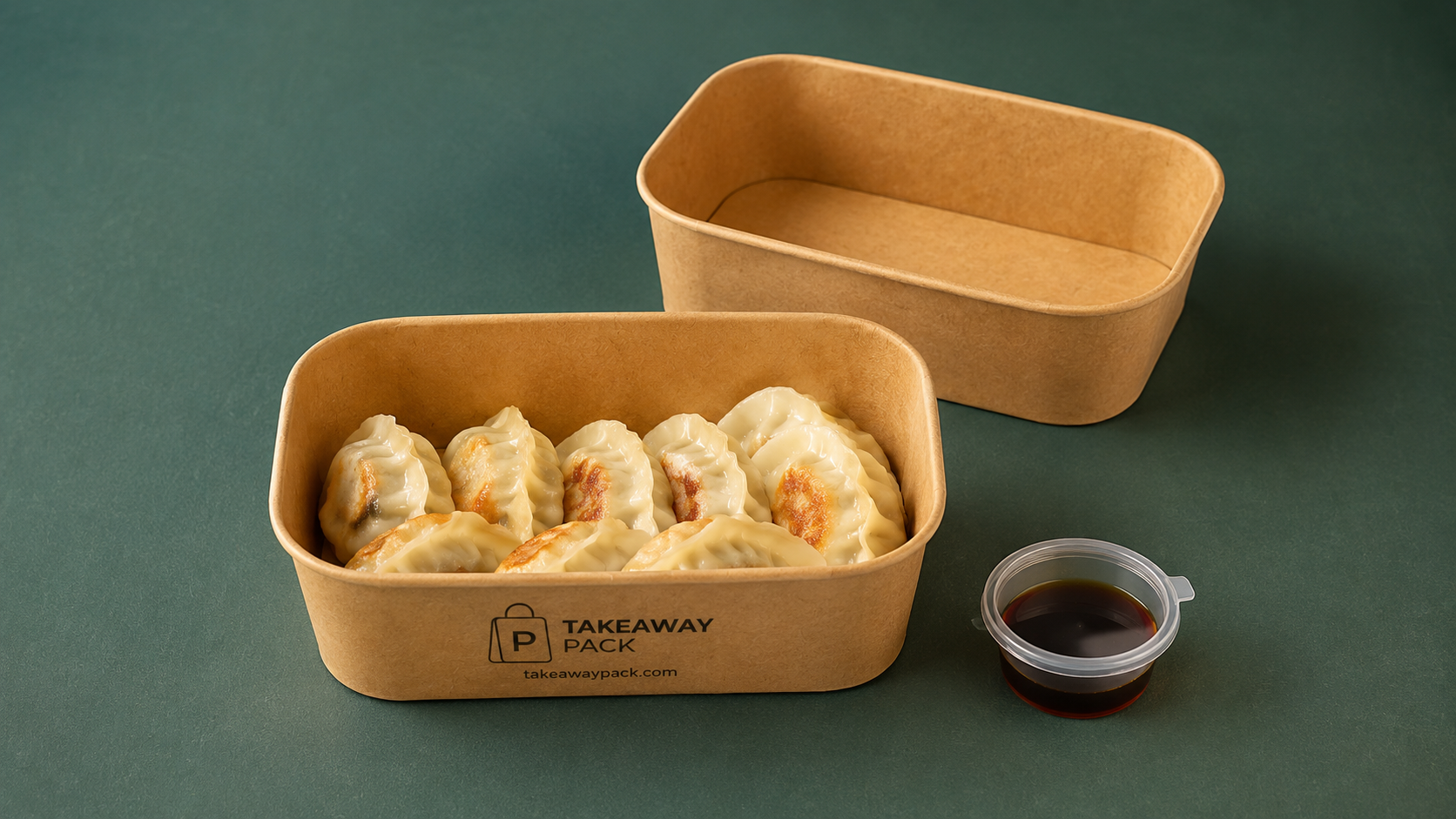
Hinged cups — where the lid is moulded to the cup and folds over — are the safer choice for delivery. There is no separate lid to lose, and the packer closes it in one motion. The Takeawaypack range in food-grade PP covers:
- 1 oz / 25 ml, 4.2 cm top diameter, 2.9 cm tall — enough for a single soy-vinegar dip per person
- 1.5 oz / 45 ml, 5.5 cm top diameter, 2.4 cm tall — the shallow, wide profile that sits flattest in a box corner
- 2 oz / 62 ml, 6 cm top diameter, 2.8 cm tall — the common default for a shared dip
- 3 oz / 80 ml, 6 cm top diameter, 3.9 cm tall — a taller version when you want volume without a wider footprint
- 4 oz / 130 ml, 7 cm top diameter, 3.5 cm tall — for chilli oil or garlic sauce sold as an add-on
Separate-lid cups are also stocked, at 2 oz / 70 ml and 4 oz / 150 ml, both 7.3 cm top diameter. They stack more tightly in storage and give you a flat lid surface that takes a printed label cleanly. The trade-off is one extra assembly step per cup and one more thing a rushed packer can forget.
A practical note on capacity: pick the smallest cup that genuinely holds one serving. Overfilled cups leak at the seal regardless of how good the closure is, and a 2 oz cup filled to 2 oz is more likely to leak in a tilted delivery bag than a 3 oz cup filled to 2 oz.
Give the sauce one fixed location
The most reliable fix for missing sauce has nothing to do with the cup. It is making the sauce cup's position part of closing the box.
Three approaches, in order of how much they cost to implement:
Fixed corner placement. Decide that every sauce cup goes in the same corner of the main container, and that the lid does not close until it is there. This costs nothing and works because the empty corner is visually obvious to whoever is packing.
Compartment container. A moulded container with a smaller well beside the main cavity removes the judgement call entirely. The catalog carries bagasse lock-lid boxes in single and double compartment layouts at 250 × 165 mm, plus 8-inch and 9-inch square single-compartment formats. Plant-fibre compartment trays are also available in three, four, five and six section layouts — the 3-section tray is 232 × 198 mm with 39.1 mm depth, the 6-section is 319 × 219 mm at 28 mm depth. A PP three-compartment container with a clear lid at 24 × 17.5 cm and 4.7 cm depth gives you the same separation with a transparent top, which some shops prefer because the packer can verify the sauce is present after closing.
Seal that spans the sauce cup. A printed sticker or paper band applied across the closed container becomes a verification step: the seal only goes on after the cup is in. This has the side benefit of being tamper-evident.
Whichever you choose, print the sauce type on the cup label rather than relying on colour memory. Soy vinegar, chilli oil and garlic sauce look similar through a translucent lid, and "wrong sauce" generates the same customer-service ticket as "no sauce."
Size the box to the portion, then check it against your delivery bag
A container that is too large lets dumplings slide and collide; one that is too small forces stacking, which crushes the bottom layer and traps moisture between pieces. Measure a plated portion of your actual product before shortlisting sizes.
Two checks people skip:
Single-layer footprint. Count how many pieces you need to lay flat without touching. For most six-to-eight piece portions that lands around a 125 × 100 mm to 175 × 140 mm internal footprint. The catalog's 500 ml white cardboard box (125 × 100 mm top, 45 mm high) and 1400 ml box (175 × 140 mm top, 65 mm high) bracket that range.
Bag geometry. Check that your chosen container plus sauce cup fits your delivery bag without tilting. A cup that sits proud of the container rim will get pressed sideways by the bag above it. This is where the shallow 1.5 oz cup at 2.4 cm tall often outperforms a taller cup of similar volume.
Getting your shop name on it without a large first order
This is usually the point where small shops stall, because they assume custom packaging means committing to a pallet of printed boxes.
Takeawaypack works as a foodservice packaging supply chain partner with its own printing facility alongside multiple partner factories, serving buyers in North America, Europe, Australia and the Middle East. The catalog spans cups, bowls, boxes, containers, trays, lids, bags and cutlery, and MOQ is handled flexibly rather than as a single fixed number — the actual figure depends on the product and the print method, and is confirmed on the quotation for your specific order. For a shop testing a first branded run, the realistic conversation is which items in your kit carry your name first, not whether custom printing is possible at all.
A sensible sequencing for a shop that does not yet know its monthly volume:
- Start with the item the customer physically handles most — often the sauce cup lid or the outer bag, not the main box.
- Add printed main containers once your size choice has stopped moving. There is no point printing 5,000 boxes in a footprint you are still testing.
- Keep the print artwork simple enough to survive being scaled across container sizes.
Custom printing runs on a buyer-approved digital proof: artwork goes to proof, you confirm it in writing, and production starts from that approved file. Build a few days of proof review into your timeline, because that step is where colour and logo placement problems get caught cheaply rather than on a finished pallet.
On documentation — food contact paperwork is confirmed per SKU, per order and per destination market rather than as a blanket claim across a catalog. If you are in a jurisdiction with specific single-use or compostability rules, raise it in the enquiry so the right documentation is scoped in from the start.
A packing sequence your staff will actually follow
Written as four steps a new hire can learn in one shift:
- Rest before boxing. Let pan-fried dumplings sit briefly on a rack so the initial steam surge escapes into the room instead of into the box. Boxing straight from the pan guarantees condensation.
- Single layer, then liner if needed. Lay dumplings flat. Add a greaseproof liner for pan-fried orders to keep the base out of any liquid that does collect.
- Sauce cup into its fixed position. Same corner or same compartment every time. Close the cup before it goes in, not after.
- Close, then seal. Close the container without taping over the vents — taping a vented lid shut converts it into a sealed one and undoes the whole design. Apply the branded sticker or band last, as your verification that steps 1 to 3 happened.
The reason to write this down and post it at the packing station is that it converts a memory task into a visual one. Nobody forgets an empty compartment they can see.
Questions worth asking before you commit to a size
- What is my longest realistic delivery time, not my average? Venting requirements change between 15 and 40 minutes in a bag.
- Do steamed and pan-fried need separate containers on my menu, or does one dominate enough to standardise?
- Does my sauce cup sit flush inside the closed container, or does it stand proud of the rim?
- What is my per-order packaging cost across the full kit — container, sauce cup, liner, bag — rather than per item?
- Which single item should carry my branding first?
Test with your own dumplings, at your own portion size, over your own delivery times, before you order in volume. Steam behaviour varies more between recipes than most spec sheets suggest.
If you want to compare specific container footprints, sauce cup capacities and lid types against your menu — or work out which part of your packing kit is worth printing first — the Takeawaypack catalog and enquiry form are at takeawaypack.com. Bring your portion count, your longest delivery time and a photo of a packed order; that is usually enough to narrow the options in one conversation.