How QSR and Chain Restaurants Can Build a Scalable Packaging System
QSR and chain restaurant packaging should be selected as an operating system, not as a collection of containers. A practical system maps menu items to formats, reduces unnecessary SKUs, supports fast assembly, and gives purchasing teams a clear method for controlling stock and supplier quality. This article explains how restaurant groups can make packaging decisions that stay workable as the number of outlets grows.
2026-08-19 - 6 min read
Summary
Summary: QSR and chain restaurant packaging should be selected as an operating system, not as a collection of containers. A practical system maps menu items to formats, reduces unnecessary SKUs, supports fast assembly, and gives purchasing teams a clear method for controlling stock and supplier quality. This article explains how restaurant groups can make packaging decisions that stay workable as the number of outlets grows.
Why Packaging Becomes a Chain-Operations Issue
For one restaurant, packaging can look like a straightforward buying decision. A growing QSR group faces a different problem: every format, supplier, and packing step has to work repeatedly across locations.
The package is part of the guest experience at the counter, in a delivery bag, and at home. When two outlets use different packs for the same item, the brand experience becomes less consistent. When a key format is unavailable, an outlet may need to change its packing process at short notice.
That is why QSR packaging deserves the same kind of planning as menu specifications and kitchen workflows. The goal is not simply to find a box or cup. It is to create a repeatable system that helps teams pack the right order, at the right speed, with clear purchasing controls.
Start With a Menu-to-Packaging Map
The first useful document is a menu-to-packaging map. List every sellable item, then define its primary container, closure or lid, and any essential accessories. Keep the record practical: the team should be able to use it during onboarding, purchasing, and outlet checks.
Do not assume that a pack is suitable because its shape appears familiar. Trial the actual menu item, the normal packing sequence, and the intended delivery or handoff flow. Record the outcome before making the format a chain standard.
| Menu group | Questions to answer before selecting a format |
|---|---|
| Burgers and sandwiches | Does the format accommodate the finished item without excessive empty space? Can staff close it quickly during peak periods? |
| Fried snacks | Does the pack suit the portion and the way the item is carried with dips or napkins? |
| Rice, noodles, and meal boxes | Can one format cover more than one stable portion without making the order confusing to pack? |
| Soups and other liquid foods | What closure, handling, and transit checks are required before the format is approved? |
| Drinks and desserts | Which cup, lid, sleeve, spoon, or straw combinations are actually needed for each service channel? |
| Sauces and add-ons | How will the team identify, count, and include the correct portion with a multi-item order? |
Reduce SKU Complexity Without Reducing Menu Clarity
Every additional packaging SKU adds work. It creates another item to order, receive, store, count, distribute, and teach to outlet teams. A large catalogue can also make packing stations harder to manage when staff are working quickly.
Look for genuine opportunities to standardise. For example, a restaurant may find that one correctly evaluated meal-box format covers several menu items. The decision should be based on real portions and service conditions, not on a wish to force unrelated foods into one pack.
A simple review can help:
- Identify formats used for only one low-volume menu item.
- Check whether a tested, approved format already covers that item.
- Keep separate formats where food presentation, order identification, or operational handling requires them.
- Update the menu-to-packaging map and outlet instructions whenever a change is approved.
Standardisation is valuable when it makes the operation easier to run. It is not a reason to overlook menu fit or customer usability.
Design for the Packing Station
A packaging choice affects the seconds between an order appearing on screen and a completed handoff. Observe the full assembly sequence rather than evaluating containers in isolation.
Ask staff to pack representative orders during a normal service simulation. Note where they pause: finding an accessory, selecting between similar formats, closing a container, adding labels, or arranging an order in a bag. These observations can reveal whether the issue is packaging design, station layout, training, or too many similar SKUs.
Document a standard packing sequence for each common order type. Clear instructions matter especially for combo meals and delivery orders, where a missing condiment or mismatched item can turn a simple packaging problem into a customer-service issue.
Choose Between Plain and Branded Packaging Carefully
Branded packaging can make an order easier to recognise and reinforce a consistent customer experience. It also introduces design approvals, inventory commitment, and less flexibility when menus or branding change.
For a newer or changing concept, plain formats combined with approved labels, seals, or bags may be easier to adjust. For an established chain with stable menu formats, branded components may be worth evaluating as part of a controlled specification.
Before approving a branded item, the purchasing team should confirm:
- the final artwork and revision-control process;
- the exact format and dimensions to be supplied;
- how stock will be used if the menu or design changes;
- the supplier's written production, quality, and replenishment terms; and
- how outlet teams will identify the correct version.
Do not treat branded packaging as a substitute for a workable packaging system. The format still has to fit the food and the operation.
Build Cost Control Around Comparable Information
The unit price printed on a quotation is only one input to a QSR packaging decision. Restaurant groups should compare like with like: the same format, specification, pack quantity, delivery terms, and service assumptions.
A useful internal review includes the following fields for each approved item:
- item name and version-controlled specification;
- pack size and ordering unit;
- expected usage by outlet and by menu channel;
- quoted unit price and all clearly stated additional charges;
- delivery destination and agreed supply terms;
- supplier contact and quotation date; and
- the reason the item is approved.
Consolidating demand can give a purchasing team better visibility and a clearer basis for supplier discussions. It should not lead to unverified assumptions about price, order quantity, delivery time, or savings. Obtain those commitments in writing for the exact item and order scenario.
Plan Supply for Every Outlet
A multi-outlet group needs a defined owner for packaging purchasing and replenishment. Without one, outlets may buy substitutes independently, creating avoidable variation and making demand harder to forecast.
Set a reorder point for each critical item using the group's own usage data, replenishment experience, and an agreed buffer. Review these levels after menu launches, seasonal demand changes, promotions, or supplier disruptions. Critical formats may also warrant a documented backup option, but a backup should be trialled and approved before it is needed.
The key is visibility. Outlet managers should know what to count, when to report low stock, and which formats cannot be replaced without central approval.
Make Quality Checks Routine
A chain does not need to wait for a major complaint to evaluate packaging quality. Create written acceptance checks for every approved format and make them usable at receiving locations.
Depending on the item, the checklist may cover the received version, quantity, visible condition, dimensions, closure fit, print appearance, and any other specification agreed with the supplier. Staff should record issues with photos and batch or delivery details where available, then report them through one central channel.
When evaluating a new format, test it in the real workflow. Include the food, assembly method, carrying method, and normal service period. Where food-contact, regulatory, environmental, tamper-evidence, or performance claims matter, request and assess the relevant supporting documentation rather than relying on a product name or appearance.
Treat Delivery Packaging as an Order-Accuracy Tool
Delivery packaging has to help the restaurant team hand over a complete and identifiable order. For each delivery channel, define how the team will label the order, separate hot and cold components when needed, include accessories, and make handoff checks.
Use a short packing checklist for high-risk orders, such as combinations with sauces, drinks, or multiple meal components. Review customer feedback and outlet reports for recurring packaging-related issues. The objective is to find the point in the process that needs correction, not simply to add more material.
Set a Practical Improvement Roadmap
A scalable packaging programme can be improved in stages:
- Stabilise: document approved formats and create a menu-to-packaging map.
- Simplify: remove avoidable SKU overlap after real menu trials.
- Control: centralise specifications, purchase records, reorder rules, and issue reporting.
- Review: evaluate supplier performance and packaging feedback at regular intervals.
- Change responsibly: assess material or design changes against the actual product, operating workflow, and applicable requirements before rollout.
This approach gives QSR and chain restaurant teams a decision framework that can grow with their outlet network while keeping menu execution understandable for staff.
A Product Record Can Support Better Specification Discussions
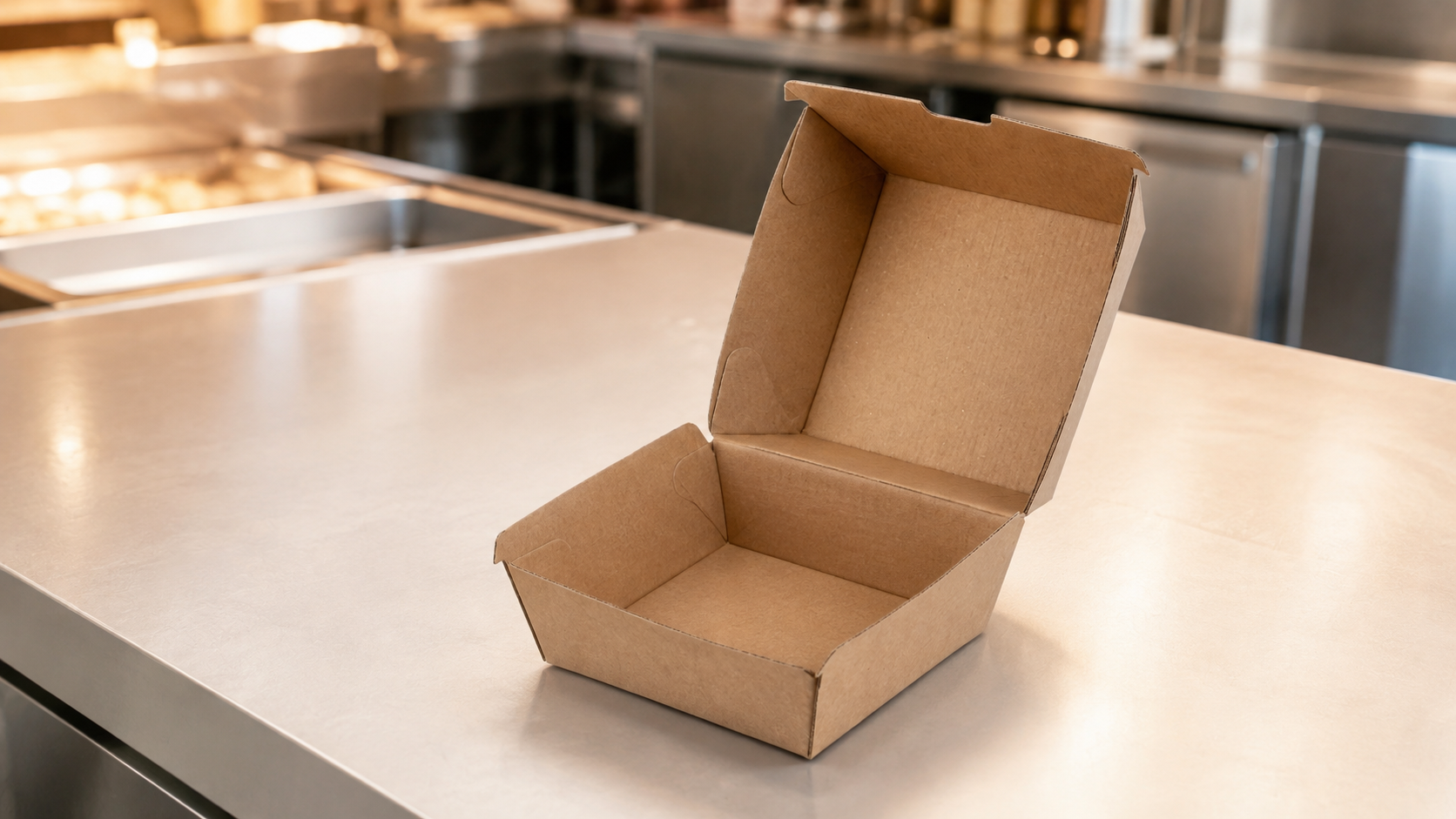
A product record is useful when it gives procurement and operations teams a shared starting point. For example, Takeawaypack's product record identifies the Corrugated Hamburger Box 105mm as a paper product with recorded dimensions of 105 × 105 × 85 mm. Its catalogue description identifies hamburgers, sandwiches, and takeaway fast food as intended uses.
Those details can help a team decide whether to request a sample or run a menu trial. They do not replace on-site testing, supplier documentation, or confirmation of suitability for a particular food and workflow.
For teams building a clearer menu-to-packaging specification, visit Takeawaypack to explore the range and discuss the information needed for an informed selection.