How to Approve Custom Printed Food Packaging Before Production
A production approval should be a documented release, not a casual “go ahead.” Before custom printed packaging enters a full run, lock the final specification, quantities, artwork, labels, quality criteria, timing, commercial terms, and change-control rules so the factory is not forced to interpret incomplete instructions.
2026-08-27 - 5 min read
Summary
A production approval should be a documented release, not a casual “go ahead.” Before custom printed packaging enters a full run, lock the final specification, quantities, artwork, labels, quality criteria, timing, commercial terms, and change-control rules so the factory is not forced to interpret incomplete instructions.
Approval is the point where assumptions become inventory
Production approval commits materials, print capacity, factory time, and downstream delivery plans. A sample that looks right, a quote that has been accepted, or an artwork file sent by email may all be useful milestones, but none alone tells a supplier exactly what to manufacture.
Small omissions can create costly results: an old artwork file is printed, a barcode lands in the wrong position, carton details remain undecided, or a lead time is discussed without being tied to the approved configuration. A real release means the supplier has the complete, final instruction set and does not need to guess.
Keep quote approval, sample approval, and production approval separate
Quote approval confirms price, scope, and often a target quantity. Sample approval confirms that a prototype, print proof, mock-up, or pre-production sample is acceptable. Production approval authorizes the full order using final commercial and technical details.
Do not let a good sample stand in for a production release. The sample can be approved while SKU quantities, final artwork versions, barcode data, carton configuration, defect tolerances, tests, dispatch timing, and the final approver are still open. Close those points in writing before the release.
Build one final, version-controlled specification set
The factory should work from one approved document set—not a mixture of emails, prior samples, and attachments. For each SKU, identify the product name and revision, dimensions and units, material and finish, colour reference or approved sample, key tolerances, performance needs, assembly notes, and component-level specifications where relevant.
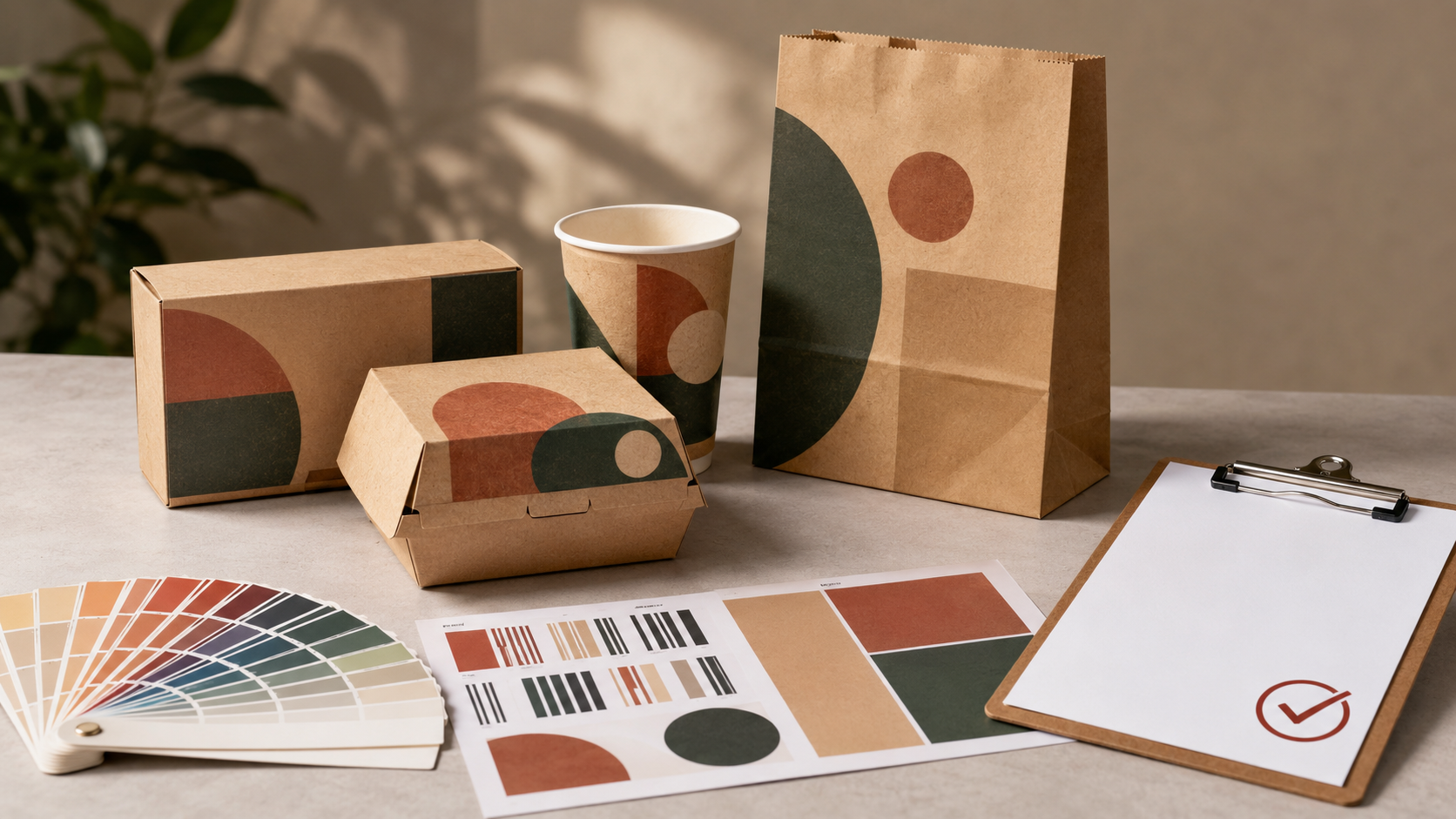
Artwork deserves the same discipline. Name approved files by SKU and version, clearly mark superseded files, and list the exact files in the release message. Include the approved dieline, print-ready artwork, barcode data and placement, carton and pallet labels, plus any required marks or retailer and warehouse labeling rules.
For private-label foodservice packaging, buyers can also ask for a traceable record of custom-print approvals, Pantone colour control, artwork versions, and reprint approvals. TakeawayPack’s knowledge base recognizes those as key screening questions for chain programs. The useful test is simple: can everyone identify the one authorised version for this SKU?
Confirm quantities and the physical pack-out
“10,000 units” is not a complete manufacturing instruction. Confirm units by SKU, any permitted overrun or underrun, inner-pack quantity, case pack, master-carton configuration, carton dimensions or weight where needed, SKU-mixing rules, and known pallet requirements.
This protects receiving and replenishment as well as production. A carton configuration chosen for factory convenience may not match a distributor’s warehouse plan, routing guide, label data, freight cube, or storage system. Set the pack-out before approval, rather than discovering it after stock ships.
Define quality, timing, and commercial conditions
A release should state inspection criteria, applicable testing requirements, acceptance limits, and any permitted variance. It should also establish material, printing, assembly, and quality-control timing; the dispatch date; and the freight assumption.
Commercial points need the same clarity: agreed price, payment timing, Incoterms, freight responsibility, and who bears rework responsibility if defects or delays occur. Identify the final approver, the approval date, and the approved document list. Once production begins, any change should trigger a documented review and re-approval rather than an informal message.
For a multi-SKU brand rollout, ask the supplier to explain the printing method, substrate and colour limits, proofing or acceptance approach, custom-print MOQ, and the timing from artwork approval to first delivery. These are the practical inputs needed to judge whether a proposed programme can be repeated across cups, food boxes, and bags.
Use a release message that leaves no open interpretation
Before authorizing a run, send one release that names the supplier, PO, SKUs, quantities, approved file set, pack-out, quality criteria, delivery target, commercial terms, and final approver. State plainly that open items are closed and that changes require written re-approval.
This does not eliminate every production risk, but it creates a common record for design, sourcing, operations, quality, and the factory. It also makes the next print run easier to manage because the approved configuration, proof, and change history can be traced rather than rebuilt from email threads.
If you are preparing a private-label packaging brief, start by defining the SKU-specific artwork, colour, pack-out, proofing, MOQ, and delivery questions you need answered. Explore packaging options and begin that conversation with TakeawayPack.