How to Choose Digital, Offset, or Flexo Printing for Custom Food Boxes
Digital, offset, and flexographic printing can all be considered for custom food boxes, but they should not be compared as interchangeable labels. The right procurement decision depends on the proposed box structure, expected order quantity, number of versions, colour-critical artwork, content placement, approval process, destination, and quotation evidence.
2026-08-16 - 10 min read
Summary
Digital, offset, and flexographic printing can all be considered for custom food boxes, but they should not be compared as interchangeable labels. The right procurement decision depends on the proposed box structure, expected order quantity, number of versions, colour-critical artwork, content placement, approval process, destination, and quotation evidence.
For catering boxes that carry a contract caterer’s brand, dietary category, allergen communication, and sorting instructions, start with the information that must be legible and stable on the finished pack. Then ask suppliers to state the proposed print process and to quote the same defined configuration at relevant quantities. A process name alone does not establish printable area, colour result, ink or coating suitability, regulatory status, availability, or any commercial outcome for a particular food-box project.
Start with the communication job, not the press name
A printed food box may need to do more than display a logo. In a managed catering programme, it can help staff and recipients distinguish meal groups, dietary categories, service instructions, and order identifiers. That makes the hierarchy of information a practical packaging decision.
Create an artwork brief that separates four types of content:
- brand content, such as the catering or client identity;
- meal-identification content, such as menu name, dietary category, or order grouping;
- safety or operational content, including allergen-related wording or handling instructions supplied and approved by the responsible team; and
- changeable content, such as event names, dates, QR codes, regional versions, or rotating menus.
This separation helps the buyer decide what needs consistent reproduction across a long-running box programme and what may change from one event, location, or order cycle to another. It also prevents a decorative artwork discussion from obscuring critical copy, fold locations, glue areas, or label zones.
What each printing route changes in a custom-box decision
The three processes have different setup, artwork, and production characteristics. The useful question is not which is universally better, but which proposed route fits the defined packaging programme.
Digital printing: useful when versions change often
Digital printing images artwork directly from a digital file rather than relying on conventional printing plates. For a buyer, its most relevant feature is flexibility: it can be considered where artwork versions, personalised content, short promotional cycles, or pilot designs are important.
A catering team may, for example, need one visual system with distinct designs for vegetarian, vegan, halal, gluten-related, or client-specific meal groups. The buyer should ask whether the supplier can quote the required versions as one project and identify how artwork changes affect the proposed configuration and proofing process.
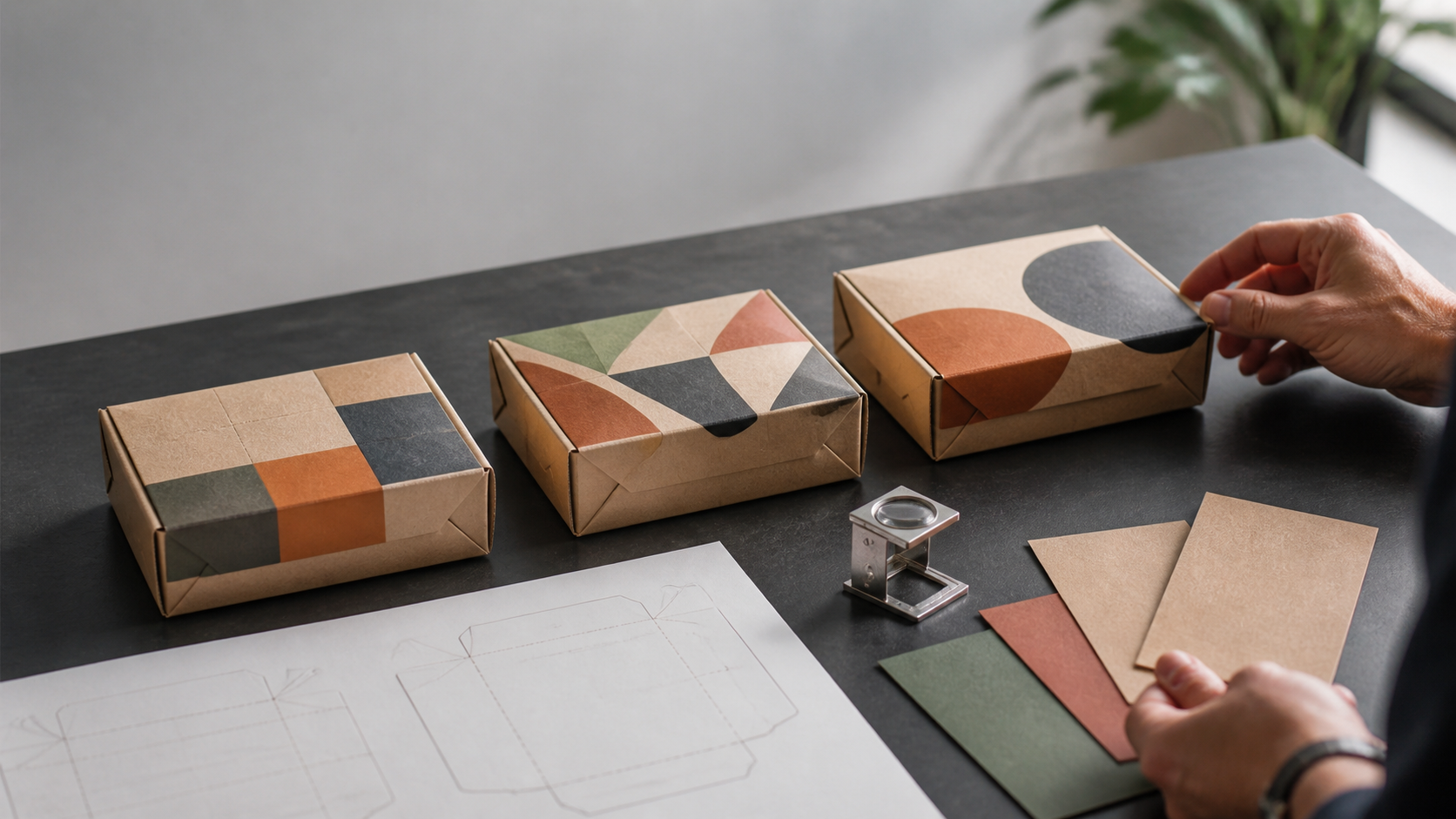
Digital output should still be reviewed on the actual proposed substrate and structure. A screen proof is not a substitute for checking type size, contrast, line work, colour appearance, placement around folds, and the way the final box is assembled. If a specific brand colour is commercially important, state the colour reference in the brief and ask how the supplier proposes to reproduce and approve it.
Offset printing: useful where artwork detail and repeatability are central
Offset printing commonly uses plates to transfer ink to a printing surface. It may be considered for box programmes with detailed graphics, photographic elements, carefully controlled colour, or a stable design used across a planned volume.
For food-box communication, offset is not simply a “premium” choice. Its value must be tied to the actual design. Small reversed text, fine dietary icons, subtle colour differences, or a branded retail-style presentation may justify a closer process discussion. Conversely, a simple one- or two-colour operational design may not need the same artwork complexity.
Ask the supplier to explain the proposed construction as well as the print method. For example, the printing surface, subsequent converting steps, and the box structure can affect how the approved image translates to the finished pack. Request a physical proof or representative sample when the printed result is material to the purchase decision.
Flexographic printing: useful for bold artwork and sustained programmes
Flexography uses flexible printing plates and is often associated with direct printing on paperboard or corrugated formats. It can be a candidate when the structure, artwork, and quantity profile suit the supplier’s flexographic process.
Design discipline matters in a flexo proposal. Bold colour blocks, clear symbols, generous type, and uncomplicated registration requirements can be easier to evaluate than dense photographic artwork or very fine copy. That does not mean flexo cannot be used for a particular design; it means the buyer should ask the supplier to assess the exact file, substrate, and printable areas rather than assuming feasibility from a general description.
Where allergens, dietary categories, or sorting instructions are involved, legibility is a functional requirement. Keep critical wording away from folds, cut edges, glue flaps, and areas that may be obscured after closing. Confirm the final placement on the approved dieline and proof.
Use order quantity as quotation evidence
Quantity changes the setup and production assumptions behind a finished box, but no generic quantity threshold should decide a real project. Box dimensions, board, colour count, print coverage, finishing, structure, number of versions, destination, and the supplier’s own production plan can all change the proposal.
Instead of treating one process as the automatic commercial choice, issue the same controlled RFQ at the quantities that matter to the programme. For each quantity, request that the supplier identify:
- the proposed box structure and material description;
- the proposed printing method;
- the number of artwork versions and colours covered by the quotation;
- any plates, proofs, tooling, finishing, or artwork-preparation assumptions;
- the printable zones and excluded zones on the dieline;
- the quoted commercial assumptions and destination; and
- what would change if the design, quantity, version count, or destination changes.
The point is not to make suppliers promise a result before reviewing the project. It is to make competing quotations comparable. A quotation attached to an undefined structure or a different version count should remain a clarification item, not a decision-ready comparison.
Plan version changes before choosing a core process
Many catering and food-service programmes have a stable outer design but change operational information frequently. Trying to force all content into one print decision can create unnecessary rework or inconsistent control.
Separate fixed and variable artwork
Map the content into a fixed layer and a variable layer. The fixed layer may include the primary brand system, basic colour fields, and recurring product information. The variable layer may include event names, menu groups, dates, customer-specific branding, lot-related identifiers, or final dietary markers.
This exercise can reveal whether the programme needs multiple printed versions, a separate label workflow, or another controlled method for applying approved variable information. The responsible food business should approve the wording and process for allergen and dietary communication; a packaging-print decision does not replace that responsibility.
Treat every version as a controlled change
A new colourway, icon, language, QR code, or dietary statement is not only an artwork change. It can affect proofing, file control, inspection points, and the risk of mixing variants during packing.
Use version IDs in the artwork file name, proof record, purchase order, and receiving check. Require the supplier to identify which artwork revision is quoted and approved. If a box is intended for different destinations, do not assume a graphic or claim approved for one destination can be reused elsewhere without review.
Make colour decisions with approved physical evidence
Colour can be a preference, a brand requirement, or a meaningful sorting cue. Its importance should be written into the brief. If staff use colour to distinguish meal categories, check the design under the lighting and handling conditions where the boxes will actually be packed and handed over.
Specify what must match
State whether the requirement is a general visual match, a specified brand reference, or a clear distinction between categories. Provide approved artwork files and any colour references. Avoid relying on a monitor view as final evidence: substrate, ink system, print coverage, coatings, and production conditions can change the perceived result.
Review critical copy separately from colour
A visually successful proof can still fail its operational purpose if the smallest copy is hard to read, an icon sits on a fold, or a glue flap covers a category marker after assembly. Review an assembled sample from the normal viewing angles. Check the front, sides, lid, bottom, and closed condition—not only the flat printed sheet.
Tie structure and print area together
A food box’s dieline determines more than its shape. It defines folds, cut lines, panels, closure zones, glue areas, and the visible surfaces available after the box is erected. The structure therefore needs to be confirmed before artwork placement is final.
Request the actual dieline for the proposed configuration and mark:
- the primary branding panel;
- the panel used to identify the meal group;
- the intended location for approved allergen-related or dietary information;
- any areas reserved for operations, labels, or date coding; and
- areas where printing may be limited by folds, glue, closure features, or converting tolerance.
Do not claim that a particular TakeawayPack box has a given printable area, coating, ink system, or process compatibility unless the supplier has confirmed the exact SKU or custom structure. The same caution applies to material suitability, food-contact documentation, and any destination-specific requirement.
Build an approval path before production
A clear approval path reduces the chance that an outdated logo, wrong dietary version, or incomplete instruction reaches the packing line. Define who owns content, brand review, packaging review, and final sign-off.
Use a proof checklist
Before approving a proof or sample, check at minimum:
- the box SKU, dimensions, structure, and dieline revision;
- the artwork revision and version identifier;
- all logos, meal categories, symbols, and approved text;
- placement of critical content after the box is folded and closed;
- readable contrast and type size in the finished condition;
- the intended print method, colour assumptions, and any stated finishing;
- the proposed destination and commercial assumptions; and
- the evidence needed for any food-contact, environmental, or regulatory statement.
Keep the approved file, proof, sample notes, quotation, and change log together. If any of these items changes, review whether a new proof, sample, or quotation is needed.
Include destination and evidence in the buying decision
A box programme can be operationally sound yet still be incomplete as a procurement decision if its destination is not known. Destination can affect documentation requests, language, claims, labelling expectations, import arrangements, and the evidence a buyer needs to evaluate.
Ask for supporting records that identify the proposed configuration, not a generic company statement. The relevant record may be a specification, drawing, sample identification, quotation, artwork approval, or—where applicable—documentation that can be reviewed for its scope. Match the evidence to the SKU or agreed custom structure, intended use, quantity, and destination.
This is especially important for statements about food contact, materials, recyclability, compostability, PFAS, performance, or compliance. Those matters should be assessed from configuration- and destination-specific evidence; they should not be inferred from the print process or a broad supplier claim.
A practical decision sequence for custom printed food boxes
Use this sequence to compare digital, offset, and flexo proposals without overclaiming what any method can deliver:
- Define the box’s purpose and the content that must remain legible.
- Confirm the proposed structure and obtain its dieline.
- Separate fixed brand graphics from variable catering or meal-identification content.
- Issue a common RFQ for the relevant quantities, versions, colours, and destination.
- Ask each supplier to identify the proposed process and all commercial and technical assumptions.
- Review physical proofs or samples for the actual substrate and assembled box.
- Verify that critical text, dietary identifiers, and approved instructions appear in usable positions.
- Compare quotations only after the configuration and evidence basis are aligned.
- Document approvals and treat later changes as a controlled re-review.
Discuss a custom food-box RFQ with TakeawayPack
For a custom food-box project, TakeawayPack can discuss the product category, custom requirements, artwork details, estimated quantity, and destination through an RFQ conversation. Bring the box structure or target format, dieline if available, artwork versions, critical copy, expected quantity, and destination so the proposed configuration can be reviewed on a defined basis. Start with TakeawayPack to discuss the project.