How Multi-Brand Kitchens Approve Custom Packaging Remotely with Digital Proofs and Samples
When a brand owner and a cloud kitchen operate in different locations, approving custom packaging before a full print run comes down to a repeatable remote workflow built on digital proofs and physical samples. This guide explains the sample types to request, what each one verifies, and how to run a remote approval process brand-by-brand so you can commit to production with confidence. The goal is simple: confirm structure with unprinted samples, confirm artwork with a digital proof, confirm color and finish with a pre-production sample, and only then start mass production.
2026-08-11 - 7 min read
**Summary:** When a brand owner and a cloud kitchen operate in different locations, approving custom packaging before a full print run comes down to a repeatable remote workflow built on digital proofs and physical samples. This guide explains the sample types to request, what each one verifies, and how to run a remote approval process brand-by-brand so you can commit to production with confidence. The goal is simple: confirm structure with unprinted samples, confirm artwork with a digital proof, confirm color and finish with a pre-production sample, and only then start mass production.
Why Remote Approval Needs a Structured Workflow
When several virtual brands share one kitchen, each brand typically wants its own packaging. That means multiple SKUs, each with its own structure, artwork, and print requirements. Approving them remotely adds a layer of risk because you cannot see and hold every sample in person.
The practical fix is to manage packaging as a series of checkpoints rather than as one big decision. Each checkpoint verifies a specific thing: the box fits the food, the artwork is correct, and the final color matches what you approved. When these steps are confirmed in order, the risk of a costly mistake drops sharply.
For a multi-brand rollout, the useful question is not only "how long will custom printing take." It is also "what must be decided and approved before this SKU can move forward." Different SKUs can have different materials, sizes, print requirements, and quantities, so treating each one as its own controlled item is the safer approach.
The Sample Types to Request for Remote Approval
1. The Digital Proof
The digital proof is the first checkpoint. It is usually a PDF that shows the dieline, or flat shape, of the box with your artwork applied. Its purpose is to confirm content and placement: spelling, logo position, barcode placement, and whether the artwork extends to the bleed lines.
A digital proof is two-dimensional. It cannot show how the box feels or how colors look on real paper. That is why you should treat it as a content and placement check, not as a color or material check.
For custom printed orders, TakeawayPack prepares a PDF dieline simulation from the customer's files, and production starts only after the proof is approved in writing. That written approval is an important project gate.
2. The Structural "White" Sample
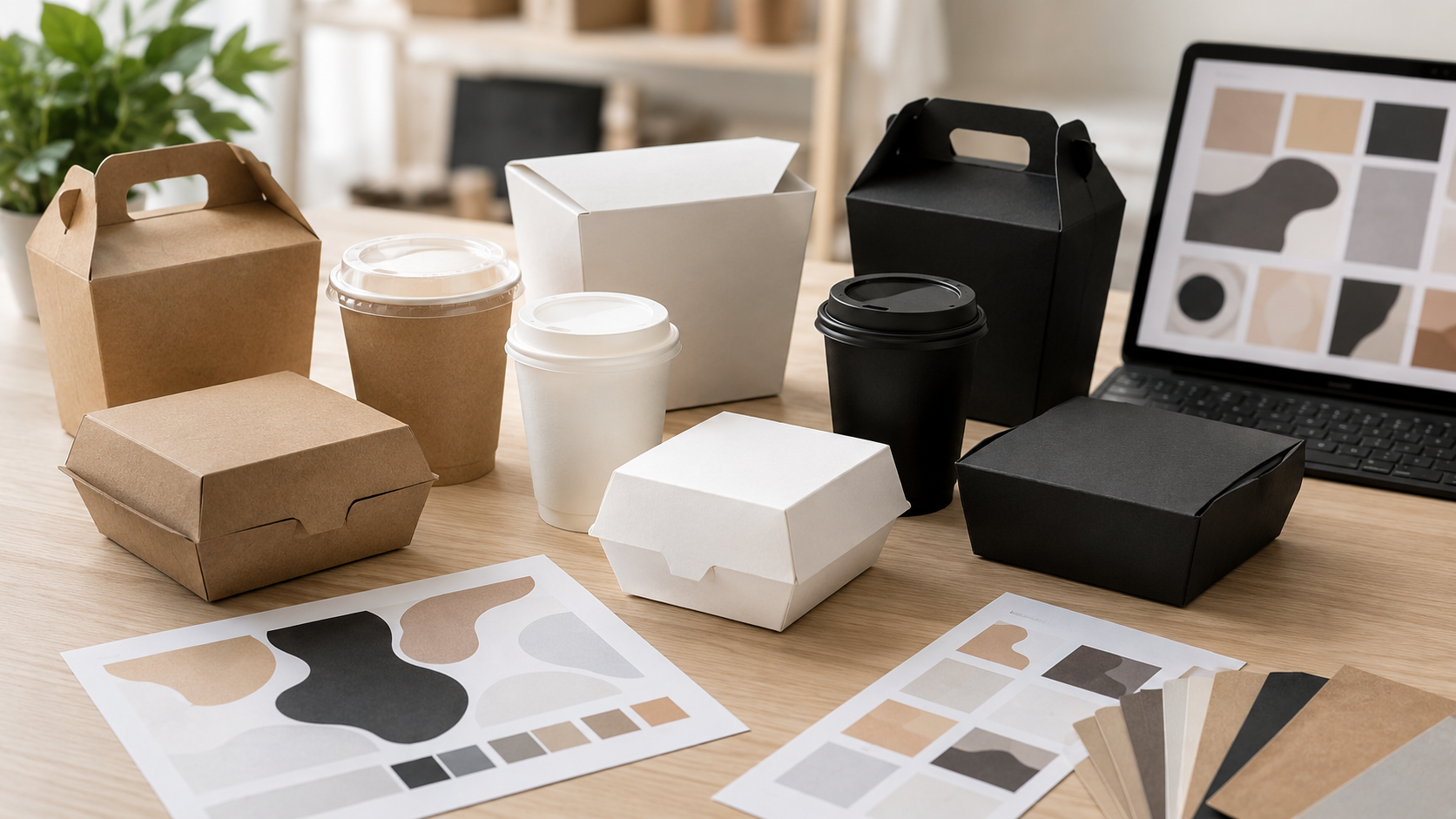
The white sample is an unprinted prototype cut on a CAD table using the paper stock you intend to use. It is blank, which is why it is called "white." Its purpose is to verify dimensions and fit.
You should put your actual product inside the sample. Does it rattle? Is it too tight? Does the box close properly? You can also use it for drop tests and to check stacking strength.
This is the step that tells you whether the box works as a box before you spend money on printing plates.
3. The Digital Print Sample
If you want to check the layout of graphics on the physical box without paying for production plates, ask for a digital print sample. It is usually printed on a large-format inkjet printer and then cut.
Its purpose is to visualize how the artwork sits on the three-dimensional box. It helps you see if a logo is covered by a flap or if text is too close to a fold.
One important limitation: digital print colors will not match mass production. Digital printing uses toner or inkjet, while mass production uses wet ink. Use this sample for layout, not for final color approval.
4. The Pre-Production Sample (PPS)
The pre-production sample is the real thing. A true PPS is made using the actual mass production equipment: the press, the die cutter, and the final finish such as foil, UV, or lamination. It is more expensive because the factory sets up the production line for a single unit.
Its purpose is to verify everything at once: color accuracy, print finish, glue quality, and material feel. For high-value or multi-brand orders where packaging consistency matters, this is the sample to demand. If the PPS is wrong, the mass production will be wrong.
5. The Golden Sample
Once you approve the pre-production sample, it becomes the golden sample. You sign and date two copies: one for you to keep and one to send back to the factory.
It serves as the reference standard for quality control. If the final shipment arrives and the color is different, you compare it to the golden sample to identify the defect. This is especially useful when you are approving remotely and cannot inspect every batch in person.
6. The Shipment Sample
The shipment sample is pulled randomly from the final production run, packed, and shipped to you before the rest of the cargo leaves the factory. Its purpose is to verify that mass production matches the golden sample.
It lets you catch any last-minute problems before the goods are loaded. For a multi-brand kitchen, this is a useful final check that each brand's packaging came out as approved.
A Remote Approval Workflow for Multi-Brand Kitchens
Running approval remotely works best when you follow a strict sequence and keep records per brand and per SKU. Here is a practical order:
- 1. **Approve the white sample** to confirm the box works structurally and fits your food.
- 2. **Approve the digital proof** to confirm the artwork, logo, and copy are correct.
- 3. **Approve the pre-production sample** to confirm color and finish.
- 4. **Start mass production** only after the pre-production sample is approved.
For remote teams, keep everything documented. Each SKU should reference its own artwork version, structure, color reference, print position, and approval owner. This reduces ambiguity when the brand owner and the kitchen are in different places.
Be aware of color management limits. If you approve a digital sample, do not expect offset production to match it perfectly. If color is critical, you need a pre-production sample or a press check. Test samples under standardized lighting to avoid surprises from different light sources.
What to Include in Your RFQ for Custom Packaging
When you are building a remote approval workflow across several brands, a clear request for quotation helps from the start. For each SKU, include:
- Product or category (cup, bowl, box, container, lid, bag, or cutlery)
- Material
- Size or capacity
- Expected quantity
- Logo, color, and print requirements
- Destination port or country
- Any required lid match, carton format, or packaging instruction
Supplying these details early gives both sides a clear basis to discuss the specification rather than relying on an incomplete visual reference. TakeawayPack's RFQ can collect exactly these details, and the company can discuss structure, coating, capacity, printing, lid matching, and carton packaging during the inquiry stage.
How Sampling and MOQ Work for Custom Orders
For custom printed SKUs, the production approach is based on the approved proof and the specific quotation. MOQ can be flexible: some stock items may support trial orders, while custom MOQ depends on the product and production method. Because there is no single answer that fits every SKU, the MOQ and lead time for a custom item should be confirmed in its own quotation rather than assumed from another product or order.
If you are launching several virtual brands at once, you can treat each brand's packaging as its own controlled SKU. Sample and approve each one, then commit to production for the whole set. This keeps the approval process manageable and helps you avoid mixing up brands when the packaging is printed.
TakeawayPack Can Help You Approve Custom Packaging Remotely
TakeawayPack is a foodservice packaging brand and sourcing coordinator that works with multiple packaging manufacturers. For custom printed orders, it prepares a PDF dieline simulation from your files and starts production only after you approve the proof in writing. During the inquiry and project alignment stages, it can provide samples, drawings, or print-file alignment, and help with packaging and export handover communication.
The catalog covers Cups, Bowls, Boxes, Containers, Trays, Lids, Bags, and Cutlery, so a multi-brand kitchen can source several packaging types from one partner. If you are running multiple virtual brands from one kitchen and want a clear remote approval path for your custom packaging, start by discussing your SKU-by-SKU requirement with the TakeawayPack team. Visit https://takeawaypack.com to request a quote and begin the sampling conversation.