Seasonal Dessert Packaging Without the Leftover Nightmare: A Two-Campaign Strategy for Restaurants
Running two limited-time dessert campaigns — one for Mid-Autumn Festival and one for Christmas — can double your seasonal revenue, but it also doubles the inventory risk if every box, bag, and sleeve is printed with a specific holiday motif.
2026-09-07 - 11 min read
Running two limited-time dessert campaigns — one for Mid-Autumn Festival and one for Christmas — can double your seasonal revenue, but it also doubles the inventory risk if every box, bag, and sleeve is printed with a specific holiday motif. Many restaurant owners order a single fully custom run, only to find themselves sitting on mooncake boxes in January and Santa-print carry-out bags in March. This article lays out a layered packaging strategy that keeps your base boxes evergreen, moves the festive message onto removable components, and lets you reuse the same core inventory across both campaigns.
The Core Problem: One Campaign, One Box, One Write-Off
When a restaurant commissions a custom dessert box with gold foil mooncakes and a Mid-Autumn greeting, that box is married to the calendar. After the festival ends, it cannot be given out with a regular brownie order. The same applies to a Christmas-themed clamshell printed with holly and red ribbon art. Once the season passes, leftover stock becomes dead stock.
The issue is compounded by minimum order quantities (MOQs). A typical custom printed paper-board box from a packaging supplier may carry an MOQ of 1,000 units. If you order 1,000 Mid-Autumn boxes and only sell 600 dessert packs during the four-week campaign, 400 boxes go straight to storage. Do the same for Christmas, and you double the problem. Two campaigns, two separate custom runs, twice the leftover risk.
The fix is not to skip seasonal packaging — it is a proven revenue driver. The fix is to separate the permanent structure from the seasonal decoration.
A Two-Layer Architecture for Dual Campaigns
Instead of designing a unique box for each holiday, build a single base structure that works year-round, then layer the holiday identity onto removable components. This approach mirrors how smart packaging buyers have been managing seasonal inventory for years.
| Layer | What It Is | Examples | Inventory Role |
|---|---|---|---|
| Evergreen base | The structural box, bowl, or bag that holds the dessert | Plain kraft or white paper dessert boxes, window cake boxes, sauce cups, paper bags | Can be sold before, during, or after either campaign. Order against baseline demand. |
| Festive overlay | Printed or branded components that carry the holiday message | Custom stickers, printed sleeves, gift bags with seasonal art, branded seals, tissue paper | Campaign-specific. Order in smaller quantities against the campaign forecast. |
The base box never changes. It carries your permanent logo or a neutral brand mark. The festivity lives on the sticker, the sleeve, or the gift bag — components that are cheaper to produce, easier to store, and much simpler to reorder.
Why Stickers and Sleeves Beat Fully Custom Boxes for MOQ and Risk
A fully custom printed folding carton with full-color offset printing usually requires an MOQ of 1,000 to 3,000 per design. That is a big bet for a two-month campaign. By contrast, custom stickers and band sleeves can be ordered in quantities as low as 500 pieces, and digital printing turns even 100–200 units into a viable order.
Compare the exposure rather than the unit price:
- Fully custom holiday box. Highest per-unit cost, highest MOQ, and zero salvage value once the holiday passes. Every unsold box is a write-off.
- Evergreen base box. Moderate per-unit cost, but the units keep earning after the campaign because they serve everyday dessert orders. Effective write-off risk approaches zero.
- Custom sticker. Lowest per-unit cost of any printed component and the smallest order commitment. Leftovers cost a fraction of a leftover box run.
- Custom printed sleeve or band. Low cost, flat-packed, and cheap to store. Reorderable mid-campaign if the promotion outperforms.
The principle is simple: the seasonal element should always be the cheapest and most replaceable part of the package. Ask any supplier to quote each layer separately so you can see where the risk actually sits. Suppliers like takeawaypack.com offer custom printing on stickers, seals, and paper bags with MOQs as low as 500–1,000 units, which means you can test a holiday design without betting the kitchen budget on it.
It is also worth asking whether the overlay can be produced digitally rather than with plates. Digital printing carries no plate charge, so the setup cost does not have to be amortized over thousands of units. That is exactly what makes a 500-piece sticker run economically sane for a four-week campaign, while a plate-based custom carton at the same quantity would be priced punishingly per unit.
Applying the Architecture to Mid-Autumn Festival and Christmas
Mid-Autumn Festival Campaign (September–October)
For a mooncake or seasonal dessert menu, the evergreen base could be a window-lidded cake box or a rigid two-piece gift box in a neutral kraft finish. Add the festive overlay:
- Custom sticker: A round sticker with moon phases, osmanthus flowers, or a lantern motif applied to the box lid.
- Printed sleeve: A kraft band that wraps around the base box, printed with a "Mid-Autumn Harvest" message in warm gold and deep red.
- Gift bag: A small paper bag with the same seasonal art, used for handoff or takeaway.
After the festival, peel off the sticker, remove the sleeve, and the same box becomes a standard dessert box. No leftover holiday imagery, no dead stock.
Christmas Campaign (November–December)
The same base box gets a new identity:
- Custom sticker: A snowflake, pine tree, or star motif in white and green.
- Printed sleeve: A red or forest-green band sleeve, flat-packed and slid over the box.
- Gift bag: A matching holiday paper bag with the same design family.
The base box is identical. The festive components are swapped. Your warehouse holds one box SKU and two sets of flat-packed overlays instead of two fully custom box SKUs.
Designing the Base Box for Maximum Reuse
The evergreen box is the backbone of this strategy. A few design rules will keep it working across both campaigns and beyond:
- Keep the year and holiday names off the box. A neutral "Dessert Collection" phrase or a simple logo works for every season.
- Use one permanent color scheme. Kraft, white, or solid black — choose a finish that does not clash with red-and-gold (Mid-Autumn) or red-and-green (Christmas).
- Reserve a sticker zone. Leave a smooth, unprinted area on the lid or front panel where a seasonal sticker applies cleanly. The same zone works for both holidays.
- Choose a sleeve-friendly dieline. A rectangular or square box with straight sides (no tapered or curved fronts) lets a sleeve slide on and off without wrinkling.
If you are sourcing from a supplier such as takeawaypack.com, their standard window cake boxes, kraft dessert boxes, and rigid two-piece gift boxes are already neutral in finish and accept sticker or sleeve decoration without modification.
Matching Base Formats to Different Dessert Types
Not every dessert travels well in the same container, and picking the wrong base format undermines the whole strategy. If the base box only suits mooncakes, it will not carry your Christmas dessert and you have lost the reuse benefit. Choose a base format that works for both campaigns and for your everyday menu.
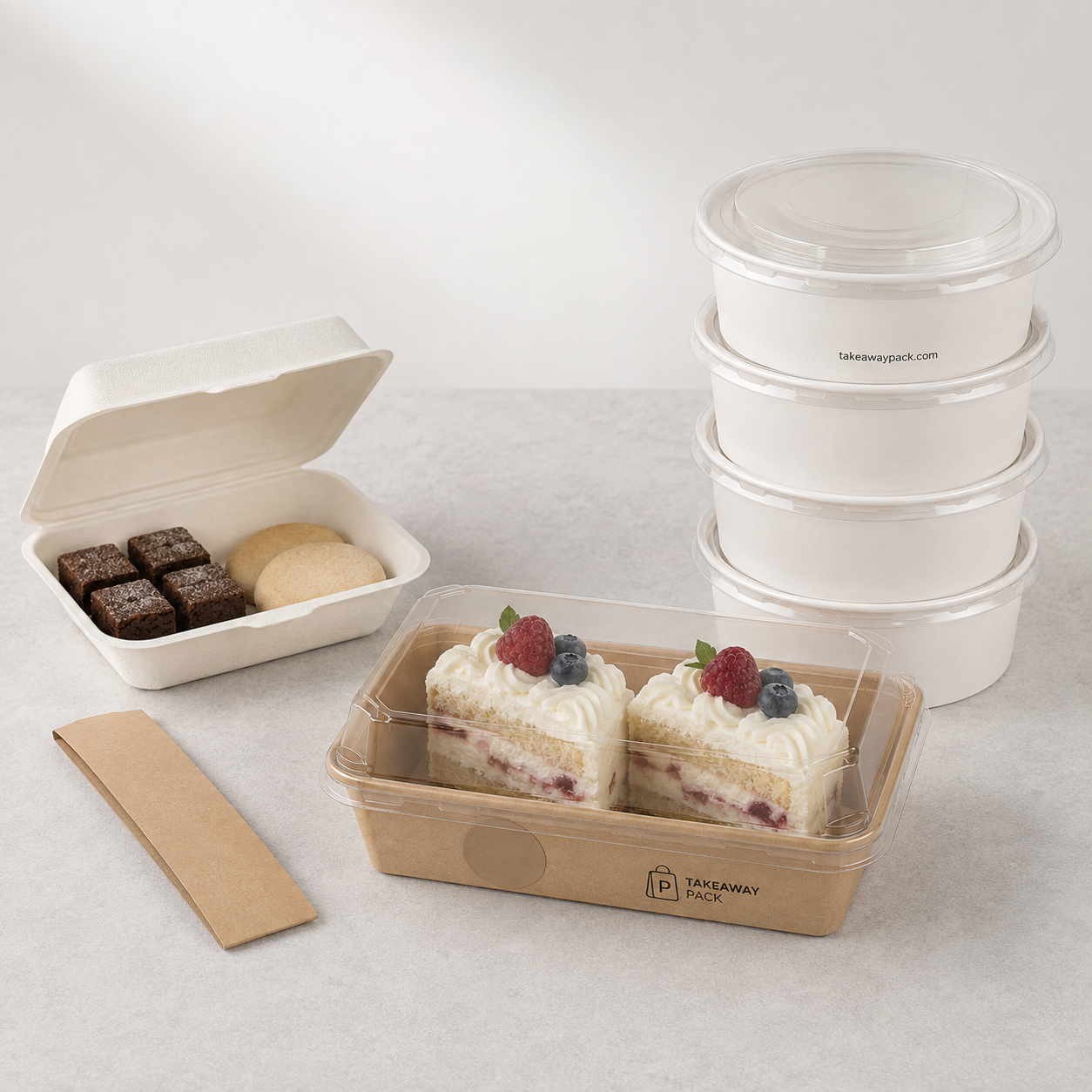
- Layered cakes, slices, and tarts. A window box lets the product sell itself and stays visually neutral. The window also means the sticker or sleeve does not have to compete with the product for attention.
- Puddings, mousses, and soft-set desserts. A lock-lid PP bowl or a clear PET container holds shape during transport and resists leaking. These are already stock items in most catalogs, so no custom structure is needed.
- Cookies, brownies, and pastries. A kraft dessert box or compartment tray keeps items separated. Compartment trays are especially useful when a campaign bundles multiple small items as a tasting set.
- Warm desserts and sauced items. Molded pulp or clamshell boxes handle heat and moisture better than plain board. Pair them with small sauce cups so a drizzle or syrup ships separately.
- Multi-item gift sets. A rigid or two-piece box with a paper insert lets you change the bundle contents without changing the outer shell.
Because these are standard stock formats rather than bespoke structures, they carry no custom tooling cost. You are only paying for custom work on the overlay layer. A supplier such as takeawaypack.com stocks lock-lid PP bowls, window boxes, clear PET containers, compartment trays, molded pulp and clamshell boxes, cake boxes, and sauce cups, which means the base layer can usually be assembled entirely from existing formats.
What to Send Your Supplier for an Accurate Quote
Vague inquiries produce vague quotes and slow the whole timeline. If you want a usable comparison across the two campaigns, send the supplier a single brief covering both at once. Include:
- Base box dimensions and capacity, or the dessert dimensions if you want the supplier to recommend a fit.
- Both campaign windows and dates, so production and freight can be scheduled against a single calendar rather than two separate rush orders.
- Quantity range for each layer, split into low, base, and high scenarios. Ask for pricing at each tier.
- Overlay specifications — sticker diameter and finish, sleeve width and dieline, gift bag size and handle type.
- Artwork status, including whether files are print-ready or still in draft, and whether you need a dieline template.
- Sample requirements. Always request a physical sample of the base box with the actual sleeve and sticker applied before committing to bulk. A design that looks correct on screen can misalign on a real box.
Quoting both campaigns together often produces a better outcome than quoting them separately. The base box can be ordered as a single larger run covering both seasons plus baseline demand, which improves your position on the volume tier, while the overlays stay in small campaign-sized batches.
Forecasting Demand Without Overordering
Even with a modular system, you still need to forecast how many base boxes and how many seasonal overlays to buy. A simple worksheet can help.
| Planning Input | Example | Notes |
|---|---|---|
| Average weekly dessert orders (non-seasonal) | 60 per week | Use last 8 weeks of actual orders, not foot traffic |
| Campaign selling window | 4 weeks (Mid-Autumn) | Multiply: 60 × 4 = 240 base units |
| Expected seasonal uplift | 40% | Estimate based on prior promotions or comparable holidays |
| Base order quantity | 240 + 40% = 336 units | Round up to 350 for safety |
| Seasonal overlay quantity | 350 sets | Stickers, sleeves, bags — order the same as base boxes |
| Reorder gate | 2 weeks before campaign end | After this point, switch to evergreen-only packaging |
The base box quantity is tied to your normal demand plus a seasonal uplift. The overlay quantity is tied only to the campaign. If the campaign undersells, the overlays are a small loss; the base boxes continue to serve everyday orders.
Production Calendar: Planning Backward from the Campaign
Seasonal packaging requires lead time. A typical timeline for custom printed overlays from a US-focused supplier is:
- 8 weeks before campaign: Freeze dessert menu, box size, and overlay design.
- 6 weeks before: Approve artwork and dieline. Order physical samples.
- 4–5 weeks before: Confirm bulk production schedule and freight in writing.
- 3 weeks before: Production completes. Overlays and base boxes ship.
- 1 week before: Arrival and quality check. Begin staging for campaign launch.
For Mid-Autumn Festival (late September), start planning in late July. For Christmas, start in early October. Running both campaigns means the production calendar overlaps — but because the base box is the same, you only need to manage the overlay orders through the same timeline.
Storage and Changeover at the Restaurant
A modular system is also easier to manage at the store level.
- Base boxes: Store in a single location. Use for all dessert orders year-round.
- Seasonal overlays: Store in a labeled bin. When the campaign starts, train staff to apply the sticker or slide on the sleeve during packing.
- Changeover: At campaign end, remove the remaining overlays and store them for next year or discard. The base boxes stay in service.
No separate storage zones for holiday-specific boxes. No confusion about which box goes with which season. The pack line changeover takes minutes, not hours.
Common Questions About Dual-Campaign Dessert Packaging
Can I use the same overlay design for both years? Yes — if you skip the year number on the design. A "Mid-Autumn Collection" sticker works in 2026 and 2027. A "2026 Mid-Autumn Collection" sticker forces a redesign next year. Keep the year off the artwork to extend the shelf life of the overlay.
What if the base box runs out during the campaign? Order base boxes against normal demand plus a seasonal buffer. If you run low, the base box is a standard SKU that can be reordered quickly. You can also use a different neutral box temporarily — the overlay still fits.
How do I handle gift bags for the two holidays? Order a small run of custom printed paper bags per campaign (e.g., 500 bags per holiday). The bags are flat-packed, low-cost, and the least reusable component. If they sell out, switch to the standard branded bag. Gift bags are the easiest component to keep lean.
Will a sticker look as premium as a printed box? A well-applied sticker on a quality base box, especially with foil or embossed finish, can look intentional and premium. Many gifting brands use sticker-and-box combinations deliberately to create a "limited edition" feel without the cost of a full custom run.
What MOQ should I look for? Aim for a supplier that offers base box MOQs around 1,000 units and overlay MOQs (stickers, sleeves, bags) as low as 500 units. Suppliers like takeawaypack.com offer custom printed paper bags and stickers from 500–1,000 units, making it feasible to run two campaigns without committing to a full container of each.
Building a System That Works Next Year Too
The real value of this layered approach compounds over time. Once you have one evergreen base box and two sets of seasonal overlays, next year's campaigns are simply a reorder of the overlays — or a refresh of the artwork if you want to change the design. The base box stays the same. The MOQ risk stays on the small, replaceable components. The leftover inventory is measured in stickers, not in boxes.
If you are planning your Mid-Autumn and Christmas campaigns and want to compare base box options and overlay pricing, reach out to a US-based packaging supplier like takeawaypack.com. Their team can walk you through the MOQ tiers, sample process, and lead times for a three-component system — base box, seasonal sleeve, and festive sticker — that gives you two distinct holiday looks from one inventory commitment.
Send both campaign windows, your dessert dimensions, and a low/base/high quantity range in a single brief, and ask for the layers to be quoted separately. That one request will tell you more about your real leftover exposure than any amount of internal spreadsheet work.
Contact Takeawaypack to discuss your campaign calendar and get a quote for a dual-season packaging system.