How Specialty Coffee Shops Build a Consistent Brand Identity with Low-MOQ Cups and Takeaway Bags
Specialty coffee shops serving growing takeaway and delivery volumes need packaging that looks unified across every touchpoint — but the usual minimum order quantities for fully custom printed cups can feel risky when the brand is still evolving.
2026-09-03 - 9 min read
Summary: Specialty coffee shops serving growing takeaway and delivery volumes need packaging that looks unified across every touchpoint — but the usual minimum order quantities for fully custom printed cups can feel risky when the brand is still evolving. This article walks through a practical, step-by-step approach: starting with low-commitment items like cup sleeves and sealing stickers, expanding to printed cups and carrier bags only after the visual identity is tested, and keeping every piece in the same color system and material language. The goal is a repeatable brand moment that travels beyond the counter, whether the customer picks up in-store, orders through a delivery app, or carries a drink to the office.
Why Brand Consistency Matters for Takeaway and Delivery
The moment a customer walks out of a coffee shop, the packaging becomes the brand. A cup seen on a desk, a sleeve photographed for social media, or a carrier bag carried through a parking lot — each is a brand impression that costs nothing beyond the packaging itself. But when the cup comes from one supplier, the sleeve from another, and the carrier bag from a third, the look can feel disjointed.
For specialty coffee shops, where the customer experience is part of the product, an inconsistent takeaway package sends the wrong signal. One drink might leave the counter in a plain white cup with a kraft sleeve, while another goes out in a branded cup with a mismatched lid sticker. The result is a brand that looks unfinished, even when the coffee inside is excellent.
Building a consistent identity doesn't require a massive upfront order. With flexible minimum order quantities, coffee shops can test individual pieces, measure customer response, and scale the elements that work.
Which Packaging Items to Customize First
Not every packaging item needs to be custom-printed from day one. The most effective approach is to prioritize based on visibility — the items customers hold longest and see most often — and on MOQ, choosing items that are easier to test in small batches first.
Cup Sleeves — The Low-Risk Starting Point
Cup sleeves are one of the most practical first items to customize. A sleeve sits in the customer's hand for the full life of the drink, visible to anyone nearby. Because sleeves use less material than a full cup, they are often available at lower MOQs and can be produced in smaller test runs.
A sleeve also works across multiple cup sizes when the cups share a rim diameter. Because Takeawaypack's 8 oz through 22 oz double-wall paper cups all use a 90 mm top diameter, one sleeve spec can serve the whole hot-drink line — though exact fit still depends on cup style and should be confirmed against a sample. For coffee shops using double-wall paper cups — which already provide insulation — a sleeve is not needed for heat protection, but it remains a valuable branding surface for logo placement, a tagline, or seasonal artwork.
Takeawaypack's catalog includes 90 mm cup sleeves sized around an 8 cm top and 7 cm bottom diameter at 5.5 cm tall, plus a 98 mm transparent sleeve for larger cold cups. Sleeve MOQ is flexible and confirmed on quotation, which makes a sleeve a realistic first custom item for a café that wants to prove the artwork before printing cups.
Sealing Stickers — The Delivery Signature
For delivery orders, the sealing sticker is often the first branded element the customer touches. It closes the lid, secures the bag, and signals that the order was handled with care. Stickers are also among the lowest-cost custom items to produce, and small test runs are generally easier to arrange than a full cup print run.
A well-designed sticker can carry the shop's logo, a thank-you message, a QR code linking to the loyalty program, or a hand-written style note. Because stickers are easy to change between runs, they are ideal for testing different messages or seasonal campaigns before committing to a larger print run on cups or bags.
Printed Cups — The Centerpiece of the Brand
A fully printed cup is the most visible packaging surface a coffee shop owns. It wraps around the entire drink for the whole time the customer is holding it, and it appears in photos, office meetings, and public spaces. But printed cups also require more careful planning, because the design covers a larger area and the MOQ is typically higher than for sleeves or stickers.
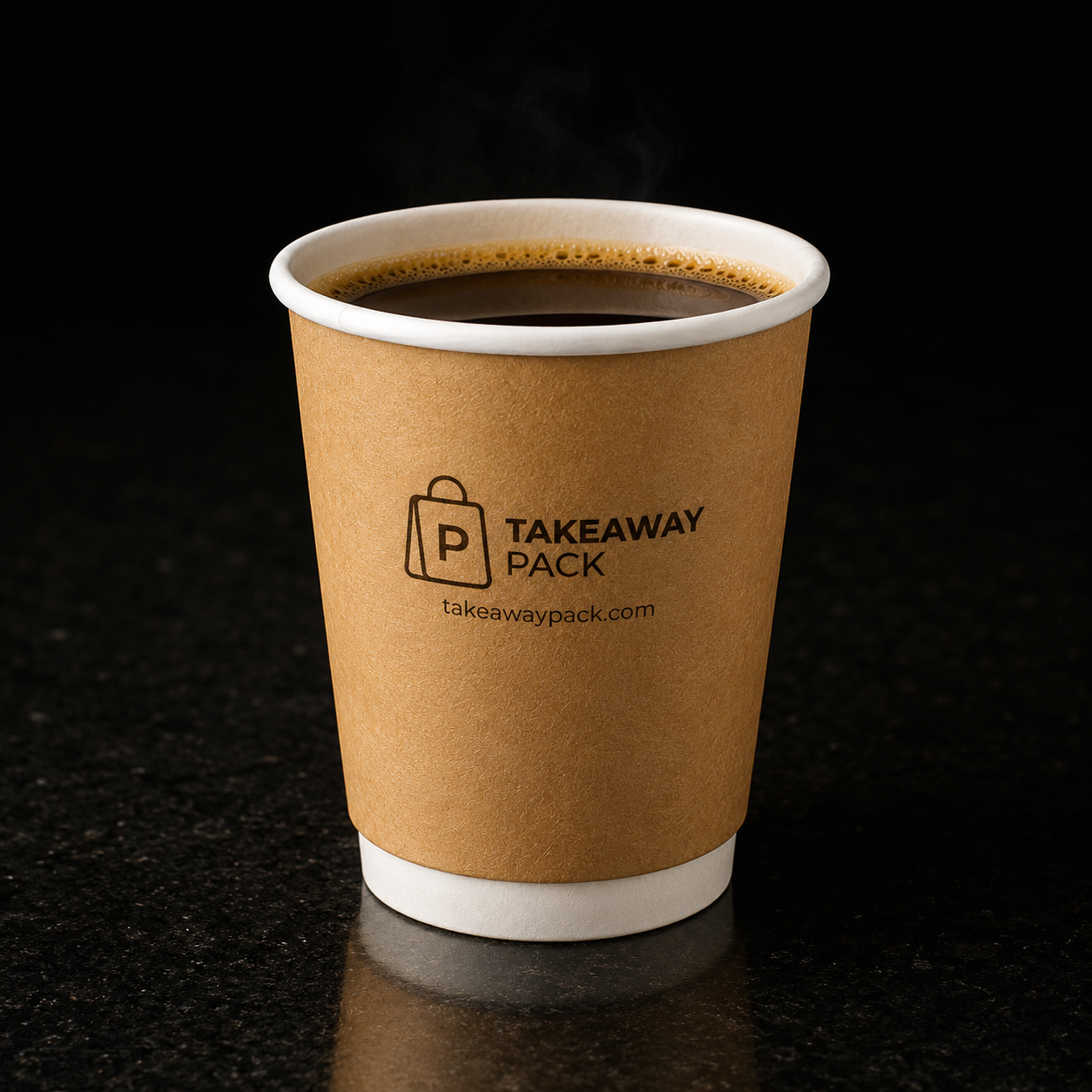
The key is to settle on a visual identity first — logo placement, brand colors, font style — through sleeves and stickers, then apply that same system to the cup. Takeawaypack's double-wall paper cups run from 8 oz (280 ml, 90 mm top diameter, 59 mm base, 85 mm tall) through 12 oz (400 ml, 112 mm tall) and 16 oz (500 ml, 138 mm tall) up to 22 oz (700 ml, 168 mm tall), in kraft, white, and black food-grade wood-pulp paper, printed by four-color gang-run printing. Because every size shares the same 90 mm rim, one lid and one sleeve spec covers the whole hot-drink menu. For iced drinks, food-grade PET cold cups are offered in 90 mm, 93 mm, and 98 mm rim diameters — for example a 98 mm 16 oz at 500 ml and 126 mm tall — with offset printing.
Carrier Bags and Cup Carriers — The Walking Advertisement
A carrier bag with a clean logo and a consistent color system is essentially a mobile billboard. Every bag that leaves the shop walks through a neighborhood, an office lobby, or a transit station. For coffee shops that serve multi-drink orders, a branded cup carrier — typically a molded-pulp four-cup tray — keeps the presentation intact during delivery.
Takeawaypack's molded-pulp cup carriers, made from sugarcane bagasse, hold four drinks with a cushioning structure that resists tipping, and come in both separable and non-separable formats with inkjet printing. For single and double drink orders there are 98 mm cup bags — a single-cup version at roughly 28 cm high by 16 cm wide with a 20 cm handle section and a 4.5 cm bottom gusset, and a double-cup version at about 28.5 cm high by 31 cm wide. For food alongside the coffee, kraft paper bag stock is offered in 15×15 cm and 18×18 cm formats with flexographic printing.
How to Create a Cohesive Takeaway Brand System
A consistent brand identity is not about matching every item to the exact same design. It is about creating a visual language that repeats across every piece of packaging, so the customer sees the same brand whether they are holding a cup, a sleeve, or a bag.
One Visual Language Across Every Touchpoint
Start with a simple palette: one or two main colors, one font family, and one illustration style or logo treatment. That palette should appear on the cup sleeve, the sealing sticker, the printed cup, and the carrier bag. When the same accent color appears on the sticker sealing the lid and on the sleeve wrapping the cup, the customer registers the brand as intentional.
A practical rule is to use the same logo file at the same size ratio across all items. The logo should be legible at a glance — clean, high-contrast, and large enough to read from a few feet away. For shops with multiple locations or a growing wholesale program, this consistency also helps customers recognize the brand when they encounter it at a farmers' market, a pop-up, or a partner café.
Color Matching and Print Methods
One challenge coffee shops face when sourcing packaging from multiple suppliers is color drift — the logo color on the cup sleeve may look different from the same logo on the sticker. That is why working with a single supply partner who uses the same print method across items is valuable.
Takeawaypack uses four-color gang-run printing for its paper cups and sleeves, and offset printing for PET cups. The difference between Pantone spot colors (PMS) and CMYK process printing matters here: spot colors are premixed for exact brand matching, while CMYK mixes four base inks on press. For cafés that need precise color reproduction across multiple packaging items, specifying CMYK values for the artwork file helps the printer maintain consistency across the whole order.
Functional Details That Build Reputation
Brand consistency is not just visual. A lid that seals properly, a sleeve that fits snugly, and a carrier that holds drinks steady all contribute to the customer's perception of the brand. A leaking lid or a flimsy bag can undo the goodwill created by a great latte.
Takeawaypack's 90 mm lids are available in single-hole, double-hole, multipurpose, foldable, and rotating designs, all made from food-grade PP. The matching ensures that the lid fits the rim of the double-wall paper cup or the PET cold cup, reducing the risk of spills during delivery. For shops that serve both hot and iced drinks, selecting a lid that works across both cup types simplifies inventory and reduces the chance of a mismatch.
Testing Small Batches Without Overcommitting Inventory
The fear of ordering custom packaging is ending up with a carton of branded cups that the shop no longer likes. The solution is to test in phases.
Start with the low-commitment items: a run of 500 sleeves and a batch of stickers. Put them into circulation for two to four weeks. Watch for customer reactions — do they photograph the sleeve? Do they comment on the sticker? Track repeat orders and social media tags. If the response is positive, move to the next phase: a small run of printed cups in the two most popular sizes, using the same artwork system.
This phased approach depends on a supplier that treats MOQ as flexible rather than fixed. Takeawaypack works with flexible minimum order quantities, with the final figure confirmed on quotation once the product, material, print method, colour count and destination market are known — bag formats sit at a higher threshold than cups and lids because the production setup differs. The practical move is to send the actual monthly volume per size and ask for the quote against that, rather than guessing at a minimum.
Building a Takeaway Brand That Lasts
A consistent packaging identity does not need to be expensive or complicated. It needs a clear visual system, a deliberate order of customization, and a supply partner who can match the artwork across cups, sleeves, lids, and bags. By starting with low-MOQ items and scaling based on real feedback, a specialty coffee shop can build a takeaway brand that feels as intentional as the coffee inside.
For coffee shops ready to explore their options, Takeawaypack works with cafés of all sizes to coordinate branded packaging across cups, sleeves, lids, carriers, and bags, with a digital proof review before production begins and food-contact documentation confirmed per SKU and destination market.