Allergen Warnings and Heating Labels on Takeout Packaging: What Belongs Printed on the Pack
If your prepared meals need microwave reheating and contain tree nuts and dairy, the packaging question is not "what should we mention" but "what must a customer be able to read without scanning anything." US law puts specific allergen wording on the label itself, food safety agencies expect reheati…
2026-09-03 - 8 min read
Summary: If your prepared meals need microwave reheating and contain tree nuts and dairy, the packaging question is not "what should we mention" but "what must a customer be able to read without scanning anything." US law puts specific allergen wording on the label itself, food safety agencies expect reheating and storage directions where the customer can see them, and QR codes are only useful for the extras. This article separates the print-it layer from the scan-it layer, shows the wording formats the statute actually permits, and covers the artwork and proofing steps to settle with your packaging supplier before print.
Why "Contains Nuts and Dairy" Is Not Enough
The US allergen labeling rule lives in the Federal Food, Drug, and Cosmetic Act at 21 U.S.C. § 343(w). A packaged food containing a major food allergen is misbranded unless the allergen is declared in one of two ways:
- The word "Contains" followed by the food source name, printed immediately after or adjacent to the ingredient list, in a type size no smaller than the ingredient list itself; or
- The food source name in parentheses inside the ingredient list, following the ingredient's common name.
The same subsection adds a detail that catches a lot of meal brands: for a tree nut, fish, or crustacean shellfish, the "name of the food source" means the specific type of nut or species. So "Contains: Tree Nuts" does not satisfy the requirement. "Contains: Milk, Almonds" does. If your recipe rotates between almonds and walnuts across SKUs, the artwork has to rotate with it.
Two practical consequences for a prepared-meal line:
- Dairy is declared as milk, not "dairy." Ingredients like whey, casein, and sodium caseinate are milk proteins, and the source name has to be visible even when the ingredient name hides it.
- The allergen declaration is a label element, not a lookup. The statute allows required allergen information to appear in labeling in lieu of on the label only where the Secretary makes a specific finding — which is why a QR code or an emailed receipt is not a substitute for printed allergen wording on a retail pack.
Where the Printed Information Has to Sit
Placement is regulated too, not just content. 21 CFR § 101.2 defines the information panel as the panel immediately to the right of the principal display panel, with fallbacks when that panel is unusable label space — folded flaps and can ends are called out explicitly. Required label information has to appear on either the principal display panel or that information panel.
This matters more for takeout formats than for a rectangular carton. A round bowl with a film lid, a compartment tray, or a foil container with a board lid gives you a very different usable print area than a folding box. Deciding which panel carries the ingredient list and "Contains" statement is a structural decision, and it is cheaper to make it during artwork than after the first print run.
21 CFR § 101.4 governs the ingredient list itself: common or usual names, descending order of predominance by weight, on the principal display panel or the information panel.
Reheating Instructions: Print the Steps a Customer Cannot Guess
USDA's Food Safety and Inspection Service guidance on reheating leftovers is the clearest public reference for what a reheat instruction needs to accomplish. FSIS advises reheating to 165 °F measured with a food thermometer, bringing sauces, soups, and gravies to a rolling boil, covering food to retain moisture so it heats through, and covering and rotating food in a microwave for even heating. It also notes that the covering must be suitable for the microwave and that the lid or wrap should be vented to let steam escape.
Translated into label copy, the on-pack reheating block should carry:
- Power level and a time range, not a single time
- What to do with the lid or film: remove, vent, or leave on
- A stir or rotate step partway through
- A standing time after heating
- A doneness cue the customer can actually check — steaming hot throughout, or an internal temperature
- A caution that the container and contents will be hot after heating
Note the direction of the FSIS advice: it tells the customer to use a container suitable for the microwave and to vent the covering. That means your label needs to state plainly whether this pack, with this lid, goes in the microwave — and if it does not, the instruction has to tell the customer to transfer the food. That statement has to come from the specification and documentation for the exact container and lid combination you bought, not from a general assumption about the material.
What goes behind the QR code instead: oven and air-fryer alternatives, wattage adjustment tables, video walkthroughs, and texture tips. Useful, but nobody is unsafe for missing them.
Storage Statements Belong on the Principal Display Panel
For meat and poultry products under USDA jurisdiction, 9 CFR § 317.2(k) is explicit: packaged products requiring special handling to maintain wholesome condition must display "Keep Refrigerated," "Keep Frozen," "Perishable Keep Under Refrigeration," or a similar approved statement prominently on the principal display panel. Products distributed frozen but thawed for retail display carry "Keep Frozen" on the shipping container, and consumer-size containers carry "Previously Handled Frozen for Your Protection, Refreeze or Keep Refrigerated." The rule even sets minimum letter heights for perishable canned products.
If your meals contain meat or poultry, that is the regime you are in, and jurisdiction is worth confirming early: FDA regulates most packaged foods, FSIS regulates meat and poultry products under its inspection, and state rules can add requirements on top. Either way, the basic keep-refrigerated or keep-frozen directive is a print-it item. Extended shelf-life detail, after-opening windows, and temperature history are scan-it items.
The Print-It / Scan-It Split
A workable panel plan for a microwaveable meal: product name, net quantity, storage directive, and the "Contains" statement on the front or top; ingredient list, nutrition panel, reheating block, handling cautions, and responsible-party information on the information panel; QR code placed where it does not compete with the allergen statement for attention.
| Information | On the pack | QR code or receipt |
|---|---|---|
| Allergen declaration with specific source names | Required | Expanded cross-contact detail only |
| Full ingredient list | Required for packaged food | Optional duplicate |
| "Keep Refrigerated" / "Keep Frozen" | Required where handling affects wholesomeness | Extended storage and after-opening guidance |
| Core microwave steps, venting, standing time, doneness cue | Oven and air-fryer alternatives, wattage tables, video | |
| "Container and contents will be hot" caution | — | |
| Whether the pack is suitable for microwave use | — | |
| Product identity, net quantity, responsible party | Required | Optional duplicate |
| "May contain" / shared-facility statement | Voluntary; print if used | Good place for allergen program detail |
| Nutrition, macros, dietary swaps | Panel as required | Customization and pairing content |
| Sourcing, traceability, feedback, disposal instructions | — | Good fit |
Getting It Onto the Pack: What to Settle With Your Supplier
The regulatory reading is only half the job. The other half is whether the container you chose can carry that copy legibly, and whether the print process reproduces it.
Practical items to fix before you commit to a run:
- Usable print area per panel, for the actual container geometry — a round bowl wall, a compartment tray flange, and a folding box panel are not interchangeable.
- Minimum legible type size for the ingredient list, since the "Contains" statement is pegged to it and cannot be smaller.
- Print method and its limits — screen printing on a molded or coated container behaves differently from offset on flat board, and fine text and tight registration are where cheap artwork fails.
- Whether the pack and lid are documented for microwave use, per SKU and per market, with the supporting food-contact paperwork rather than a verbal assurance.
- A written proof step, so the allergen wording and reheat copy you approved are the wording that prints.
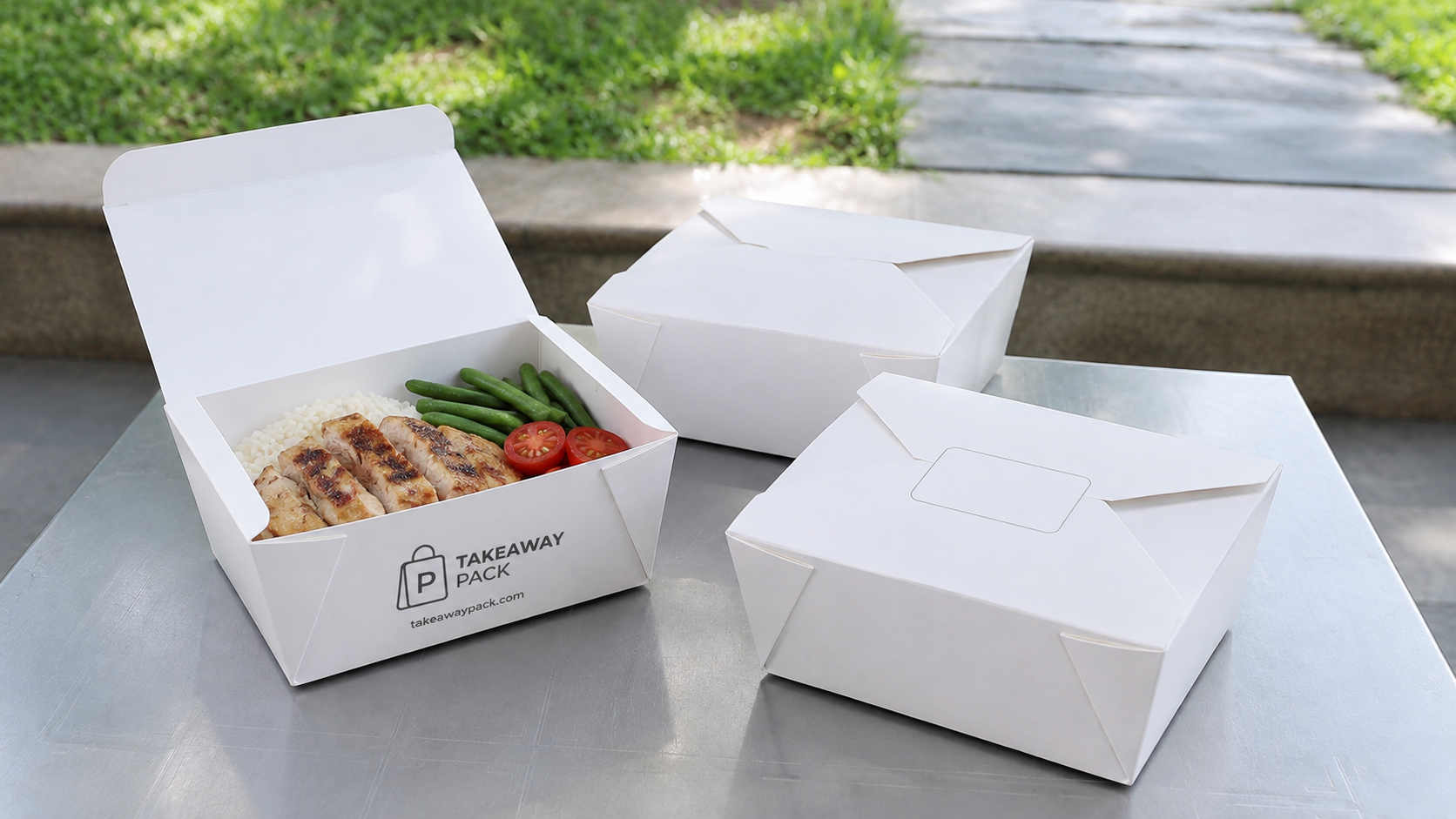
Takeawaypack works as a foodservice packaging supply-chain partner on exactly this kind of brief: it runs its own printing facility and works with a network of partner disposable-packaging factories, and its online catalogue spans cups, bowls, boxes, containers, trays, lids, bags, and cutlery — the formats prepared-meal programmes usually draw from. MOQs are flexible with small-batch options available, confirmed against the specific product and quote rather than assumed.
Two parts of that process map directly onto label work. Custom printed orders are produced from a digital proof made from your files and confirmed in writing before production starts — which is the control point for allergen wording, since an unreviewed artwork change is how a wrong nut name reaches 10,000 lids. And food-contact documentation is confirmed per SKU, per order, and per destination market, which is the right way to answer "is this pack microwave suitable" and "does this claim hold in the market we're shipping to" with paperwork instead of assumption. Takeawaypack supplies buyers across North America, Europe, Australia, and the Middle East, so destination-specific document scope is a normal part of the conversation rather than an exception.
One boundary worth stating plainly: a packaging supplier can give you print area, structure, process capability, and per-order food-contact documentation. It cannot sign off your allergen declaration. Whether "Contains: Milk, Almonds" is complete and correct for your recipe, channel, and jurisdiction is a question for your own regulatory or legal review, and for the current FDA and FSIS guidance that applies to your product.
If you are specifying containers for a microwaveable meal line and want to work through print area, structure, and per-order documentation against your label copy, the catalogue and enquiry route are at takeawaypack.com.
Sources
- 21 U.S.C. § 343 — Misbranded food — subsection (w), major food allergen labeling requirements
- 21 CFR § 101.2 — Information panel of package form food
- 21 CFR § 101.4 — Food; designation of ingredients
- 9 CFR § 317.2 — Labels: definition; required features — paragraph (k), special handling statements
- USDA FSIS — Leftovers and Food Safety — reheating to 165 °F, covering and rotating, venting the covering