Best Boxes and Vented Lids for Crispy Fried Chicken and Fries During 30–45-Minute Delivery
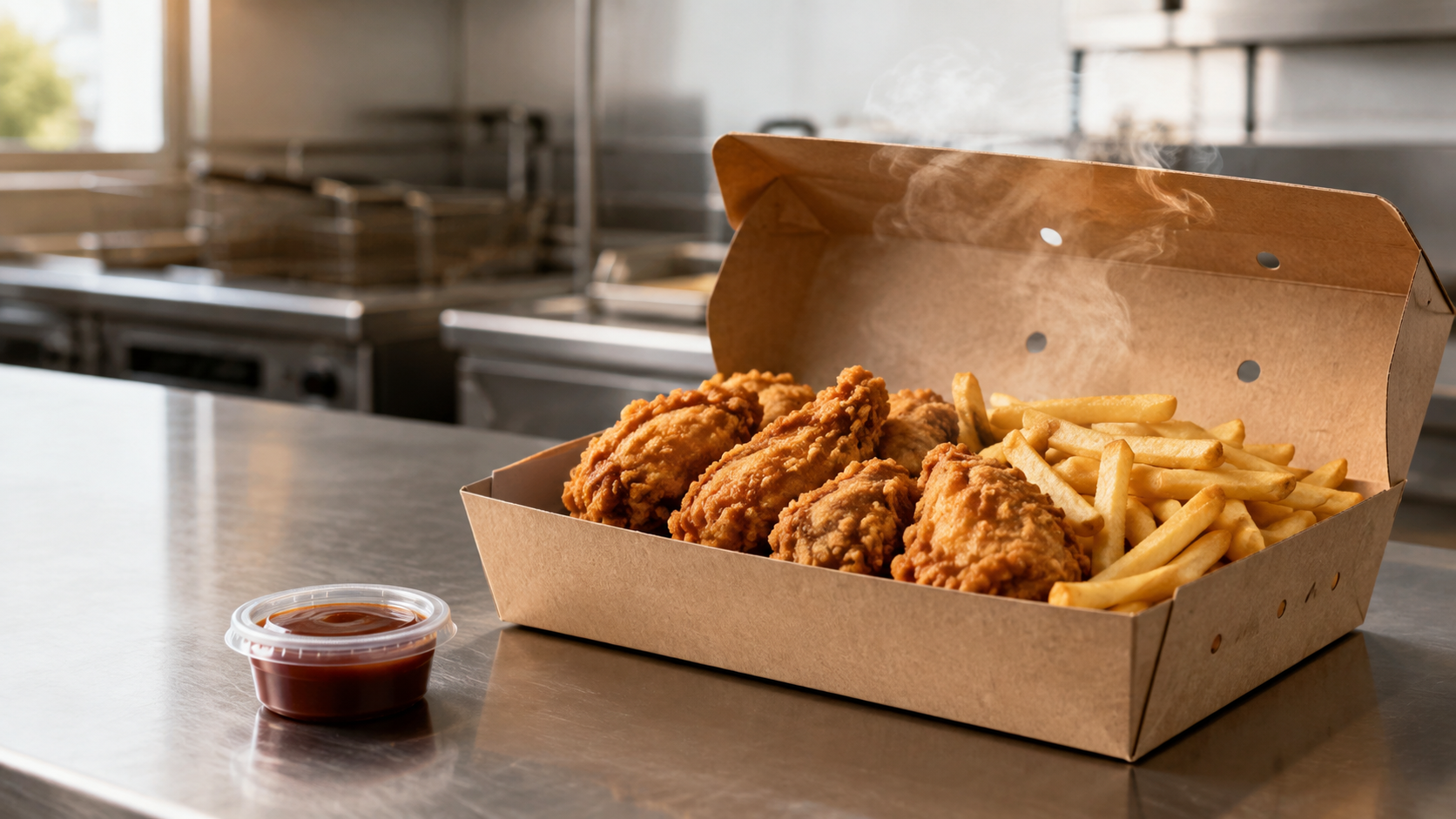
For a 30–45-minute rider journey, start by evaluating a rigid, right-sized food box with a grease-resistant food-contact surface and controlled vents in the lid or upper sidewalls. The vents should give humid air a path out without exposing the greasy base. Avoid assuming that paper, plastic, or a “vented” label will solve the problem by itself. The finished box-and-lid system, portion load, outer delivery bag, kitchen process, and route all affect the result.
2026-08-11 - 6 min read
Summary
For a 30–45-minute rider journey, start by evaluating a rigid, right-sized food box with a grease-resistant food-contact surface and controlled vents in the lid or upper sidewalls. The vents should give humid air a path out without exposing the greasy base. Avoid assuming that paper, plastic, or a “vented” label will solve the problem by itself. The finished box-and-lid system, portion load, outer delivery bag, kitchen process, and route all affect the result.
No box can guarantee that fries or fried chicken will remain as crisp as they were at the fryer. A cloud kitchen should compare samples under its own operating conditions, including 30- and 45-minute rider tests, before choosing a format.
Why Fried Food Turns Soggy in a Closed Box
Fried chicken and fries continue releasing heat and water vapor after packing. In a tightly closed container, that vapor raises the humidity around the food. It can condense on the cooler lid and walls, while the crust or surface absorbs moisture and softens.
Oil creates a different packaging problem. It can collect beneath chicken pieces or fries, stain exposed paper fibers, weaken folds, and soften the base. Venting and grease resistance therefore have separate jobs: vents manage humid air, while the food-contact surface and overall structure manage oil and moisture exposure.
This is why adding more vents is not automatically better. Large or badly placed openings may release heat quickly, weaken the closure, become blocked, or create an unwanted path for contamination. A coating alone is also incomplete: a highly closed package can still trap steam.
What Box Structure Should a Delivery Kitchen Shortlist?
Begin with finished packaging systems rather than a material name. Vented paperboard cartons are a practical candidate because lid and sidewall openings can be incorporated into the structure. Other container formats may also work if the lid fit, vent placement, base stiffness, and food-contact surface suit the meal.
For each candidate, check:
- whether the base and lower walls resist visible grease under the actual hot load;
- whether the lid closes securely without touching or pressing the crust;
- whether vents are located above the greasy contact zone;
- whether the box remains rigid when lifted, stacked, and carried;
- whether openings remain clear after the box enters the outer delivery bag; and
- whether the box is sized for the real portion rather than a nominal capacity alone.
Do not treat “kraft,” “paper,” “plastic,” or “coated” as performance specifications. Fold lines, corners, locking tabs, cut edges, and the base seam can behave differently from a flat sheet. Sample the converted box and matched lid as one system.
How Should Vented Lids Be Evaluated?
A vented lid should provide controlled steam release while staying securely matched to the box. Vents in the lid or upper sidewalls are generally more sensible to investigate than openings near the oily base. However, the number, shape, and position of vents should be selected through testing, not guessed from a product image.
The outer bag matters too. A vented container inside a tightly closed, moisture-trapping carrier may not behave like the same container on an open counter. Test the packaging inside the exact rider bag and with the stacking pattern used during service. Also check whether another hot item placed above the box blocks its vents.
Do not choose between “hot” and “crisp” based on surface temperature alone. Record both food temperature and texture at each checkpoint, and keep all food-safety controls aligned with the requirements that apply to your operation.
Size the Box Around the Menu
An oversized box can allow food to slide, collide, shed crumbs, and mix with wet sides. A box that is too tight can compress the crust, force pieces to overlap, and obstruct airflow. Aim for controlled clearance: enough headroom and separation to avoid compression, but not so much empty space that the meal moves freely during braking and turns.
Cloud kitchens should create separate loading rules for common order types:
- **Single meals:** favor a mostly single-layer arrangement with the lid clear of the food.
- **Wings or small pieces:** distribute the portion across the base instead of piling it deeply.
- **Chicken and fries:** compare separate packs with divided formats; one food can add moisture and grease to the other.
- **Family orders:** test the weight on the base, lower pieces, folds, and closure.
- **Sauces and wet sides:** use securely closed sauce containers and keep them away from the fried coating.
The best format for a virtual brand may therefore be a small packaging family, not one universal box for every order.
Run a 30–45-Minute Rider Test Before Ordering
Use the normal recipe, fryer procedure, drain time, portion, packing station, outer bag, and delivery method. Compare at least two box-and-lid candidates. Include an unvented control if practical so the team can see whether a vented design makes a meaningful difference in its own workflow.
Inspect samples at packing, 15 minutes, 30 minutes, and 45 minutes. Repeat the test on more than one production run. Record:
- crust and fry texture;
- food temperature under the kitchen’s food-safety procedure;
- condensation on the lid and walls;
- grease marks, seepage, and base softening;
- closure security and stack stability;
- food movement and presentation; and
- whether vents were blocked inside the rider bag.
Use a simple scorecard and photograph every result under similar conditions. One successful run is not enough: portion variation, oil pickup, loading speed, weather, and rider handling can change the outcome. Approve a format only after it performs acceptably across the longest realistic route your business plans to serve.
Prepare a Clear Packaging RFQ
When contacting TakeawayPack, provide the category or product sought, material preference, size or capacity, order quantities, printing or color requirements, logo customization, and destination port or country. During an RFQ, TakeawayPack can discuss product structure, coatings, capacity, printing, lid matching, and carton packing. It can also provide samples, drawings or print-file alignment, plus packaging and export handover communication.
Stock items may support trial orders, while the minimum order quantity for custom packaging depends on the product and customization method. For custom printing, customer files are used to prepare a digital proof, and production begins only after written customer approval.
Treat samples as candidates, not evidence of delivery performance. Test the exact box, lid, food load, and rider route before purchase or rollout. To start a packaging discussion, visit https://takeawaypack.com.