
Best Containers for Crispy Fried Chicken and Fries During 30–45-Minute Delivery
Fried chicken and fries turn soft in delivery when hot steam is trapped around the food or moisture collects beneath it. For a 30–45-minute courier ride, the best packaging combines controlled ventilation, a rigid shape, a suitable food-contact material, and enough room to avoid crushing. The right choice depends on whether the order is mostly fries, larger chicken pieces, or a mixed meal. Test the complete packed order on the route you actually serve before standardizing a format.
2026-08-11 - 5 min read
Summary
Fried chicken and fries turn soft in delivery when hot steam is trapped around the food or moisture collects beneath it. For a 30–45-minute courier ride, the best packaging combines controlled ventilation, a rigid shape, a suitable food-contact material, and enough room to avoid crushing. The right choice depends on whether the order is mostly fries, larger chicken pieces, or a mixed meal. Test the complete packed order on the route you actually serve before standardizing a format.
Why Fried Food Goes Soggy in Takeout Packaging
Freshly fried food releases steam after it leaves the fryer. In a tightly closed container, that steam condenses on the walls and base, then returns to the coating as moisture. Fries and breaded chicken lose their crisp surface quickly when they sit in this humid environment.
A flat, damp contact surface makes the problem worse. If food is packed too densely, the lower layer receives less airflow and is exposed to more steam. A delivery bag can add another warm, enclosed environment, so the packaging decision needs to consider the full journey rather than the box alone.
Packaging Mistakes That Reduce Crispiness
A fully sealed container may look tidy and stack well, but it can trap steam from hot fried food. Paper packaging without a ventilation plan can have the same issue. Conversely, an overly open pack may release heat too quickly or provide too little protection during transport.
Oversized boxes can also be a poor fit. Food may slide, crush, or stack unevenly, while a tightly overfilled box reduces the air spaces that help steam escape. One format is not automatically right for every menu item: thin fries, thick-cut fries, breaded chicken, wings, and mixed meals all behave differently after packing.
Five Container Features to Consider for Fried Foods
1. Vented clamshell-style boxes for mixed meals
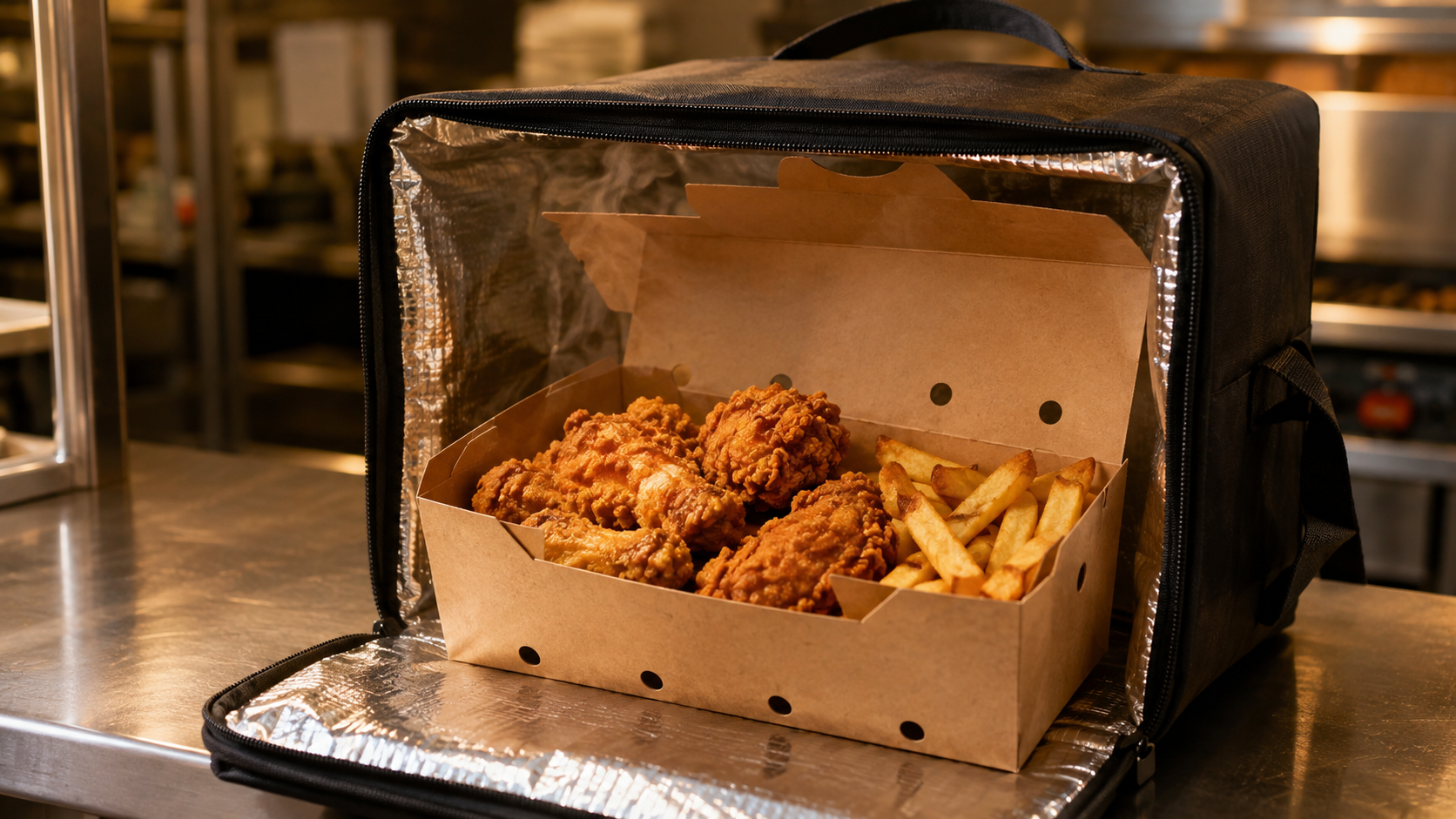
A rigid clamshell-style box with intentional ventilation can suit fried chicken pieces, fish, or a combination meal. The structure helps protect the food from compression, while the vents provide a path for steam to leave.
The useful question is not simply whether a lid has holes. Check where the vents sit, whether the pack stays stable when stacked, and whether the vent layout still protects the food from spills and handling during the actual courier route.
2. Open-top or vented fry boxes for fries and lighter snacks
For fries and smaller fried snacks, a lightweight paper fry box can provide more natural airflow than a sealed pack. The format should be sized so the fries are not compressed into a dense layer.
Grease-resistant liners may help manage excess surface oil, but the finished pack should still be tested with the menu item at its normal handoff temperature. A liner cannot compensate for a box that traps too much steam.
3. Rigid paperboard boxes for heavier fried portions
Heavier orders such as larger chicken portions, fried seafood, or a chicken-and-fries combo benefit from a container that resists crushing. A rigid paperboard box can help protect the portion in a delivery bag while allowing a ventilation design to be considered.
For a mixed order, make sure fries are not packed beneath hot, heavy items where they can be compressed and exposed to trapped moisture. A divider, separate fry pack, or different packing sequence may be worth testing.
4. Elevated or textured bases that limit wet contact
A base with raised texture or channels can help keep food from resting directly on pooled condensation. This is especially relevant for breaded chicken, wings, and other items with a larger surface area against the bottom of the pack.
The surface design should support the food without damaging the coating. Combine it with the right portion size and ventilation approach, then inspect the food after the target delivery time rather than judging the empty container alone.
5. Perforated trays inside a protective outer pack
A perforated tray can create controlled airflow for fries, tempura, and smaller fried items. Used inside a protective outer pack, it can help balance texture preservation with the need to protect an order during transport.
This two-part approach requires practical testing. Review whether the tray stays in position, whether the outer pack traps the released steam, and whether the complete assembly is easy for kitchen teams to use consistently during busy service.
How to Choose a Box and Vented Lid for Your Menu
Start with the food, the portion, and the real delivery window. Pack a normal order at the same temperature, place it in the same bag used by couriers, and evaluate it after 30 and 45 minutes. Check crispness, heat, grease migration, lid security, stacking performance, and how the pack looks when opened.
For fries, prioritize enough airflow and a shape that prevents a compressed, damp lower layer. For fried chicken, prioritize a stable structure, protection from crushing, and a base that does not hold condensation against the coating. For mixed meals, consider whether separate components will protect texture better than packing everything in one compartment.
A packaging supplier should be able to discuss the practical variables behind the specification: container structure, coating, capacity, compatible lid options, and packing details. This gives the kitchen a clearer starting point for sampling rather than relying on a generic container description.
Work With TakeawayPack on a Delivery-Tested Packaging Brief
TakeawayPack is a foodservice packaging brand and procurement coordinator that works with multiple packaging manufacturers. Its online catalogue includes boxes, trays, containers, and lids, and its RFQ process can collect the product category, material, size or capacity, expected quantity, customization requirements, and destination country. During an inquiry, TakeawayPack can discuss structure, coating, capacity, lid matching, printing, and carton packing.
If you are sourcing packaging for fried chicken, fries, or a mixed delivery menu, prepare a brief that includes the food type, portion size, target delivery time, expected order volume, and the markets you serve. Start your packaging inquiry at TakeawayPack to discuss a format that you can validate with real packed-order tests.