
Best Takeout Containers for BBQ: Keeping Ribs, Brisket, and Saucy Sides Hot
The best BBQ takeout container is usually a small system rather than one universal box: choose a lidded format suited to the meat portion, pack wet sides and extra sauce separately, and decide on venting only after testing the actual menu, fill temperature, hold time, bagging method, and delivery ro…
2026-09-09 - 6 min read
Summary
The best BBQ takeout container is usually a small system rather than one universal box: choose a lidded format suited to the meat portion, pack wet sides and extra sauce separately, and decide on venting only after testing the actual menu, fill temperature, hold time, bagging method, and delivery route. For most operations, a lidded foil tray is a sensible trial candidate for larger meat portions, while a rigid PP container with a matched lid is a sensible trial candidate for individual saucy portions. Confirm the result through an operational test instead of inferring it from the material or container shape.
Estimated reading time: 6 minutes
What is the best overall container setup for BBQ takeout?
Answer: Use a meal-specific setup, not one container for brisket, ribs, beans, slaw, and sauce.
BBQ creates competing packaging needs. Brisket and ribs can be heavy and release juices. Beans and mac and cheese are wet sides. Coleslaw is a cold side. Extra barbecue sauce adds another liquid component. A single shallow box can make packing fast, but it also makes every item share the same moisture environment.
Start by separating the order into four roles:
- The main meat container for brisket, pulled pork, or ribs.
- A wet-side container for beans, mac and cheese, chili-style sides, or other spoonable items.
- A cold-side container for slaw, pickles, or potato salad.
- A portion cup for extra sauce rather than automatically adding more sauce to the meat box.
This approach gives the operator control over each component during testing. It also makes a failure easier to diagnose: the issue may be the lid fit, the portion size, the headspace, the bag orientation, or the sauce cup—not necessarily the material alone.
Which container should I trial for brisket and ribs?
Answer: Trial a lidded foil tray for larger or family-style portions, and a rigid PP container with a matched lid for individual portions that include sauce or juices.
A foil tray is a practical candidate when a portion needs a broad footprint, such as sliced brisket, a half rack, a full rack, or a catering portion. Its shape can make it easier to avoid crowding long cuts of meat. Specify the tray depth, portion weight, and lid style together; a tray and a lid are a system, not interchangeable parts.
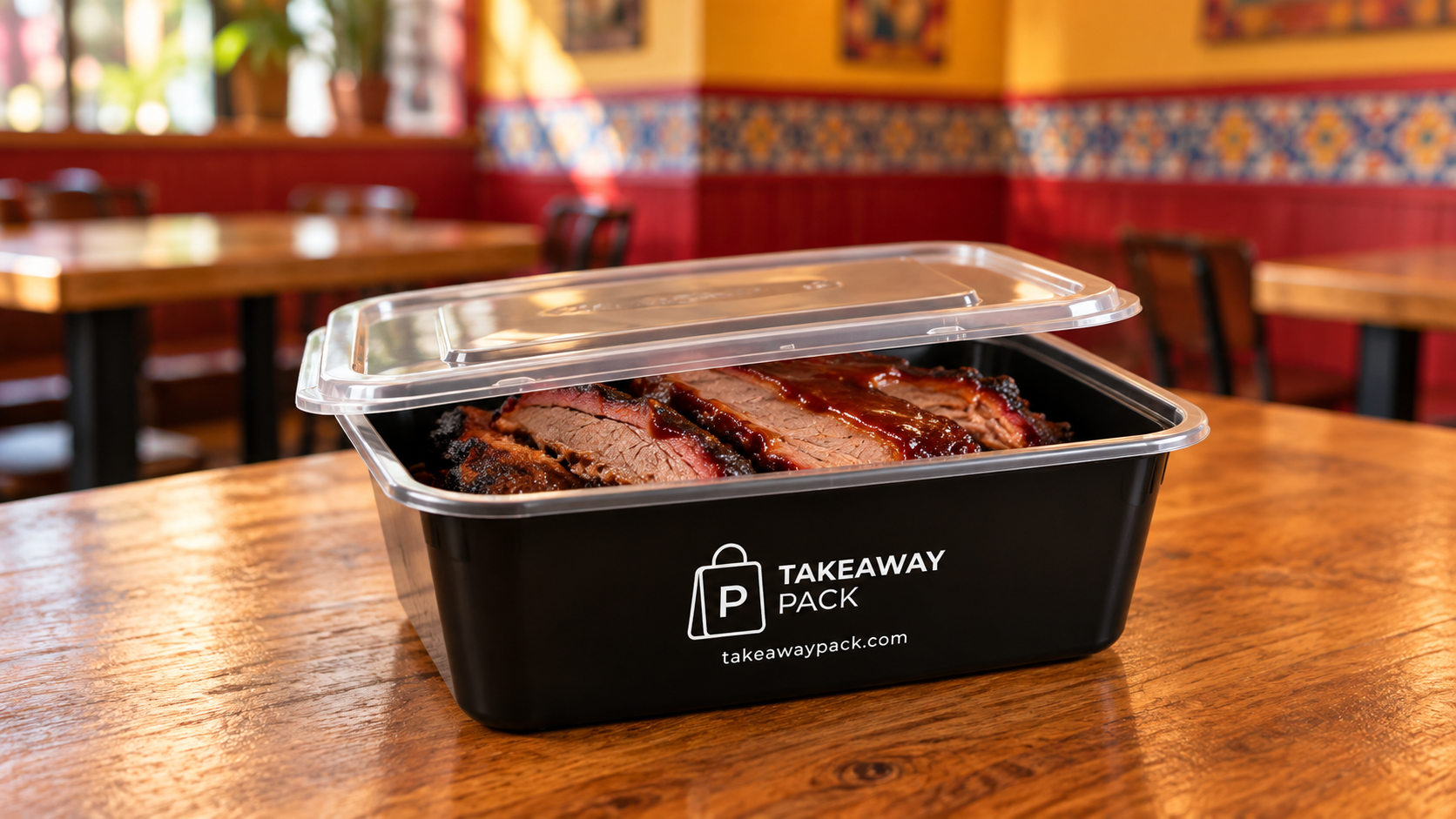
For individual BBQ plates, a rigid rectangular PP container can be a useful comparison sample. Its defined footprint can suit a sliced-meat-and-side format. If the meal includes a liquid side or a generous amount of sauce, test the exact lid with the filled base rather than assuming that a visually similar lid will fit or perform the same way.
The right choice depends on the actual portion and route. A container that looks appropriate on a counter may behave differently after it is filled, placed in a delivery bag, stacked with other orders, and carried through turns and stops.
How should I package saucy sides and extra barbecue sauce?
Answer: Keep wet sides and extra sauce in their own matched containers whenever the menu and presentation allow it.
Baked beans, mac and cheese, and similar sides should be evaluated in a separate round container or bowl with its intended lid. Extra sauce should be trialled in a dedicated portion cup. This setup avoids making the meat container responsible for every liquid element in the order.
For a BBQ combo, write a simple packing specification for staff:
| Component | Trial format | What to inspect after delivery simulation |
|---|---|---|
| Brisket or ribs | Lidded foil tray or rigid PP container | Lid engagement, visible pooling, meat position, container flex |
| Beans or mac and cheese | Separate round container with its matched lid | Lid fit, residue around the rim, sidewall shape |
| Slaw or cold side | Separate cold-side container | Separation from hot food and presentation |
| Extra sauce | Dedicated portion cup with matching lid | Closure, placement in the bag, interaction with hot items |
Do not make a containment claim because a format passed a quick bench check. Use the same fill level, handling pattern, bagging method, and delivery distance that the restaurant actually uses.
Should BBQ containers have vents?
Answer: Sometimes, but venting is a product-specific moisture-management decision—not a universal rule for every BBQ order.
Steam is part of the problem when hot food is enclosed. Some foodservice containers use vents to release moisture. That does not mean that every BBQ item should be vented, or that a vented lid will automatically keep food hot or preserve a particular texture.
Use a controlled comparison. Pack the same menu item in two candidate systems: one with the proposed vent configuration and one without it. Keep the starting fill temperature, portion weight, headspace, bag, route, and evaluation time the same. Then compare condensation, meat surface, side appearance, lid condition, and customer-ready presentation.
For saucy ribs or beans, containment may be the first priority. For a dry-rub item or a component where surface texture matters, moisture release may deserve more weight. The sample test should decide the trade-off for that menu item.
What about compartments?
Answer: Compartments can simplify a full plate, but only if the portion layout stays stable in real delivery handling.
A compartmented base can be a good trial format for a protein, a hot side, and a cold side. Before standardizing it, test whether the compartment walls keep the intended separation once the box is tilted, stacked, or carried in a bag. A compartment is not a substitute for a separate sauce cup when a side is particularly wet or when customers add sauce to order.
Use the same rule for every format: select the smallest practical container that gives the food enough room without crowding the lid. Then test it with the actual portions instead of sizing from a catalogue image.
How do I validate a BBQ takeout container before ordering?
Answer: Run a documented, menu-specific delivery simulation before committing to a format.
- Pack the hottest, greasiest, sauciest, and heaviest version of each relevant menu item.
- Use the intended base, lid, portion cup, bag, and carry orientation.
- Simulate the longest normal delivery or pickup hold the restaurant expects.
- Check the lid, rim, corners, sidewalls, bag, and each food component at the end of the test.
- Record what changed and repeat the test after any change to the portion, sauce amount, liner, lid, or bag.
Treat the restaurant’s cooking, hot-holding, cooling, and local-code procedures separately from packaging selection. A container test is not a substitute for those procedures or for the restaurant’s own time-and-temperature controls.
When is the setup ready to standardize?
Answer: Standardize only after the format passes the restaurant’s own defined test for the relevant menu and route.
Keep a short record for each approved combination: menu item, portion weight, container base, lid, sauce cup, packing sequence, delivery bag, route duration, and observed result. This helps staff reproduce the same setup and makes future changes easier to evaluate. It also prevents a packaging decision made for dry brisket pickup from being copied unchanged to a saucy rib delivery order.
Plan a BBQ packaging enquiry with TakeawayPack
To compare container categories, material preferences, portion capacity, lid fit, expected quantity, and destination for a BBQ takeout project, start an enquiry at takeawaypack.com. Confirm final suitability, availability, commercial terms, and any required product documentation against the specific SKU, quote, samples, and destination market before placing an order.