Best Takeout Containers for Breakfast and Brunch: Eggs, Pancakes, Hash Browns
Breakfast takeout works best as a menu-by-menu purchasing decision, not as a search for one universal box. A brunch operator can shortlist a divided candidate for an eggs-and-hash-browns plate, a wide shallow candidate for pancakes, and a separate format for bowl-style items, then compare them with…
2026-09-10 - 7 min read
Summary
Breakfast takeout works best as a menu-by-menu purchasing decision, not as a search for one universal box. A brunch operator can shortlist a divided candidate for an eggs-and-hash-browns plate, a wide shallow candidate for pancakes, and a separate format for bowl-style items, then compare them with the actual portion, delivery route, and handling routine. The final choice should rely on confirmed SKU details and a practical trial rather than a broad material label or an assumed performance claim.
Estimated reading time: 7 minutes
Is there one best takeout container for every breakfast order?
No. Eggs, pancakes, and hash browns can appear together, but they do not create the same purchasing brief. The portion shape, components that should remain separate, condiments, expected holding time, and delivery-bag setup all affect the format to evaluate.
Begin with the menu item that is hardest to pack. That might be a plate with a moist egg component beside potatoes, a stack that needs lid clearance, or a bowl with a topping added at the last moment. Then compare candidate formats against that specific order.
What should be compared before choosing a format?
Ask for the internal dimensions, usable depth, compartment layout where relevant, closure or lid type, and the exact base-and-lid pairing. A stated capacity alone does not show whether the plated portion fits without touching the lid or leaving excessive unused space.
Treat material as one specification to confirm, not a shortcut to a result. A container’s finished construction, lid, coating or liner where applicable, and intended use all need SKU-level confirmation.
How should you buy for eggs and a classic breakfast plate?
For scrambled eggs, omelets, or eggs served beside potatoes and protein, start with the way the plate is assembled. Note which elements need their own area, the largest portion in each area, and whether a sauce or condiment is packed with the meal.
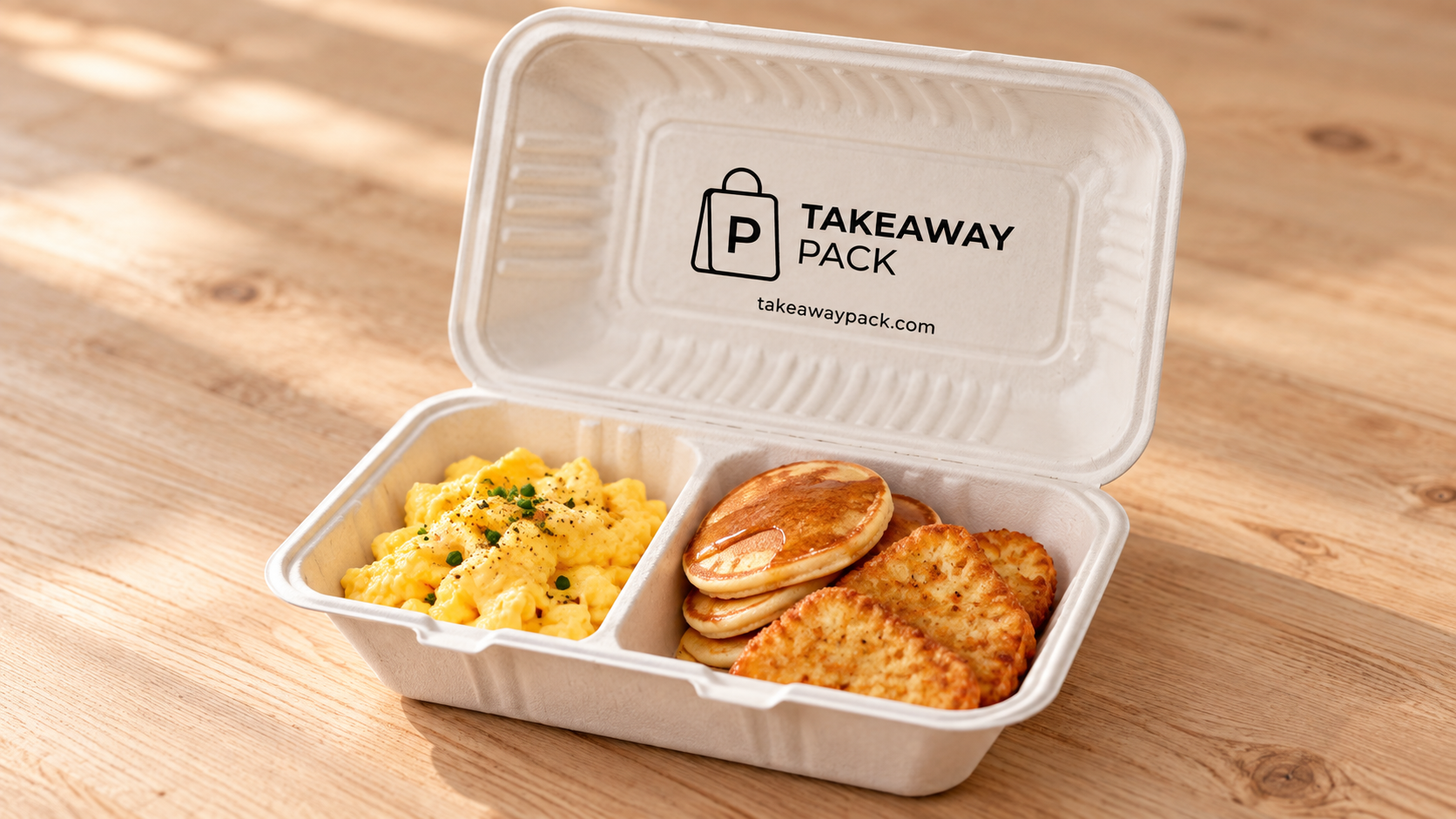
A divided format is a candidate when the operation wants physical separation between components. It should not be selected simply because it has two or three wells. Measure the real egg portion, potato portion, and protein or fruit portion against each well, then check the completed order after normal handling.
When is a single-compartment format the better candidate?
A single compartment may be worth comparing for an egg sandwich, breakfast burrito, or a plated order that does not need partitions. The key test is product fit: pack the normal serving, close the package at service speed, and inspect whether the food and closure work together as intended.
For eggs with a separate condiment, test the complete order with the condiment packed as it would be for delivery. This keeps the purchasing decision tied to the actual service routine rather than a container viewed in isolation.
How should you buy for pancakes, waffles, and French toast?
Start with the footprint of the stack. A wide, shallow candidate may be more appropriate to trial than a deep divided tray when the priority is lid clearance and a level presentation. Confirm this with the largest standard stack, not a single pancake.
Syrup, butter, berry compote, or other additions deserve their own purchasing decision. An operator may compare a separate portion format with an in-box serving approach, but both versions should be trialed with the actual recipe and route.
What should the pancake trial reveal?
Check whether the closed package accommodates the stack without pressing it, how the meal looks when reopened, and whether the condiment setup is workable for kitchen staff and customers. Run the same test at the beginning and end of the expected delivery window.
Do not assume that a flat box, a fiber format, or a vented design will produce a particular result. Evaluate the exact SKU with the menu item before adopting it for all pancake orders.
How should hash browns change the container decision?
Use hash browns as a test item, not as a reason to accept a generic claim about a material. The trial should include the normal cook time, packing sequence, closure, bagging method, travel time, and reopening step.
Review the package for moisture, product movement, contact with neighbouring food, and the condition the customer would receive. If the meal includes eggs, pack them together during the trial; testing hash browns alone cannot answer whether the combined plate works.
Should a divided box be the default for eggs and hash browns?
Only if its wells fit the recipe and the test supports that choice. A divider is a layout feature, not proof that a particular container will manage a full breakfast plate. Compare a divided candidate with a single-compartment candidate where both are plausible, and record why one suits that order better.
Which format should you shortlist for each brunch menu item?
| Menu item | First format to request for evaluation | Purchase questions to resolve |
|---|---|---|
| Scrambled eggs, hash browns, and protein | A divided candidate | Do the individual portions fit the wells, and does the closure work with the full meal? |
| Pancakes, waffles, or French toast | A wide, shallow candidate | Is there clearance for the largest stack, and how will syrup or butter be packed? |
| Egg-and-potato bowl | A bowl-style candidate with its matching lid | What are the usable dimensions, portion fit, and results of the complete-order trial? |
| Breakfast sandwich, toast, or burrito | A single-compartment candidate | Does the item fit without changing its assembly or the closure routine? |
| Combination brunch order with sides | Divided and single-compartment candidates | Which layout matches the actual components, carrying method, and route? |
This shortlist is intentionally not a universal SKU plan. It helps a buyer ask targeted questions before reducing the range to the few formats the menu genuinely needs.
What should happen before a bulk purchase?
Run the same simple test for every finalist. Pack the normal portion at the usual service temperature, close it as staff normally would, place it in the regular delivery bag, carry or transport it for the expected route, and reopen it for inspection.
Record the SKU, food item, fill amount, lid or closure, delivery time, and any issue observed. A result for a dry sandwich does not validate the same package for a sauced egg dish or a mixed plate.
What should be confirmed in writing?
Confirm the exact SKU, material for the relevant components, dimensions or capacity, compartment layout, compatible lid or closure, case details, and commercial terms. If food-contact, FSC, GRS, origin, compostability, or similar documents are needed, request confirmation for the specific SKU, quantity, destination market, and claim category.
Avoid converting catalogue labels into promises about performance, availability, regulatory status, or end-of-life outcomes. Those points require the corresponding product and order confirmation.
How can TakeawayPack be included in a breakfast packaging brief?
TakeawayPack’s public catalog covers cups, bowls, boxes, containers, trays, lids, bags, and cutlery. For a breakfast inquiry, an RFQ discussion can specify the product category, material, size or capacity, expected quantity, printing or logo needs, and destination market.
The catalogue evidence includes 8-inch and 9-inch single-compartment locking-box examples categorized as sugarcane bagasse.
If custom printing is part of the brief, provide the customer files and approve the digital proof in writing before production begins. That approval step should follow the container trial, so the selected format and printed design reflect the same final specification.
Ready to turn your brunch menu into a testable packaging brief?
List each breakfast order, its portion, its add-ons, and its expected delivery route. Then send the category, candidate layout, material, size or capacity, expected quantity, logo needs, and destination market to TakeawayPack for SKU and quotation confirmation before making a purchasing decision.