
Best Takeout Containers for Curry and Saucy Indian Dishes
For curry, dal, korma, and other sauce-led dishes, the most dependable purchasing decision is a matched container-and-lid system rather than a material name alone. Start with a deep container that suits the served portion, a compatible positive-locking closure, and a realistic test using the hottest
2026-09-09 - 5 min read
Summary
For curry, dal, korma, and other sauce-led dishes, the most dependable purchasing decision is a matched container-and-lid system rather than a material name alone. Start with a deep container that suits the served portion, a compatible positive-locking closure, and a realistic test using the hottest, thinnest sauce on the menu. Polypropylene is a practical first format to sample for many hot, liquid-rich dishes, but the exact container, lid, fill level, packing method, and delivery conditions must all be verified before a bulk purchase.
Estimated reading time: 5 minutes
What should an Indian restaurant choose first for curry takeout?
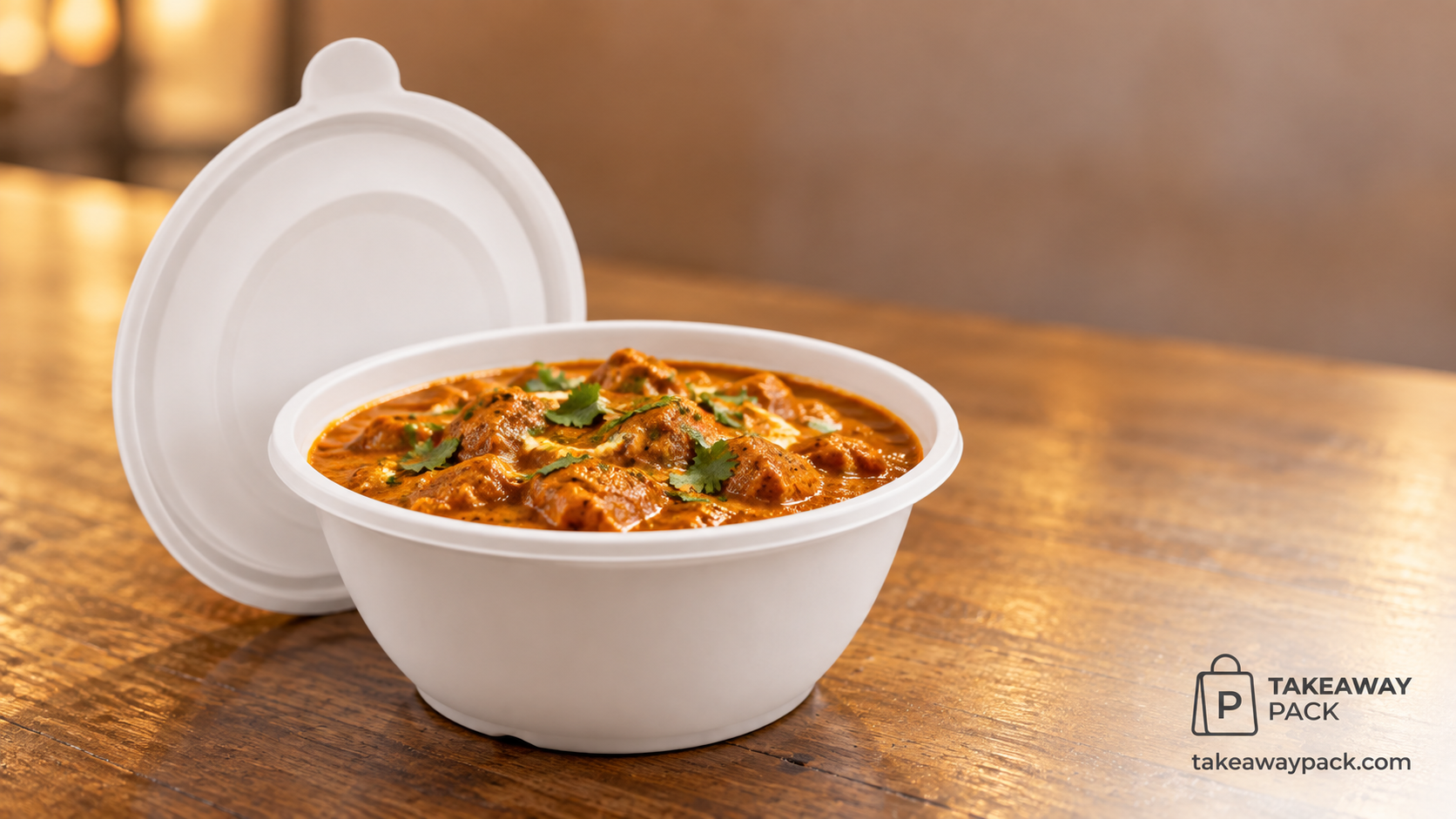
Choose a container-and-closure pair designed for liquid-rich food, then test that exact pair with the actual menu item. For a single curry portion, a deep round or high-wall container is often easier to assess than a shallow tray because the sauce sits farther below the lid. For a curry-and-rice order, use a format that keeps the gravy from reaching the closure during normal handling, or package the curry separately from the rice.
Polypropylene (PP) is a sensible first material to sample for hot curries and gravies because it is commonly offered in foodservice containers with matching lids. That is not a blanket approval of every PP item. A thin or poorly matched container can still leak, and a container that performs for one curry may not perform for a thinner dal or a larger family portion.
What is the practical default?
For a sauce-led entrée, begin with a deep PP container and the lid made to fit its exact rim. Ask the supplier to identify the matching base and lid as one system. Do not combine a container from one range with a visually similar lid from another range without testing the pair.
When should paper or molded fiber be considered?
Paper and molded-fiber formats can be considered where the exact item is specified for the food and delivery use. They should not be treated as interchangeable with a sealed plastic container. For oily or free-flowing gravy, ask for the intended-use information for the exact SKU and test the container with the actual dish before approving it. A fiber option may be better suited to rice, biryani, bread, or a drier accompaniment than to a loose curry; the test result, not the material label, should decide.
Which lid design matters most for saucy dishes?
Use a lid that creates a positive seal around the full rim. Multi-point snap closures, a continuous locking channel, or another full-perimeter locking design give the buyer a clearer starting point than a simple press-on lid held mainly by friction. The closure must stay engaged when the filled pack is lifted, tilted, nested in a bag, and stacked beneath other orders.
Should a curry container be vented?
For free-flowing curry, gravy, soup, or sauce, an open vent is a potential exit path. Prefer a non-vented closure unless the supplier provides a specific design and use method that has been tested for the dish. Vents are more relevant where escaping steam protects the texture of a dry or crispy item. A kitchen that sells both curry and crispy sides may need different packaging rules for those two jobs.
Is a heat-sealed option worth considering?
A heat-sealed film system can be worth evaluating when a business regularly packs high-risk liquid dishes and has the equipment and operating process to run it consistently. It should be assessed as a complete system: tray, film, sealing equipment, fill temperature, and sealing procedure. It is not a reason to skip a product test or to assume every tray-and-film combination is suitable.
How should the container size and fill level be chosen?
Select capacity from the served portion and the room needed for normal movement in transit, not from the nominal volume alone. A container that is filled too close to the lid can push sauce into the closure. A container with too much unused space can allow the contents to move sharply during delivery. Test the planned serving portion, including the way staff actually ladle or scoop it during a busy service.
Use separate small containers for extra sauce, chutney, or raita when those additions could compromise the main container's lid. For family portions, repeat the test with the larger format rather than assuming that a smaller successful pack will scale up unchanged.
How can a buyer verify that a curry container will not leak?
Run a menu-specific acceptance test before placing a production order. Use the thinnest, hottest, or oiliest dish that is most likely to expose a weak seal. Record the container code, matching lid code, portion, filling method, packing sequence, and result so that the approved setup can be repeated.
What should the test include?
- Fill the container to the normal service portion.
- Close it exactly as staff would during service.
- Place it in the delivery bag with the usual accompanying items.
- Tilt, carry, and stack the order in ways that reflect the expected delivery journey.
- Inspect the rim, exterior, bag, and adjacent packs for leakage, lid movement, or sauce transfer.
Repeat the test after any change to the recipe, portion, container, lid, or delivery arrangement. A sample that passes on a bench is not necessarily approved for a packed order.
What should be included in a supplier brief?
Give every supplier the same written brief so that samples can be compared fairly. Include the named dish, served portion, approximate food condition at packing, whether the order is delivered or collected, the container shape required, and whether rice or sides travel in the same pack. Request the exact container-and-lid pairing, any relevant use instructions, and samples for the acceptance test.
Do not approve a container because it is described only as “leak-proof,” “microwave-safe,” or “grease-resistant.” Ask which exact base and lid the statement covers, what use conditions it assumes, and what documentation is available for the market where the food will be sold. Confirm any food-contact, material, or disposal claim for the specific SKU and order instead of extending a claim from another product line.
Where can I begin comparing container and lid options?
Start with a short list of deep containers and their matching lids, then make the buying decision from the results of the same curry test. TakeawayPack's online directory includes container and lid categories that can be used as a starting point for that comparison. Review the available categories at TakeawayPack, and validate the exact SKU and closure against your menu before buying.