Best Takeout Containers for Hot Soup That Won't Leak or Spill
For pho delivery, the safest starting point is a rigid, round hot-liquid container and its exact matching lid—not a mix of containers and leftover lids. Separate broth from noodles and herbs, leave headspace, and test the complete packing routine with hot broth before ordering at volume. A paper sou
2026-09-09 - 6 min read
Summary
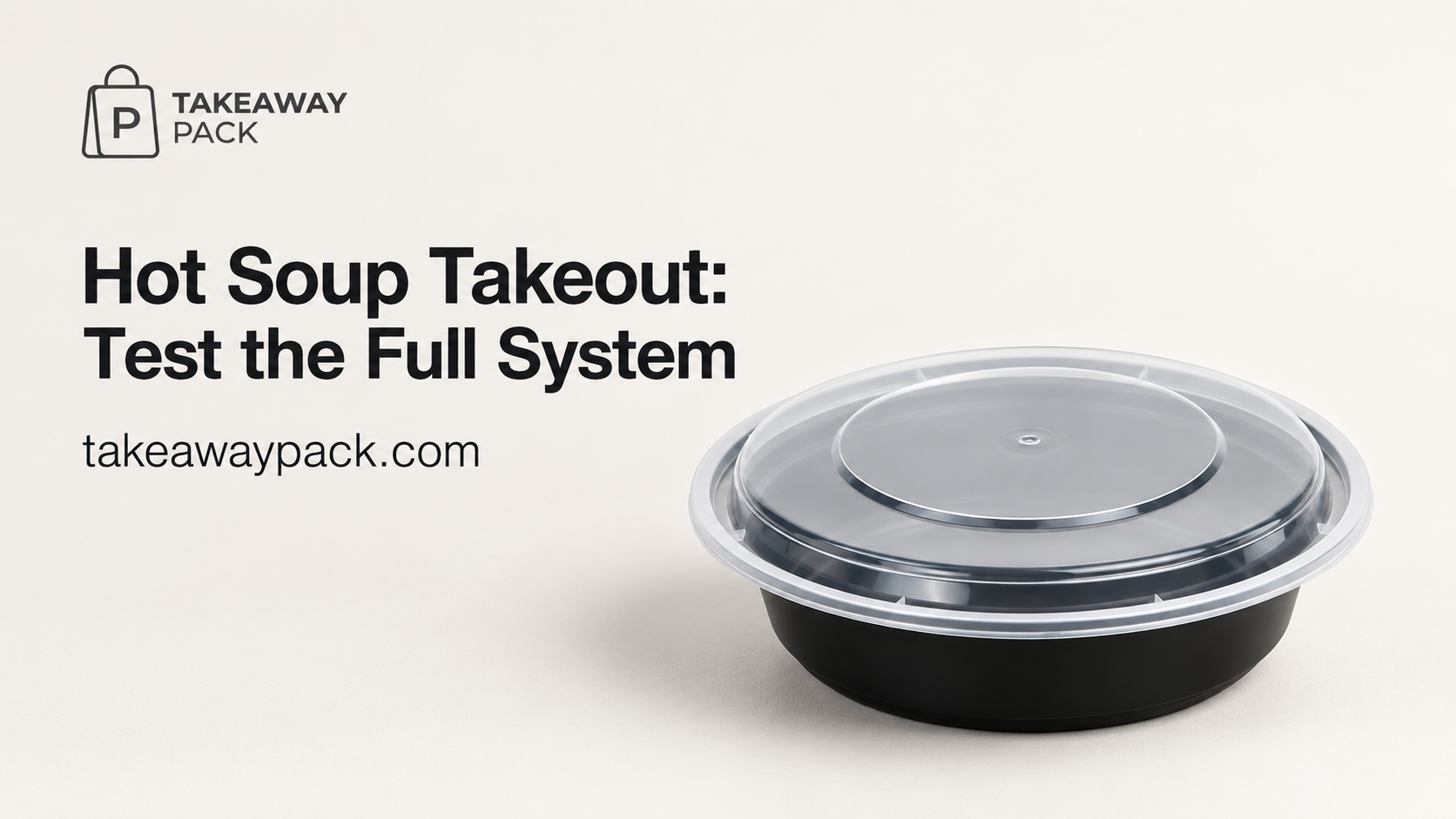
For pho delivery, the safest starting point is a rigid, round hot-liquid container and its exact matching lid—not a mix of containers and leftover lids. Separate broth from noodles and herbs, leave headspace, and test the complete packing routine with hot broth before ordering at volume. A paper soup bowl can work when its matching lid and hot-liquid rating are right; a heavy PP bowl or deli-style container is often the more practical candidate when sealing reliability is the first priority.
This article is estimated to take 4 minutes to read.
Start with a matched bowl-and-lid system
The most useful buying rule is simple: source the bowl and lid as one compatible system. Do not assume that two items with the same stated diameter or capacity will seal together. Small differences at the rim can leave a gap that only shows up after the bowl is hot and full.
For broth-focused pho, assess candidates in this order:
- Rigid walls and base. The filled bowl should stay round and stable when handled. Flex at the rim can compromise the closure.
- A full-rim closure. Press the lid around the entire circumference. A secure closure should be consistent all the way around, not merely engaged in the center.
- A hot-liquid rating for the complete system. Check the supplier’s specification for both the container and lid. Do not transfer a material claim from one item to another.
- A portion-appropriate shape. A wide round bowl is generally easier to fill, seal, and keep upright than a shallow, overfilled format.
Heavy polypropylene (PP) bowls or deli-style containers with matching snap lids are a sensible first category to test for hot broth. PP is commonly used in hot-food systems, but “PP” alone does not prove that any particular bowl and lid will be leak-proof. The actual product pairing and the restaurant’s delivery route still need testing.
Paper soup bowls are another option, especially where presentation or insulation matters. For them, the lining, bowl stiffness, and matching lid matter as much as the paperboard. Select only a system expressly intended for hot liquids, and test it for the actual delivery time rather than treating the material as a guarantee.
Choose capacity by working fill, not brim capacity
A container’s printed capacity is its maximum volume, not an instruction to fill it to the top. Hot broth needs room for movement and expansion. As a practical starting point, fill to about 80–90% of the stated capacity and establish a visible fill line for staff.
For a pho menu, separate components make sizing easier:
- Use one sealed broth container sized for the broth portion.
- Pack noodles and proteins in a separate, wider bowl.
- Keep herbs, bean sprouts, lime, and sauces away from the hot broth.
This approach reduces the amount of liquid in the main food bowl and keeps noodles from continuing to absorb broth during delivery. It also gives customers a clearer, more intentional assembly experience.
Do not choose a bowl only because it looks large enough. Run a plated portion through the real packing line. Include broth volume, solids, headspace, lid clearance, and the space the sealed bowl occupies in the delivery bag.
Vented or non-vented lids: test the specific system
There is no universal “best” vent choice for soup. Venting can help manage steam, but a vent is also a potential path for liquid if the bowl is tipped. A non-vented tight-seal lid prioritizes containment, while a purpose-designed vented lid may be appropriate when a supplier has designed the system to release steam without compromising normal upright transport.
Treat this as a product test, not a theoretical choice:
- For a tight-seal system, check that steam pressure does not lift or distort the lid.
- For a vented system, check for drips during the tilt angles that occur in a delivery bag.
- Do not invert a vented soup bowl and assume it should remain dry; inspect the maker’s stated use conditions.
- Never create ad hoc holes in a lid. That changes an engineered closure into an untested one.
For crispy food, venting usually protects texture. For broth, liquid containment is the non-negotiable requirement. Choose the lid only after a hot, route-specific trial.
Run a hot-broth delivery test before changing suppliers
A short test prevents a long series of refunds. Test a small set of matched systems with your actual broth, not cold water alone.
A repeatable test routine
- Fill the bowl to the intended fill line with service-temperature broth.
- Wipe the rim clean and apply the lid with a full-circumference press.
- Hold the bowl by the sides and inspect the rim for gaps.
- Place it in the same bag, carrier, and stack arrangement used on real orders.
- Move it through typical turns, stops, and handling for the longest normal route.
- Inspect for drips, lid lift, bowl distortion, heat loss, and damage to adjacent items.
Repeat the test with a normal portion of noodles and toppings packed separately. Record the bowl-and-lid SKU, fill amount, broth temperature at packing, route time, and result. That record makes it possible to identify whether a future complaint is a packaging failure, an overfill issue, or a handling problem.
A label or tamper seal can be useful after the closure is proven, but it should not be used to compensate for an incompatible lid. Likewise, wrapping the rim may add mess and labor without fixing a bowl that is fundamentally wrong for the route.
Pack the order so the seal can do its job
Even a well-chosen container can fail in a poor bag setup. Keep the broth bowl upright at the bottom of a flat-bottom bag or in a snug carrier. Use a divider or secondary bag when needed so it cannot slide into cold garnishes or tip against another item.
Train staff on a fixed sequence:
- Pack noodles and proteins.
- Pack dry, cold garnishes and sauces separately.
- Fill, wipe, and seal broth last.
- Perform a quick rim check and upright-placement check.
- Add a simple assembly instruction: reheat the broth as appropriate, then combine.
Standardizing one or two validated bowl-and-lid systems is usually better than stocking many near-duplicates. Fewer combinations reduce the chance of a lid mismatch during a busy service.
What to ask an American supplier
When comparing U.S. distributors or direct suppliers, ask for the exact container-and-lid pairing rather than only a catalog category. Request samples and obtain answers in writing for these questions:
- Which lid SKUs are compatible with this exact bowl SKU?
- Is the full pairing intended for hot liquids? What are its stated temperature and use limits?
- Is the lid vented, non-vented, or adjustable—and what handling conditions apply?
- What capacity is practical below the rim for hot broth?
- Can you provide a sample case and maintain the same pairing on reorders?
- What case quantity, lead time, and delivery coverage apply to my location?
Avoid generic claims such as “leak-proof” without a description of the pairing and intended use. The meaningful proof is a successful test under your own fill level, route time, and bagging method.
A practical first setup for a pho shop
For a shop receiving spill complaints, begin with one rigid round broth-container candidate and its matching lid, plus a separate wide container for noodles and protein. Set a broth fill line below the rim, pack herbs and sauces cold, and run the same route test on at least a few normal orders before replacing all inventory.
If the trial still fails, diagnose the failure point before buying a different material: look for overfilling, a dirty rim, incomplete lid seating, too much bag movement, or a route that keeps soup in transit too long. A better process can solve the problem without multiplying packaging SKUs.
TakeawayPack’s online catalog includes bowls and lids, and its RFQ process can be organized around the container category, material, capacity, quantity, lid matching, customization needs, and destination. For a comparable quote request, start at takeawaypack.com with your broth portion, target fill line, delivery route, and request for a matched bowl-and-lid sample system.