Best Takeout Containers for Tacos and Mexican Street Food
The best container for tacos is the one that matches the order format, the handoff, and the customer’s eating moment. Use an open holder or tray for immediate pickup, a divided lidded format when components need separation, and a menu test with the real food before committing to a purchase.
2026-09-13 - 3 min read
Summary
The best container for tacos is the one that matches the order format, the handoff, and the customer’s eating moment. Use an open holder or tray for immediate pickup, a divided lidded format when components need separation, and a menu test with the real food before committing to a purchase. Estimated reading time: 3 minutes
What is the first question to ask before choosing a taco container?
Question: Should the container be selected by material first?
Answer: Start with the order, not the material. A taco counter may serve an individual taco for immediate eating, a meal with a side, or a delivery bundle with several components. Those are different packaging jobs.
Write down what the guest receives: the taco count, side dishes, sauces, cold toppings, utensils, and any separate beverage or carry item. Then describe how the order moves from the kitchen to the guest. A short pickup handoff and a longer delivery handoff create different priorities.
This approach prevents a common buying error: choosing a format that looks suitable in a catalogue but does not match the assembled menu.
Which format fits each taco order?
Question: When is an open taco holder or tray the sensible choice?
Answer: An open holder or tray can be a practical format for tacos intended to be eaten soon after pickup or served at a counter. It can make the food visible and gives the operation a straightforward way to portion an individual order. It is worth considering when the menu is simple and the customer is likely to eat promptly.
Question: When should a buyer consider a lidded divided container?
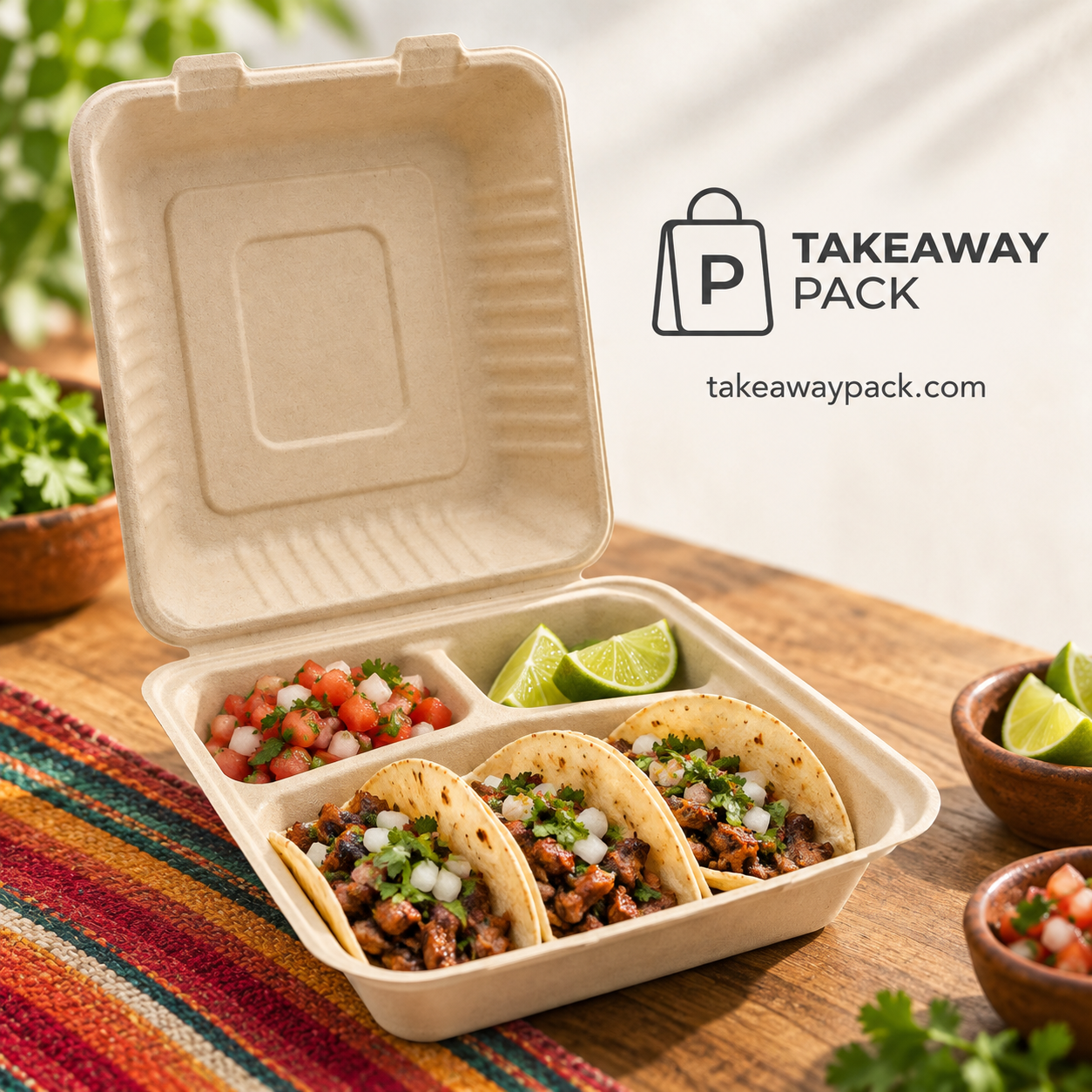
Answer: A lidded divided format may be easier to evaluate when an order includes tacos plus sides, sauces, or toppings that should not be packed together. The relevant decision is not whether more compartments are automatically better. It is whether each compartment serves a real menu need and can be filled consistently during service.
Question: What about a larger combo order?
Answer: Treat a group meal as its own format rather than scaling up an individual-taco pack. List the components, decide what needs a separate container, and consider how the complete order will be carried. This makes it easier to compare a tray, a divided format, and a combination of packs without assuming that one container must do every job.
What needs to stay separate at arrival?
Question: Which components should drive the compartment decision?
Answer: Map the order from hot and cold components to sauces and sides. A buyer can ask whether a sauce belongs in the same pack, whether a cold topping should travel apart from a warm item, and whether a side needs its own space. The answers define the number and purpose of compartments.
The same review should include assembly. A format that is difficult to fill during a busy service period can create inconsistency even if its layout looks sensible on a sample table. Ask staff to identify the fill sequence, the location for each component, and the point at which the lid or carry item enters the workflow.
Question: Does the shell itself need a special claim?
Answer: Do not assume a taco container has a particular grease, leak, heat, microwave, freezer, or food-contact performance because of its appearance or material description. Evaluate the packed menu under the expected conditions instead, and request documentation only for the specific SKU, intended use, destination, quantity, and claim being considered.
How should a taco shop test containers before buying?
Question: What is a useful test protocol?
Answer: Run a small operational comparison using the real menu rather than an empty sample. Pack each candidate format with the normal taco build, the intended toppings, sauces, and side dishes. Use the usual portion sizes and let the order wait for the expected pickup or transport period.
At the end of the test, inspect four things:
- Shell texture: note whether the eating experience has changed during the wait.
- Topping migration: check whether ingredients have moved into places where they do not belong.
- Stacking and carrying: observe how staff handle several finished orders together.
- Customer handling: ask whether the pack is simple to open, carry, and use at the eating location.
Record the result for each menu format. A result that works for an individual pickup taco may not be the decision for a delivery combo. Repeating this test with the actual handoff is more useful than relying on a general container label.
What should be included in the purchasing brief?
Question: What information helps a supplier respond accurately?
Answer: Prepare a brief that names the category you want to evaluate, the approximate dimensions or capacity, the compartment need, the expected quantity, and the destination. Add any print, color, or logo request so it can be assessed as part of the order discussion rather than treated as an assumed feature.
TakeawayPack’s catalogue includes categories such as Cups, Bowls, Boxes, Containers, Trays, Lids, Bags, and Cutlery; specific product, size, material, and availability details remain SKU- and quotation-specific. An inquiry may collect category, material, size or capacity, anticipated quantity, print, color, logo requirements, and destination. Custom-print work is order-confirmed and uses a digital proof based on client files.
For food-contact claims, FDA guidance on food-contact substances explains that food-contact substances that are food additives need an applicable authorization pathway. As a practical procurement step, obtain documentation that is specific to the SKU, intended use, destination, and claim before making or repeating a product claim.
How can a buyer turn the decision into an RFQ?
Question: What is the final decision rule?
Answer: Choose the format that serves the actual menu and handoff after a documented test, then send the purchasing brief with the details that affect the quote. This keeps presentation, component separation, ordering, and claims review in the same decision process.
The supplier network of TakeawayPack offers related products; contact TakeawayPack for SKU/quantity/destination/claim-specific documentation. To discuss a taco or Mexican-street-food packaging brief, contact TakeawayPack.