Do Customers Value Biodegradable Food Packaging Enough to Cover the Cost?
Biodegradable food packaging can be worth testing when it fits the food-service use case and full order economics. Consumer research is a reason to test value and information, not a promise of higher prices or loyalty.
2026-08-13 - 5 min read
Summary
A biodegradable packaging option can be worth evaluating when it supports a defined food-service need and the added cost works for the order. Consumer research on biodegradable food packaging found that participants placed a positive value on it, and that information increased that value. That is useful input for a packaging decision—not a promise that every customer, menu, market, or order will accept a higher price.
The practical choice is to balance four questions: What does the customer receive? What does the pack cost in the full order? Can the packaging work for the actual food and journey? And can every environmental statement be supported for the exact SKU and destination?
What does “customer value” mean in a packaging decision?
Customer value is not the same as a universal willingness to pay. In one consumer study, a choice experiment compared biodegradable plastic packaging with conventional options. The reported average premium was positive, and providing additional information increased the reported valuation further.
That result does not establish a price premium for your own business. The research used a particular consumer sample and product context. A real buyer’s decision may also depend on menu price, brand positioning, food type, presentation, local disposal options, and whether the packaging is easy to understand and use.
Use research as a reason to test a packaging proposition, not as a guarantee of higher conversion, ratings, repeat orders, or margin.
Compare the total cost per usable order
The unit price of a container is only one line in the decision. A meaningful comparison follows one order from packing to delivery and disposal.
Include:
- the container and matching closure;
- any bag, seal, label, or secondary component;
- packing time and storage requirements;
- food loss, leakage, replacement, or refund exposure in your own operation;
- the cost of a clear customer instruction; and
- the quoted commercial terms for the specific configuration.
A pack with a higher purchase price may still be a viable option, but only if its full order economics work for your business. Equally, a lower unit price is not automatically the lower total cost if the selected configuration does not suit the order.
Information can help—but it must be specific
The research finding on information is a useful design lesson: packaging communication can matter alongside the material choice. However, vague language such as “green,” “planet friendly,” or “better for the environment” leaves the customer without a practical instruction and can imply more than the evidence supports.
Before using an environmental message, define:
- 1. The component. Is the statement about the container, lid, bag, label, or the entire assembled pack?
- 2. The supported attribute. What exact material or end-of-life statement is documented for that SKU?
- 3. The condition. Does the statement depend on a particular collection route, treatment setting, market, or component-separation step?
- 4. The action. What should the customer do after use, subject to local rules?
If these answers are not documented, do not replace them with a broad sustainability message.
Test the pack under the food-service conditions that matter
A consumer may value a lower-impact packaging proposition, but the delivered food still needs a suitable packaging configuration. Review the intended menu before treating a material choice as a customer-value decision.
Test the actual SKU with the food’s expected temperature, moisture, grease, fill level, holding time, stacking, matched lid, and delivery handling. Review the complete pack rather than the main container alone. A lid, label, cutlery item, or carry bag can change both the customer experience and the disposal instruction.
Do not make a material, food-contact, compostability, recyclability, or performance claim for a general product category. Confirm it for the relevant SKU, order, and destination.
Turn a packaging change into a measured pilot
If the cost and product fit appear reasonable, make the change testable rather than assuming its commercial effect.
- Define the selected pack and the customer message.
- Keep the menu and fulfillment process as consistent as possible during the comparison.
- Track packaging cost per order and relevant operational signals, such as complaints or damage themes.
- Review feedback without claiming that the packaging alone caused a result.
- Retain the supporting files for every public statement.
This approach respects the fact that consumer valuation varies. It also gives a buyer a clearer basis for deciding whether a packaging specification should continue, change, or stop.
How TakeawayPack can support a fact-bounded sourcing request
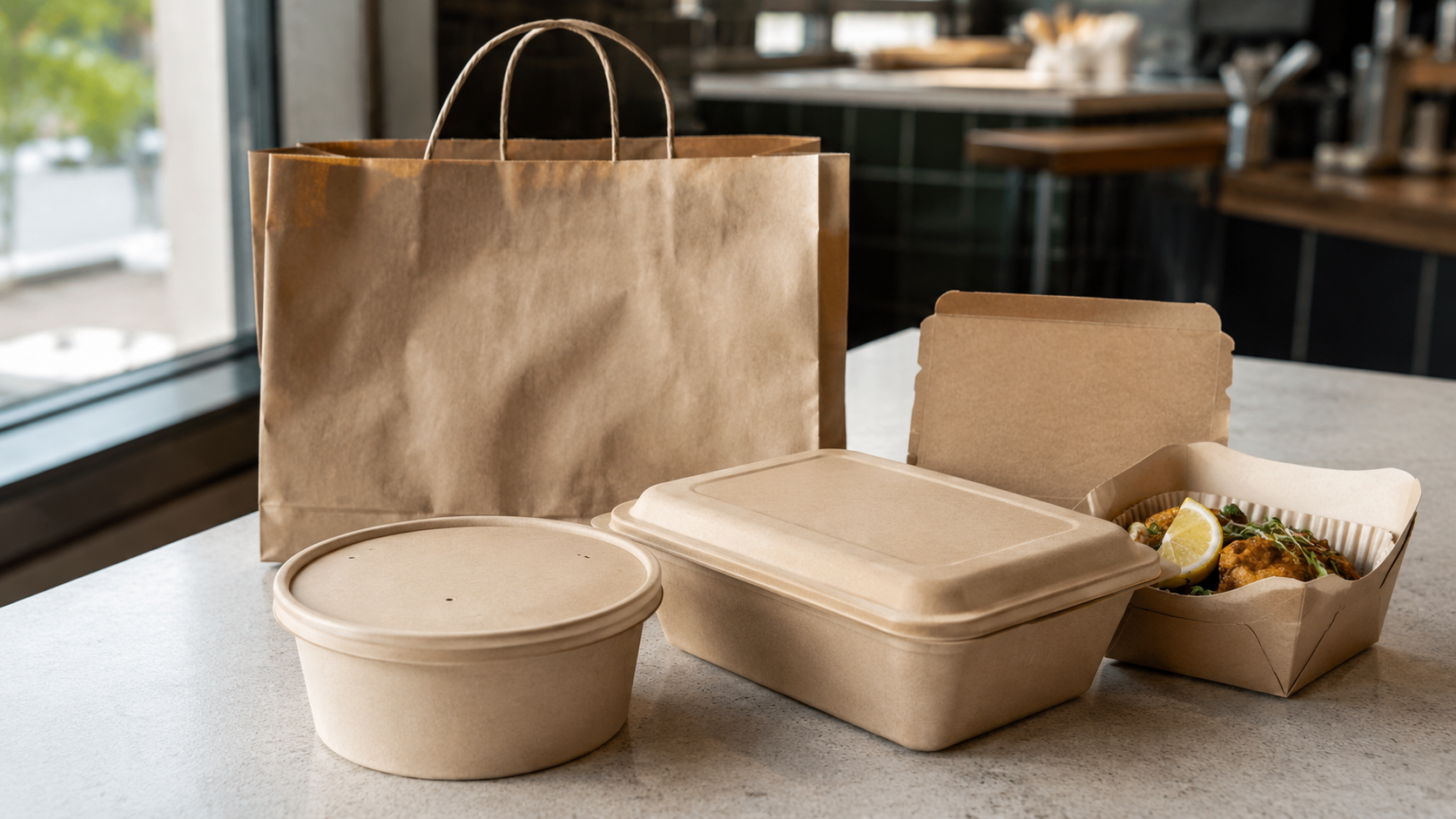
TakeawayPack’s online catalog includes food-service packaging categories such as cups, bowls, boxes, containers, trays, lids, bags, and cutlery. Its RFQ process can capture the product category, material, size or capacity, expected quantity, printing requirements, and destination.
For an order-specific discussion, provide those details and ask that any environmental, material, certification, food-contact, commercial, or delivery information be scoped to the exact SKU, configuration, order, and destination. TakeawayPack can also discuss structure, coating, capacity, printing, lid matching, and carton packing where those details are confirmed for the project.
Bottom line: Consumer research supports testing biodegradable packaging as a value proposition, especially when clear information accompanies the choice. It does not remove the need to validate cost, food-service fit, local end-of-life instructions, and claim evidence.
Disclaimer: This article provides general sourcing and communication guidance, not legal, environmental, waste-management, certification, food-contact, or regulatory advice. Verify current requirements and supporting documentation for the specific product, order, and destination before making a public claim.
Start a fact-bounded packaging inquiry at takeawaypack.com.