Bowl Requirements Should Be Defined for Hot, Saucy or Delivery-Heavy Food Before Supplier Screening
Buyers should define the use requirements for hot, saucy or delivery-heavy food before they screen takeaway bowl suppliers. This applies when the bowl will be filled with hot food, exposed to sauce, oil, moisture or liquid, held before handoff, or carried through delivery. The practical action is to turn those conditions into a written review brief before requesting product information or documents. No conclusion about a particular bowl’s performance, material suitability or food-contact status can be made without the selected configuration and product-specific supporting information.
2026-07-30 - 4 min read
Start With the Food and the Route to the Customer
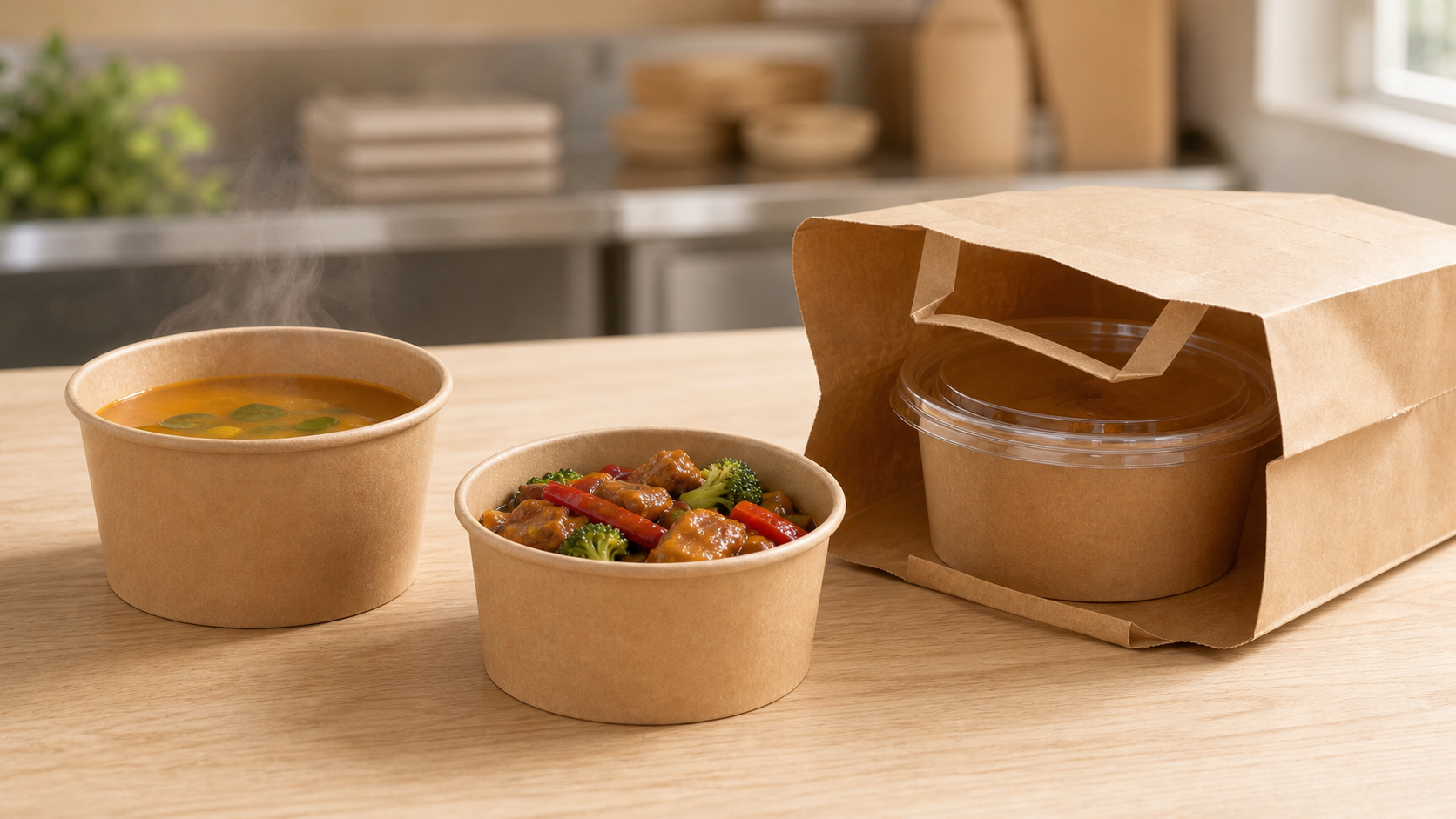
The review brief should describe the food that will contact the bowl, not merely the product category “hot food.” A dry grain bowl, a noodle bowl with broth, and a meal with oily sauce can create different conditions for the packaging system. Buyers should state whether the food contains free liquid, sauce, oil, steam, high moisture or a combination of these. They should also record the expected fill level, whether the food is placed in the bowl immediately after cooking, and whether the bowl may be held before collection.
Delivery conditions belong in the same brief. The relevant route may include packing, stacking, collection, vehicle transport, delivery time and customer handling. A supplier comparison is more useful when every candidate is assessed against the same stated conditions rather than against a general claim that a bowl is intended for takeaway use.
Define the Procurement Decision Before Asking for Evidence
The decision at this stage is not whether a supplier has the most attractive catalogue. It is whether a candidate can be evaluated for the defined use case. A buyer should be able to state the intended food, temperature at filling, expected holding and delivery period, liquid or sauce exposure, and whether a lid is part of the required configuration. Those requirements provide the basis for deciding which product details and documents are relevant to the review.
If the project team cannot describe the use conditions consistently, supplier materials cannot be compared on a like-for-like basis. The appropriate outcome is to pause the shortlist review until the operating conditions have been defined, rather than to treat broad product descriptions as proof of fit.
Use a Written Requirement Set
A concise requirement set should identify the bowl configuration under consideration, the food contact scenario and the delivery path. It should also state the destination market, because the supplier’s documentation discussion must be tied to the applicable project scope. For a US and Canada launch, the team should make clear whether one configuration is being considered for both destinations or whether the evidence request needs to distinguish them.
The requirement set should be specific enough for a supplier to identify the item being discussed. It does not need to predict a result. Its purpose is to make the later product, quotation and documentation review traceable to the same defined use case.
Ask for Evidence That Can Be Matched to the Review
Once the use brief is defined, request the supplier’s product identification and the scope of any food-contact documentation for the reviewed configuration. The request should ask what product or component the material concerns, what intended-use conditions it addresses, and whether it applies to the proposed bowl-and-lid arrangement. Product images, drawings, specifications or quotation references can help establish which configuration is under review.
Documentation should not be treated as a blanket statement about a supplier or a product family. Buyers need to assess whether the evidence can be connected to the selected item, its relevant food-contact components, the intended use and the destination of the project. A generic statement that cannot be tied to those points does not resolve the procurement decision.
Know When Not to Proceed
Do not advance a supplier based on an undefined “hot food” requirement, an unidentified bowl configuration, or documentation that cannot be related to the reviewed product. The review should also pause when the intended food conditions, the role of the lid, or the US and Canada destination scope are unclear. These are evidence gaps, not proof that a product will fail; they prevent a defensible comparison.
Similarly, do not infer resistance to heat, liquid, sauce, oil, leakage or delivery handling from a general product description. Those are product-specific questions that require the relevant configuration and supporting information.
Information Basis and Next Step
The next step is to send each candidate the same written brief: proposed bowl-and-lid configuration, intended food, filling temperature, sauce or liquid exposure, expected holding and delivery conditions, quantity, and destination. Request product-specific information and clarify the scope of any food-contact documentation before ranking candidates.
This approach is based on the principle that packaging documentation and product information must be assessed against the selected SKU, order context and destination. It is not a product test, a compliance determination or a performance claim for any particular bowl.