Can Greasy Pizza Boxes Be Recycled? What Restaurants Should Tell Customers
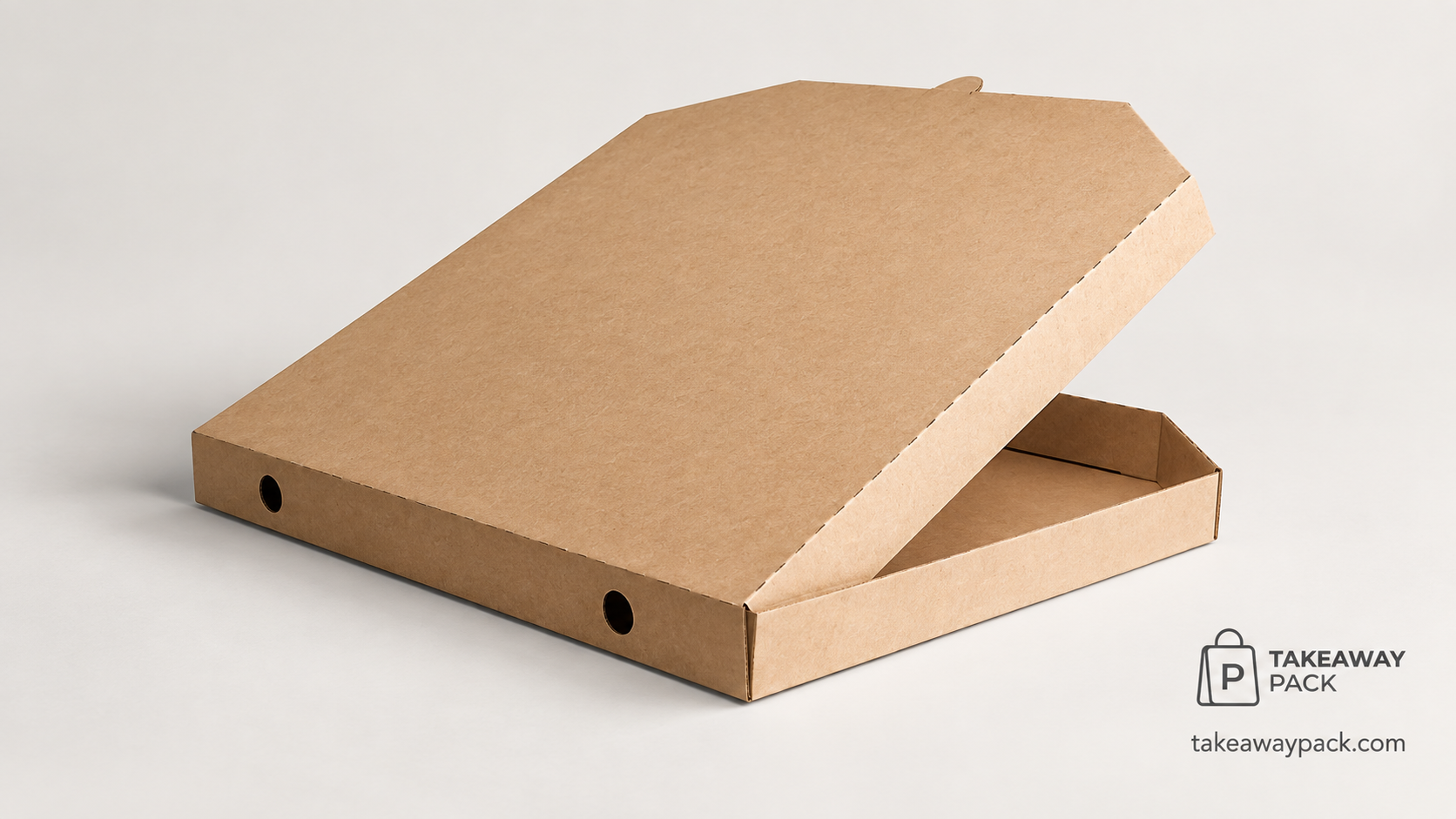
A corrugated pizza box with ordinary grease stains is technically recyclable; a few translucent spots do not automatically destroy its fiber value. The operational answer still depends on the collection program. Remove pizza, crusts, loose cheese, liners, dipping cups, and plastic supports, then fol
2026-09-09 - 7 min read
Summary
A corrugated pizza box with ordinary grease stains is technically recyclable; a few translucent spots do not automatically destroy its fiber value. The operational answer still depends on the collection program. Remove pizza, crusts, loose cheese, liners, dipping cups, and plastic supports, then follow the local authority’s instructions. A saturated box or a box with an unverified coating may need another route. Restaurants should replace the blanket rule “grease means trash” with a short, location-specific sorting message and verify the exact box construction before printing any recyclability claim.
This article is estimated to take 4 minutes to read.
The Short Answer: Normal Grease Does Not Automatically Ruin a Pizza Box
For an empty corrugated pizza box, ordinary grease staining is not by itself a technical reason to reject the whole box. Controlled pulping work has shown that the amounts of grease and residual cheese normally found on recovered pizza boxes do not prevent the fiber from being used in new paper products.
That answer needs two qualifications:
- The box must be empty. Pizza slices, crusts, loose toppings, dipping cups, liners, and plastic supports are not part of the paper-recycling stream.
- The local program makes the collection decision. A material can be technically recyclable while a city, hauler, or processor directs residents to a different bin.
This distinction resolves most of the confusion. “Can a paper mill use this fiber?” and “Will my curbside program collect this box?” are related questions, but they are not identical.
Why the Old “Any Grease Ruins the Batch” Rule Is Too Broad
Paper is recycled by mixing recovered material with water so the fibers separate into pulp. Grease is hydrophobic, so a high enough concentration can interfere with bonding when those fibers are made into new paper. That mechanism is real. The common mistake is treating any visible stain as if it were a damaging concentration.
Mill testing used greasy post-consumer boxes in increasingly severe blends. At ordinary grease levels and at the small share pizza boxes are expected to contribute to the recovered-paper furnish, changes in finished-paper strength were minimal. Meaningful strength loss emerged only under much more concentrated test conditions.
Cheese is a different issue. Its protein component does not behave like grease in fiber bonding, and larger solid pieces can be screened during pulping. That does not mean customers should leave cheese or pizza in the box. It means a small baked-on speck is not the same as loose food waste.
The defensible conclusion is therefore narrow: normal residue does not make every corrugated pizza box unrecyclable, but emptying the box and following local rules remain essential.
Technical Recyclability Is Not the Same as Local Acceptance
Collection programs are designed around local contracts, sorting systems, end markets, and organics services. Their instructions can legitimately differ.
For example, the New York City Department of Sanitation lists lightly soiled pizza boxes with recyclable cardboard. Seattle Public Utilities, by contrast, directs greasy pizza boxes to compost and clean cardboard to recycling.
Neither example creates a nationwide rule. Together, they show why a restaurant should not copy another city’s label or customer script. The source that controls the bin choice is the current official guidance for the place where the box will be discarded.
If the local page is silent, ask the collection provider a precise question: “Do you accept empty corrugated pizza boxes with ordinary grease stains?” Save the written answer and the date. Do not replace an unclear rule with wishful sorting.
Pizza Box Sorting Decision Table
| Box condition | Recommended action | Why |
|---|---|---|
| Empty corrugated box with light or ordinary grease stains | Recycle if the local program accepts pizza boxes | Normal grease does not automatically prevent fiber recovery |
| Box with pizza, crusts, toppings, or loose cheese | Remove the food first, then reassess the empty box | Food waste is not recyclable paper |
| Box with a loose paper liner, plastic support, dipping cup, foil, or film | Separate every removable component and sort each under local rules | Mixed components can follow different waste streams |
| Box soaked through or saturated with grease | Follow local guidance; use compost or trash only where instructed | Programs set different thresholds and may offer different routes |
| Clean lid with a heavily soiled base | Separate only if local instructions recommend it; otherwise follow the whole-box rule | Tearing is a fallback, not a universal requirement |
| Waxed, laminated, poly-lined, or otherwise coated box | Confirm the construction and local acceptance before claiming recyclability | A pizza-box shape does not prove a fiber-only structure |
| Box printed “recyclable” but rejected locally | Follow the local program, not the package claim | A printed symbol cannot create collection access |
A Customer-Facing Answer Restaurants Can Use
A useful counter card, receipt message, or staff response should be brief enough to follow:
Empty the box. Remove food, liners, cups, and plastic pieces. Ordinary grease stains are okay only if our local program accepts pizza boxes. Check [local authority or hauler] for the correct bin.
Where the local program explicitly accepts lightly soiled boxes, the message can be more direct:
Remove food and loose inserts, flatten the empty box, and place it in paper recycling. A few grease stains can stay.
Where greasy boxes belong in organics, say that instead. Avoid “always recyclable,” “100% recyclable,” or “grease never matters.” Those phrases erase the difference between material capability, box construction, contamination level, and local access.
What Restaurants Should Verify Before Printing “Recycle Me”
A printed sorting instruction is a product claim, not decorative copy. Verify four things before approving artwork.
1. The exact box construction
Record the substrate, corrugated grade, flute, recycled-content specification if claimed, and every coating, liner, laminate, window, adhesive, or barrier. “Cardboard” is not a complete material specification.
2. The disposal market
List the cities or service areas where the box will actually be used. If stores span different programs, a universal bin instruction may be inaccurate. A qualified instruction such as “Recycle where accepted” can reduce overstatement, but it should still point customers to a practical local source.
3. The evidence scope
Ask which document supports which statement. A certificate for a company, paper source, or different product does not automatically prove the recyclability of the finished pizza box. Match evidence to the SKU, finished structure, intended use, order, and destination.
4. The final printed proof
Check the exact wording, symbols, placement, and legibility before production. Keep the environmental instruction in an artwork area that can be revised if a local rule or box construction changes.
A Five-Step Pizza Box Recycling Policy for Multi-Location Operators
- Build a packaging record. Give each box construction a SKU-level sheet covering board, coatings, liners, print, and removable components.
- Map destination rules. Link each store or delivery zone to its current official recycling or organics instructions.
- Choose one action per condition. Define the route for an empty box, a food-filled box, a saturated box, and every removable insert.
- Train staff with the same words customers see. Align the box panel, website FAQ, counter sign, and employee response.
- Review on a schedule. Recheck official links and packaging specifications whenever a supplier, coating, artwork, hauler, or municipal program changes.
This policy is more reliable than a national yes-or-no slogan because it connects the science to the actual collection route.
Questions to Put in a Pizza Box RFQ
Before comparing offers, ask every packaging partner for the same information:
- What is the complete material and coating structure of the finished box?
- Is any liner, film, window, laminate, wax, or grease barrier present?
- Which sizes, flute profiles, and carton quantities are available for the order?
- What printing process and artwork limits apply?
- What documentation can be matched to this SKU, order, intended claim, and destination?
- Can the proposed disposal wording and symbol placement be shown on a digital proof?
- What are the quoted MOQ, pricing basis, production timing, packing method, and shipping terms for this exact specification?
Do not infer recyclability from a kraft appearance, a recycling icon, or a general supplier statement. Get the finished construction and claim basis in writing.
The Practical Verdict
Grease is not an automatic veto on corrugated pizza-box recycling. The better rule is: empty the box, remove non-paper items, identify the construction, and follow the current local program. Heavy saturation, coatings, and local collection differences require a more specific decision.
For restaurants sourcing or customizing foodservice boxes, TakeawayPack can structure an RFQ around material, construction, size, quantity, print requirements, and destination, then discuss what documentation is available for the specific SKU, order, and market. Ask for the disposal wording to appear on the digital proof before approving custom printing; final MOQ, timing, product availability, and recyclability claims must be confirmed for the exact request.