Canada’s Single-Use Plastic Ban in 2026: A Toronto Restaurant Buying Checklist
Canada’s federal single-use plastic restrictions remain in force in 2026. A restaurant can be regulated when it sells or gives customers a covered item, so existing plastic bags and straws should not be treated as harmless old stock. The federal rules cover six defined categories, but they do not ba
2026-09-09 - 7 min read
Summary
Canada’s federal single-use plastic restrictions remain in force in 2026. A restaurant can be regulated when it sells or gives customers a covered item, so existing plastic bags and straws should not be treated as harmless old stock. The federal rules cover six defined categories, but they do not ban every plastic takeout container. Toronto adds separate operating rules for accessories, paper bags, reusable bags and beverage cups. Buyers should classify each SKU, obtain construction and test evidence, and qualify alternatives through menu-specific trials before approving an order.
This article is estimated to take 5 minutes to read.
What should a Toronto restaurant do now?
Remove unresolved plastic checkout bags, straws, cutlery and stir sticks from active service until their status is documented. Do not rely on a supplier’s label such as “reusable,” “eco” or “legally cleared.”
The federal regulations prohibit manufacture, import and sale of defined items. For this purpose, sale includes providing an item free of charge. A restaurant handing an accessory to a customer can therefore be within the regulated activity; this is not only a manufacturer or importer issue. The consolidated federal regulations provide the controlling definitions and exceptions.
A customer’s possession of an old straw is a different question from a restaurant supplying it. For an operator, the defensible answer to “Will I get fined?” is that enforcement is possible when an applicable federal or municipal rule is breached. Do not promise that a business will—or will not—be charged.
Toronto’s bylaw has its own offence provisions. A person convicted of contravening Chapter 702 can face a fine from C500 to C100,000; a continuing offence can attract a daily fine of up to C10,000, and total daily fines may exceed C100,000. Those are statutory exposure ranges for Toronto bylaw offences, not a prediction and not the federal penalty schedule.
Which products fall under the federal rules?
“Canada’s plastic ban” is shorthand. Classification depends on the item’s function, shape, material and, for some products, durability.
| Category | What the buyer must establish |
|---|---|
| Checkout bag | Whether it is made wholly or partly from plastic and, if it is a plastic fabric bag, whether it passes the regulation’s carry and wash criteria. |
| Cutlery | Whether a fork, knife, spoon, spork or chopstick contains polystyrene or polyethylene, or changes physical properties after the specified dishwasher cycles. |
| Foodservice ware | Whether a covered clamshell, lidded container, box, cup, plate or bowl is for ready-to-consume food or drink and contains one of the listed problematic plastics or pigments. |
| Ring carrier | Whether flexible rings or bands are designed to surround and carry beverage containers together. |
| Stir stick | Whether the plastic item is designed to stir or mix a drink, or prevent a drink from spilling through its lid. |
| Straw | Whether it meets the regulatory material or durability definition; flexible straws then require a separate exception analysis. |
The foodservice-ware rule is narrower than an all-plastics ban. It applies to the listed formats when they contain expanded polystyrene foam, extruded polystyrene foam, polyvinyl chloride, oxo-degradable plastic, or plastic containing a black pigment produced through partial or incomplete combustion of hydrocarbons.
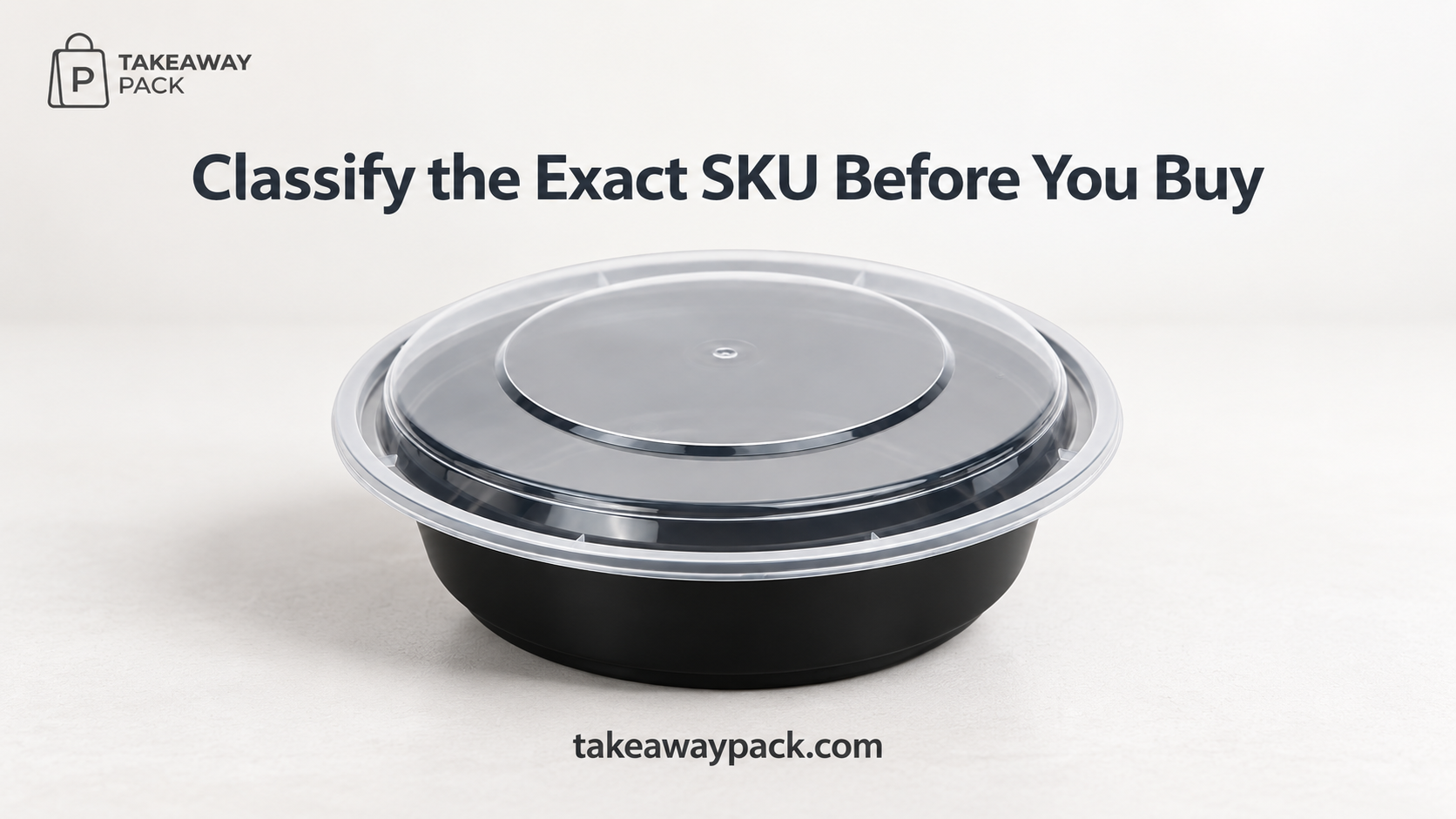
That means neither “plastic” nor “black” settles the question by sight. For example, a clear container is not automatically prohibited merely because it is plastic, while the resin name alone does not resolve whether a black container uses the specified pigment. Require a bill of materials and a pigment or colorant declaration for the exact SKU.
How should a restaurant handle flexible straws?
The federal rules preserve limited routes for single-use plastic flexible straws. They include packages of 20 or more sold business-to-business, qualifying retail packages kept out of public view and sold after a customer request, specified non-commercial settings, and care institutions.
These exceptions do not create a general restaurant-counter permission to hand out individual flexible plastic straws. Maintain accessibility without improvising a legal exception: choose a workable lawful service option and confirm any flexible-straw procedure against the current regulation and qualified local advice.
What does Toronto require in addition?
Toronto Municipal Code Chapter 702 applies to retail business establishments, including eating and drinking establishments, and addresses certain items regardless of material. Its operating rules are separate from the federal product prohibitions.
A Toronto restaurant should configure its counter, kiosk, telephone and online workflows so that:
- single-use accessory food items are supplied only after the customer is asked, after a customer request, or from a self-service station;
- qualifying single-use paper shopping bags are supplied only after the customer is asked or requests one;
- incompatible paper shopping bags are not supplied;
- customers may use reusable shopping bags;
- customers may use reusable beverage cups that meet the bylaw’s suitability conditions; and
- any business selling or providing a beverage in a single-use cup posts the required reusable-cup notice at applicable physical or virtual locations.
The paper-bag request rule has a delivery exception when the restaurant or a third-party delivery service carries the purchased goods off the premises. That exception does not erase the separate rule for accessory food items. The current Chapter 702 text should be checked for the exact definitions, exceptions and offence provisions before procedures are finalized.
How do you audit stock without guessing?
Build the audit from invoices and case labels, not from a catalogue category. Give every item one status: cleared, replace or unresolved.
- Record the supplier, product name, SKU, case pack and lot or invoice reference.
- Describe the function and format: checkout bag, straw, cutlery, stir stick, container, cup or another item.
- Obtain the complete construction, including polymers, fibre layers, coatings, adhesives and colorants where relevant.
- Identify the exact regulatory definition or exception used for the classification.
- Retain applicable laboratory evidence when a physical test determines whether the item is captured.
- Check the separate Toronto operating requirement for that item.
- Quarantine unresolved stock rather than assuming there is a sell-through allowance.
A statement that a material falls outside one federal definition does not establish food-contact suitability, recyclability, compostability or acceptance under another law. Keep those decisions as separate evidence fields.
How should you compare replacement products?
Start with the service function. Eliminate an unnecessary accessory, use a practical reuse system where one can be operated safely, and then evaluate a single-use replacement. This order follows federal guidance for selecting alternatives.
Do not buy by material name alone. Paper, wood, fibre, PET and polypropylene may each be useful in particular applications, but no material class guarantees legal status, food-contact suitability, performance or a local end-of-life route.
For each candidate, run a controlled trial with the actual menu. Record fill condition, hold time, stacking, closure retention, leakage, grease exposure, customer handling and the delivery route. Set acceptance criteria before the test. A legal classification cannot replace a performance trial, and a successful trial cannot replace regulatory documentation.
Compare commercial bids on the same specification. Useful fields include quoted SKU, case pack, minimum order quantity, sample or tooling charges, unit price, freight basis, expected production window, document status and substitution controls. Do not compare unit prices while package sizes or evidence scopes differ.
Before printing disposal language, check the exact item with the local collection and processing routes. A certificate and a municipal acceptance decision answer different questions. Avoid “recyclable,” “compostable” or similar claims unless the product scope and intended destination support them.
What belongs in a supplier RFQ?
Ask every bidder for the same evidence package:
- product name, supplier SKU, dimensions, capacity and intended use;
- complete material construction, including coatings and colorants where relevant;
- a written federal classification with the definition or exception relied on;
- test report, method, laboratory and tested sample identity when durability affects classification;
- food-contact documents applicable to the exact product and Canadian destination;
- certificate holder, certificate number, covered product scope and validity dates for any certification claim;
- sample availability and confirmation that the production item will match the approved sample;
- advance notice and approval before material, pigment, coating, factory or specification changes; and
- quote terms covering quantity, case pack, customization, freight basis and timing.
Reject a blanket compliance statement that cannot be tied to the SKU and order. If the construction or evidence changes, reopen approval rather than treating the replacement as the same item.
Can a restaurant use its remaining bags and straws?
Do not assume old stock can be distributed until exhausted. The current federal prohibition addresses sale, including free provision, and does not state a general restaurant sell-through right for inventory purchased earlier. Segregate the stock, identify the SKU and obtain item-specific advice before returning it to service.
Likewise, do not assume that switching to any paper straw, fibre container or reusable-looking bag closes the issue. The new item still needs an exact classification, food-contact review, operational fit and truthful disposal language.
Build the purchase around evidence
A defensible transition is not a one-word material swap. It is a controlled purchase: classify the current item, define the required function, collect SKU-level documents, test the candidate and preserve the approved specification.
Takeawaypack’s RFQ page accepts product or category, material, size or capacity, estimated quantity, customization and destination details. For a Canadian inquiry, add the proposed regulatory classification, full construction, requested document scope and change-control requirements. Any legal, food-contact, certification or disposal claim should be confirmed for the exact SKU, order and destination rather than treated as a blanket Takeawaypack promise.