Clear-Lid Packaging for Hot Food: How to Assess Condensation and Food Visibility
A clear lid can lose its visual value when steam condenses into droplets. For hot food, refrigerated food, and products that move between temperature zones, buyers should define the real packing and display conditions first. Then they can ask whether a proposed lid uses an anti-fog approach, venting, or both—and request evidence tied to the exact lid-and-container configuration.
2026-08-19 - 5 min read
Summary
A clear lid can lose its visual value when steam condenses into droplets. For hot food, refrigerated food, and products that move between temperature zones, buyers should define the real packing and display conditions first. Then they can ask whether a proposed lid uses an anti-fog approach, venting, or both—and request evidence tied to the exact lid-and-container configuration.
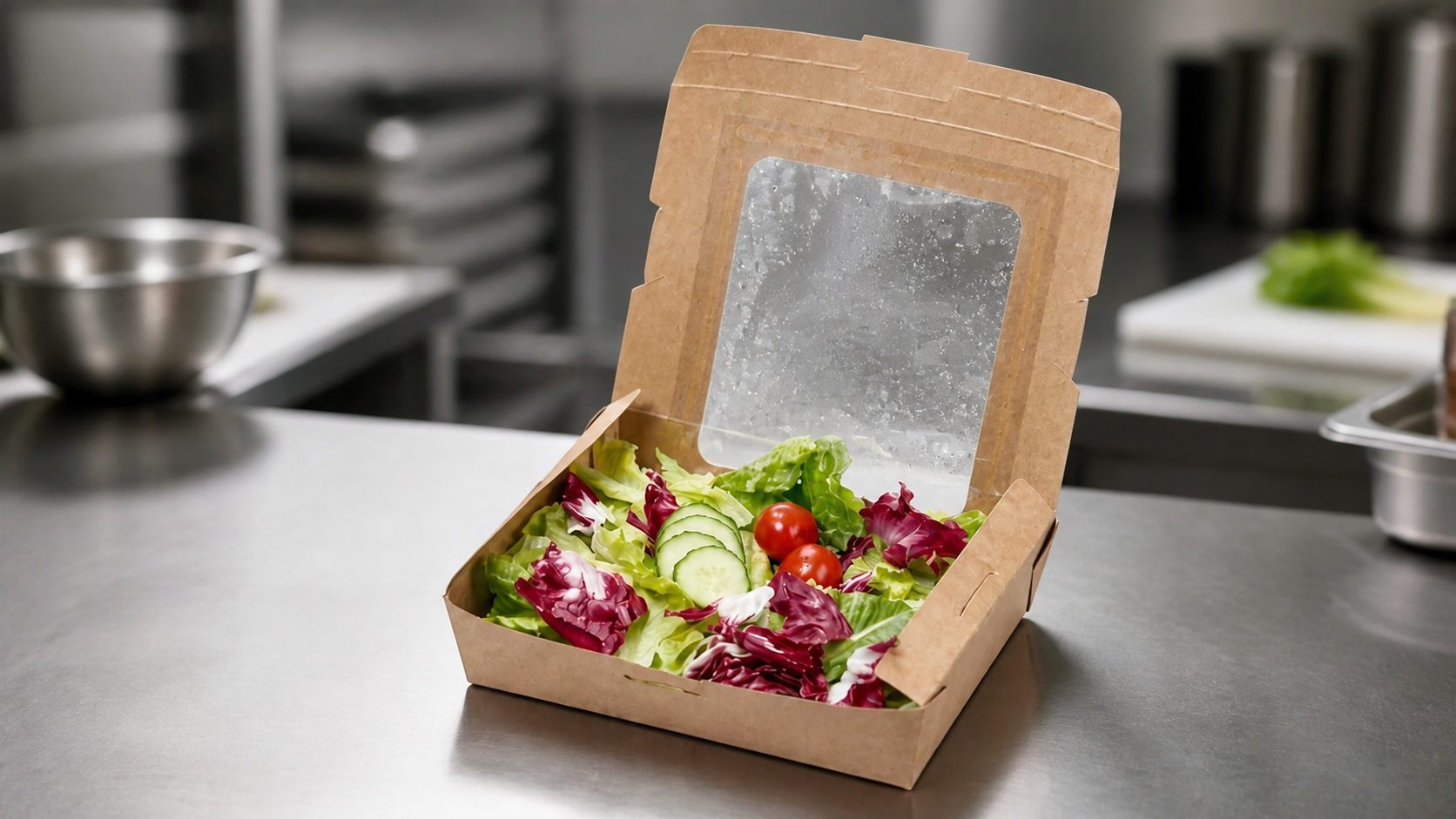
A transparent lid does not automatically remain clear after food is packed. Steam, temperature differences, and trapped moisture can turn a clear view into a cloudy one.
That matters when customers are meant to judge food through the pack. The right question is not simply whether a lid is clear when empty. It is whether the proposed configuration stays readable under the conditions in which it will be filled, held, displayed, and opened.
Why Clear Lids Fog
Fogging is condensation. It occurs when moisture in the air meets a surface at a different temperature and forms many small droplets.
Hot food creates a demanding condition
Warm, moist food releases steam after filling. If that steam reaches a cooler lid, droplets can form on the inside surface and scatter light. The result is a cloudy lid that makes the food harder to see.
The same issue can arise in the opposite direction. A chilled product moved into a warmer environment may also encounter condensation. The greatest risk is often during a temperature change, rather than at one static temperature.
Visibility is a use-condition question
A buyer evaluating a clear lid should map the actual journey of the food. Include the expected filling state, time before closure, holding method, display environment, and any movement into or out of refrigerated or heated service.
This brief turns a broad request for a “clear dome” into a reviewable use case. It also gives suppliers the information needed to respond to a specific configuration rather than a generic product category.
What Anti-Fog Approaches Are Intended to Do
Anti-fog technology is intended to manage how moisture behaves on a packaging surface. Instead of allowing many separate droplets to form, an anti-fog treatment can encourage moisture to spread into a thinner, more uniform layer.
A continuous layer may preserve a clearer view than scattered droplets. But the buyer should not assume that every transparent lid has this feature or that one approach will perform the same way in every temperature profile.
Coating and additive approaches
Two common approaches are surface coatings and additives incorporated into the plastic during material production. A coating is applied to a surface layer. An additive is incorporated into the material and may act at the surface over time.
These are technical approaches, not interchangeable purchase claims. Ask which approach applies to the proposed lid, which surface is treated, and what documentation can be provided for that exact configuration.
Venting can be part of the system
Vents may allow moisture to escape from a package. In a hot-food use case, venting can be considered alongside an anti-fog approach because both affect the moisture conditions inside the pack.
The lid, the container, the food, and the service routine should be reviewed together. A vented lid may change the handling of steam, but it should not be treated as proof that a particular food will remain visible or that a package is suitable for every use.
A Practical Review for Hot Bars and Cold Displays
For a hot bar, observe the pack after real filling and closure, not only before service. Record whether steam is visible, where droplets collect, whether the food remains visible, and how the appearance changes over the intended holding period.
For chilled food, repeat the observation through the expected transition into the display or customer environment. The aim is to identify when condensation appears and whether it affects the presentation that shoppers will see.
Use representative food, not an empty-pack test
Moisture, temperature, headspace, and the food itself all affect condensation. A dry test item may not reveal the conditions created by a hot, sauced, or high-moisture dish.
Use a representative food and the intended fill level. Keep the proposed lid and container together during the evaluation, since the visibility result belongs to the system rather than the lid in isolation.
Compare observations with supplier evidence
Ask for the proposed material and lid configuration, the intended use conditions the supplier considered, and any relevant documentation available for review. Keep the request focused on what is actually being purchased.
If a claim concerns food contact, temperature use, anti-fog treatment, or a particular configuration, request documentation traceable to that claim. Do not extend a general statement about a material or product category to every lid, destination, or food application.
Questions to Put in a Clear-Lid Inquiry
A useful inquiry can include:
- the food type and whether it is hot, chilled, moist, sauced, or dry;
- the expected filling and holding conditions;
- the container and lid configuration under consideration;
- the desired view of the food at display or handoff;
- whether vents are being considered;
- the destination market; and
- the evidence or specifications requested for the proposed configuration.
This information helps turn a visibility concern into a focused supplier discussion. It also makes it easier to separate a visual preference from a substantiated technical claim.
Discussing a Packaging Requirement with TakeawayPack
TakeawayPack’s public inquiry process can collect the product category, material, size or capacity, expected quantity, customization details, and destination country. For projects where lid visibility is important, buyers can also describe the food and temperature conditions and ask to discuss structure, coating, and lid matching for the order under review.
The outcome should be confirmed against the specific item and order. A clear-lid requirement is best treated as a documented purchasing question—not as an assumed feature of every packaging option.
For foodservice packaging inquiries, visit:
https://takeawaypack.com