Clear or Kraft? Choosing the Right Dessert Container for Bakery Takeout and Online Orders
2026-09-07 - 10 min read
Summary:
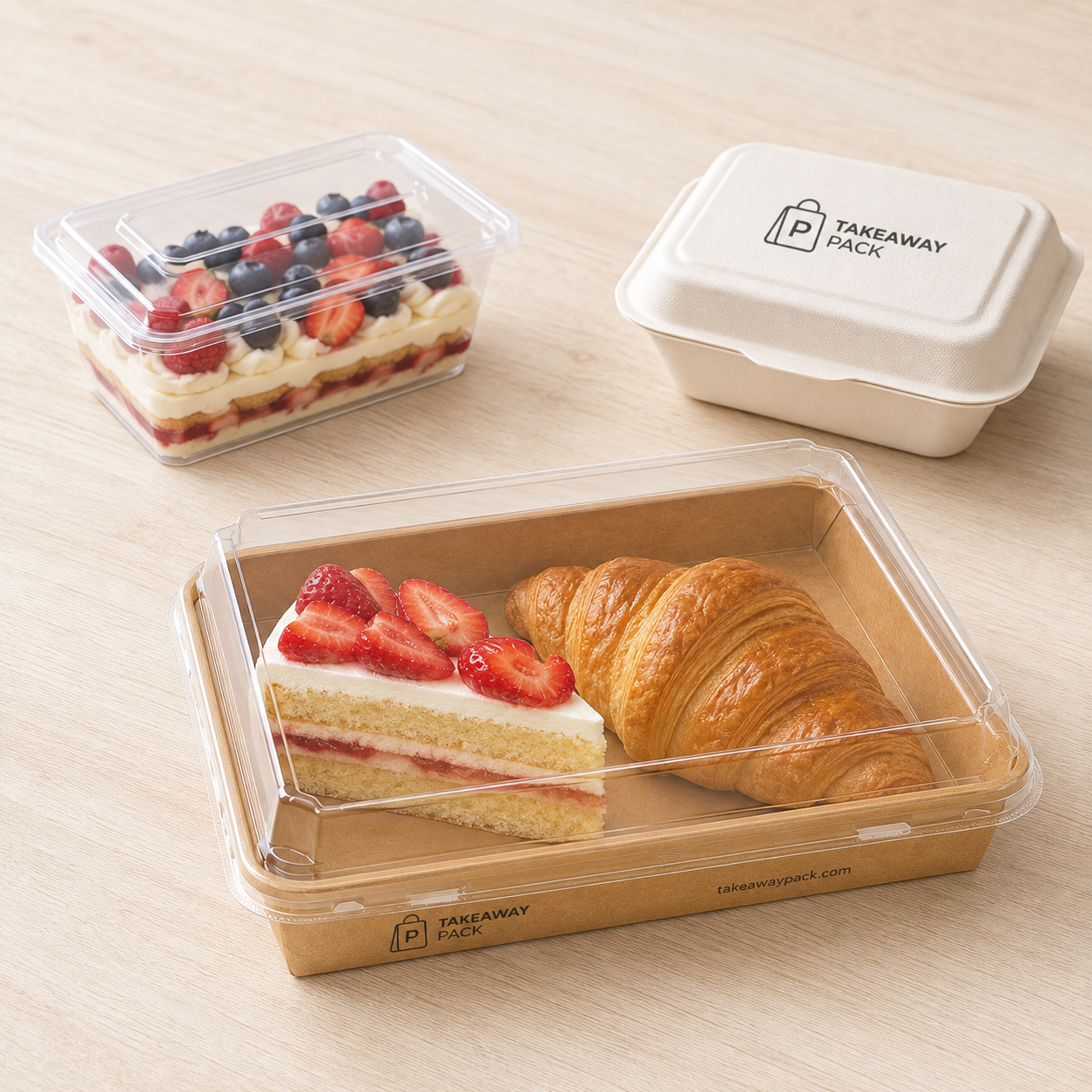
If you run a bakery or café that sells through delivery platforms where customers decide based on photos, your packaging does more than hold food — it has to sell the dessert in the image and survive the trip. Three container types dominate the decision: transparent PET boxes, windowed paper boxes, and solid kraft or white cardboard boxes. Each has a clear role in a bakery menu, and the right mix depends on what you're serving, how your customers order, and what your delivery environment looks like.
Why Container Material Changes How Customers See Your Desserts
When a customer scrolls through a food delivery app, the photo of your dessert is the first thing they judge. A container that smudges, fogs up, or hides the product works against that first impression. The material also determines whether a layered parfait arrives looking like a parfait or a puddle.
Beyond the photo, the container needs to hold up under stacking, courier handling, and the occasional bag drop. And because it touches food directly, buyers need to confirm that the material meets food-contact requirements for their market.
The three most common options — transparent PET, paper boxes with a clear window, and solid paper boxes — each solve a different combination of these problems.
Transparent PET Containers: Maximum Visibility, Strong Protection
PET (polyethylene terephthalate) is the same clear plastic used in water bottles and salad clamshells. In bakery packaging, it shows up as fully transparent hinged boxes, domed lids, and cups.
Where PET works best
- Layered or decorated desserts. Parfaits, trifles, mousse cups, fruit tarts, and multi-layered cakes rely on visual appeal. PET lets the customer see every layer without opening the lid.
- Chilled and moisture-sensitive items. Cheesecake, puddings, and cream-based desserts hold up better because PET does not absorb moisture or grease the way uncoated paper does, so the container itself will not soften or stain from the product.
- Items that need stacking in transit. PET has rigid walls that hold their shape under weight, which matters when a courier stacks several orders in a single bag.
What to watch for with PET
- PET is not biodegradable, and some customers may prefer a material that looks more natural.
- The upfront cost per unit can be higher than basic paper boxes, especially in small quantities.
- Clear plastic can show scratches and fingerprints, which may matter in retail display cases.
PET containers are a practical choice for the desserts that generate the most visual interest on your menu. They are not the right fit for every item, but for the ones that rely on appearance, they are hard to replace.
Paper Boxes with a Transparent Window: Branding Meets Visuals
A paper box with a clear window — typically a PLA (polylactic acid, plant-based) or PET film panel — sits between full-plastic and full-paper. The box body carries your logo and color scheme, while the window gives customers a peek at the product.
Where window boxes work best
- Single-item bakery goods. Croissants, muffins, danishes, cookies, and scones look appealing through a window without needing full transparency. The box body does the branding work.
- Cakes and whole pies. A window cake box lets the customer see the frosting or topping while the paper structure provides the stack strength that a full-plastic box might not be designed for.
- Orders that need logo visibility. If your bakery sells through a platform where repeat customers recognize your packaging, the printed paper surface carries your brand in a way clear plastic cannot.
What to watch for with window boxes
- The window is a cutout covered by film, so the visible area is limited. For heavily layered desserts, a full-PET box may still be better.
- The paper body still has the same moisture and grease sensitivity as a solid paper box, so very wet desserts (fruit compotes, syrupy cakes) may cause staining or softening.
- PLA windows are compostable in industrial facilities but may not be as clear as PET, which can affect photo quality.
Window boxes are a strong middle-ground option for bakeries that want brand presence on the outside and product visibility on the inside.
Solid Paper Boxes: Best for Dry Items and Brand-First Presentation
Solid white cardboard or kraft paper boxes — no window — are the most traditional option. They rely entirely on the printed surface and the customer's existing knowledge of the product.
Where solid paper boxes work best
- Dry pastries and cookies. Biscotti, shortbread, macarons, and bread-based items do not need visibility to sell. The paper box keeps them fresh without the risk of moisture buildup.
- Items sold by description. When customers already know what they are ordering (a standard chocolate chip cookie, a loaf of banana bread), a printed paper box is sufficient and often preferred for its natural look.
- Brand-focused packaging. Paper surfaces accept custom printing, embossing, foil stamping, and full-color artwork. Bakeries selling through their own website or a boutique storefront can use the box as a marketing touchpoint.
- Short-term takeout only. For items consumed within a few hours, paper performs well. For longer shelf life or refrigerated display, the material's lower moisture barrier becomes a limitation.
What to watch for with solid paper boxes
- Solid paper boxes hide the product entirely. On a delivery platform, the product photo is all the customer has — the box itself cannot reinforce the visual in the same way a transparent or windowed option can.
- Uncoated paper absorbs grease and moisture from food, which can weaken the structure. For items with any oil or moisture content, a PE-coated or PLA-lined paper box is advisable.
- Paper is less durable under stacking pressure than PET. Heavy items or multi-order deliveries increase the risk of crushing.
Balancing Photo Display, Stacking, and Food Contact
For a bakery that sells through delivery platforms, the three container types can be used together in a single menu strategy.
Use PET for the photo-driven items. The desserts that stop a customer's scroll — a layered fruit tart, a chocolate mousse with visible toppings, a colorful macaron tower — deserve the full transparency of PET. These are also the items most likely to be chilled, which PET handles well.
Use windowed paper boxes for everyday baked goods. Croissants, muffins, and cookies benefit from the partial view and the branded paper surface. The window gives enough visual confirmation for a mobile order screen while the box body carries your bakery name.
Use solid paper boxes for staples and dry goods. Cookies, biscotti, whole loaves, and items that customers order by habit rather than by photo can go into solid printed boxes. This is also the most cost-effective option for high-volume, low-margin items.
Stacking and transit. For orders that combine multiple items, consider the weight distribution. Heavier PET containers should go at the bottom of a bag. Paper boxes with windows should not be stacked under PET boxes that are much heavier, as the window film may be the weakest point in the structure.
Food contact — what to verify. In the US, materials intended for food contact must comply with FDA regulations under 21 CFR. PET is addressed under 21 CFR 177.1630 (polyethylene phthalate polymers), which specifies the polymer types and conditions of use. Paper and paperboard for food contact fall under 21 CFR 176.170 (aqueous and fatty foods) or 21 CFR 176.180 (dry foods), where the applicable section depends on whether the food is wet, fatty, or dry — a distinction that matters directly for bakery items.
Practically, this means the question to put to a supplier is not "is this food safe?" but "which regulation does this specific item and coating fall under, and what documentation supports it for my market?" If you sell outside the US, ask for the documentation set that applies to your destination market rather than assuming a US declaration transfers. A supplier who can produce per-SKU documentation tied to the material and intended food type is the practical minimum before placing an order.
Sustainability Claims and What Buyers Should Actually Ask For
Environmental claims around packaging are under increasing scrutiny. In the US, the FTC Green Guides set out what a marketer must be able to substantiate. Two sections matter most for bakery packaging:
16 CFR 260.12 on recyclable claims states that a package should not be marketed as recyclable unless it can actually be collected, separated, or recovered from the waste stream through an established recycling program. Unqualified "recyclable" claims are only appropriate when recycling facilities are available to a substantial majority of consumers where the item is sold — the FTC defines "substantial majority" as at least 60 percent.
16 CFR 260.7 on compostable claims requires competent and reliable scientific evidence that all materials in the item will break down into usable compost in a safe and timely manner. It also requires clear qualification if the item cannot be composted in a home compost pile, or if municipal composting facilities are not available to a substantial majority of consumers where it is sold.
For bakery packaging buyers, this translates into concrete questions:
- A paper box labeled "recyclable" is only recyclable in practice if the local facility accepts paper food containers — many do not, because of food residue.
- A PET container with recycled content needs documentation of the specific recycled percentage, not a general statement.
- A PLA window is typically compostable only in an industrial composting facility. Under 260.7, that limitation needs to be stated, not implied.
The practical approach is to ask your supplier for the documentation that supports each claim, tied to the exact SKU, material composition, and destination market. This is the same discipline that applies to food-contact compliance, and the two document sets usually come from the same source.
Matching Containers to Your Bakery Menu
Making the Sourcing Decision
Choosing between PET, windowed paper, and solid paper does not have to be an all-or-nothing decision. Most bakeries end up stocking two or three types and matching them to the item.
If you are starting the sourcing process, the key steps are:
- List your menu by moisture content, fragility, and visual importance. This tells you which material each item needs.
- Check lid compatibility. A PET container needs a PET lid; a paper bowl can take a PET, OPS, or PP lid depending on the rim style. Confirm fit before ordering.
- Request samples for transit testing. Load a container with the actual food item, refrigerate if needed, and simulate a 30-minute courier trip. Check for fogging, softening, leaking, and structural failures.
- Ask for documentation per SKU. Food-contact compliance documentation, and any environmental claims documentation, should be tied to the specific product you are ordering, not a general company statement.
- Consider the branding angle. If your bakery name and logo appearing in customer photos matters to your marketing, a printed paper box with a window or a printed sleeve on a PET container gives you that visibility.
On the sourcing side, the catalog formats that map to this three-way split are already standard categories: PET cups and PET lids for the transparent route, kraft and white cardboard boxes with PET or PLA window panels for the middle route, and solid kraft or white cardboard boxes, trays, and porridge buckets for dry and brand-first items. Lids are the detail most often missed — PET, OPS, PP, and paper lids each fit specific rim diameters, so the container and lid need to be quoted as a pair rather than separately.
TakeawayPack supplies foodservice packaging across these categories to international buyers, working through our own printing factory and a network of packaging manufacturing partners. Window cake boxes, PET-window and PLA-window kraft boxes, salad boxes, PET cups and matched lids, and solid paper containers are all part of the catalog, with custom printing produced against a digital proof that you confirm in writing before production starts. MOQs are flexible depending on whether an item is stock or custom-printed, and confirmed per quote rather than fixed in advance.
If you are working out the right mix for your own menu, the useful starting point is a short list: which items are photo-driven, which are moisture-heavy, what quantities you expect, and which market's documentation you need. Send that to info@takeawaypack.com or call +1 636-298-3606, and the specification, documentation scope, and pricing can be confirmed against your actual requirement rather than a generic recommendation.