
Cold Food Packaging Condensation Control: A Verifiable Process for Delivery and Display
Cold-food condensation is a condition to measure and manage, not a problem a package can universally eliminate. Moisture may appear when a warmer, humid product environment meets cooler package surfaces, but the delivered result also depends on food moisture, headspace, the lid and ventilation design, secondary packaging, storage, and the real route.
2026-08-16 - 9 min read
Summary
Cold-food condensation is a condition to measure and manage, not a problem a package can universally eliminate. Moisture may appear when a warmer, humid product environment meets cooler package surfaces, but the delivered result also depends on food moisture, headspace, the lid and ventilation design, secondary packaging, storage, and the real route.
A practical process defines the food and its temperature history, then compares container-and-lid configurations under representative storage and delivery conditions. Record droplets, fogging, food appearance, closure condition, and moisture transfer to bags or neighboring items. Use the observations to select and re-test a defined configuration rather than relying on a general condensation claim.
Why Condensation Appears in Cold Food Packaging
Condensation is water vapor changing into visible moisture on a cooler surface. For cold food, the useful question is not whether any moisture exists, but where it collects, when it appears, and whether it affects the food, label, closure, or customer presentation.
Three conditions commonly interact:
- a temperature difference between the food or air inside the pack and its surroundings;
- water released by the food, garnish, dressing, or residual wash water; and
- a collection surface, such as a lid, wall, film, or outer wrap.
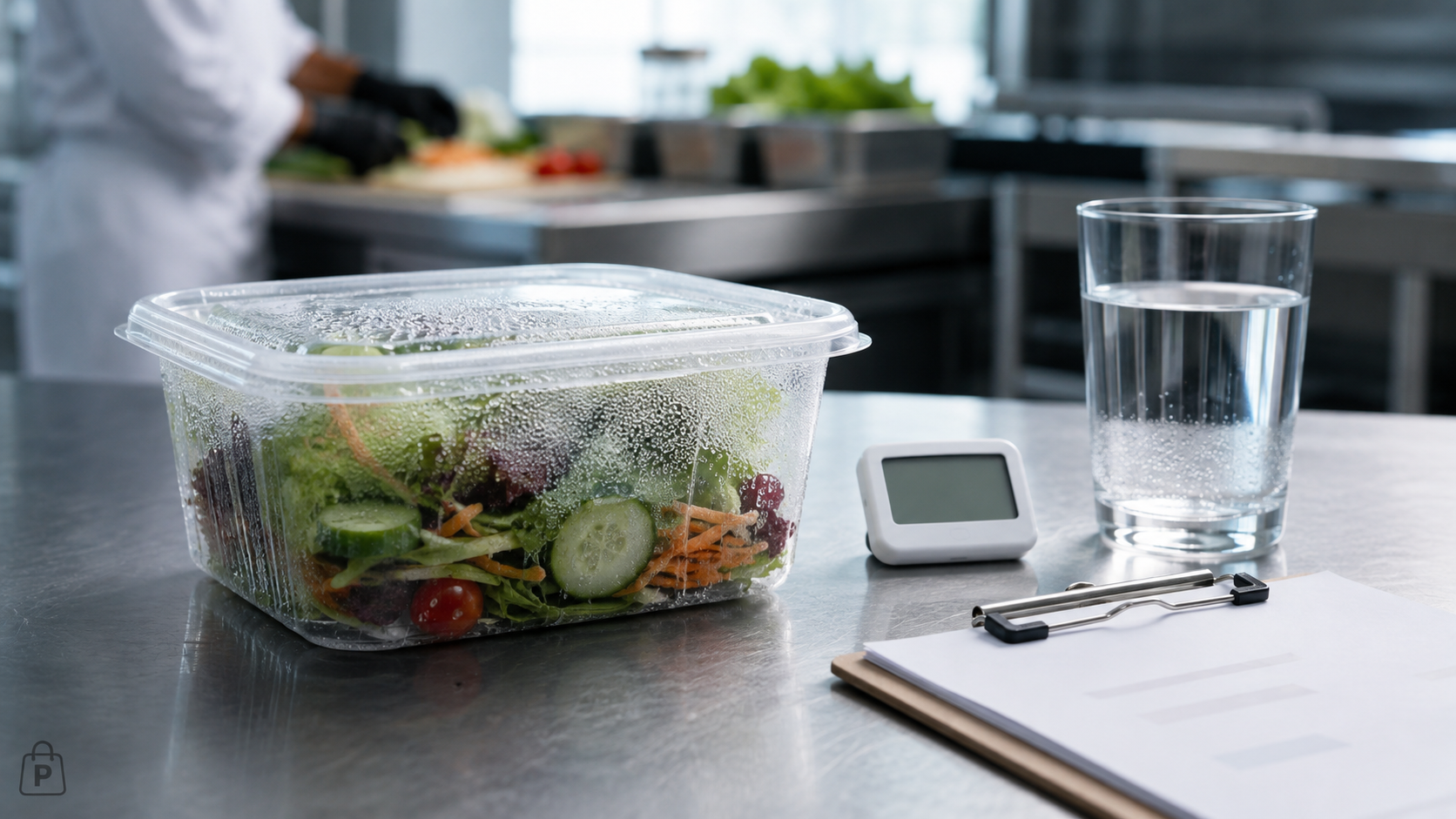
A prepared salad may enter a container after cooling and then move into a refrigerated display or insulated delivery bag. If the product, package, and surrounding air are at different temperatures, the lid can become a collection point for moisture. A similar-looking salad can behave differently when its portion, leafy ingredients, dressing placement, closing time, or storage sequence changes.
The aim is not to promise a perfectly dry package in every condition. It is to reduce avoidable moisture effects and make a packaging decision supported by observations from the intended operation.
Begin With the Product, Not the Container
A package sample cannot answer the condensation question until the product conditions are clear. Create a short product profile for each cold item before comparing formats.
Record the temperature path
Document the temperature and timing at the key handoffs: preparation completion, filling, lid application, refrigeration or bagging, and the assessment endpoint. This record helps the team identify rapid temperature transitions and long uncovered or closed holding periods. It also prevents a test from confusing a warm-packed product with one that followed the normal cold-chain process.
Identify moisture sources in the food
Cold food is not one moisture category. Leafy greens, cut fruit, prepared proteins, pasta, yogurt-based sauces, pickled ingredients, and dressings can contribute moisture in different ways. It may also come from incomplete draining, ingredient migration, ice packs, a prep surface, or a dressing cup in the main compartment.
For each dish, note portion or fill level, free liquid, dressing location, component separation, and whether ingredients are dry, wet, oily, or freshly washed. This gives operations and purchasing teams a reproducible test brief instead of a broad request for a “no-condensation container.”
Define the presentation risk
The relevant outcome varies by menu item. On a clear-lidded salad, droplets may affect product appearance. On a chilled dessert, moisture might affect a label or paper sleeve. On a multi-item order, the concern may be moisture transfer from one pack to another.
State what the team will observe: lid fogging, droplets above food, moisture on a label, pooling in a compartment, softened ingredients, closure interference, wet outer packaging, or changed appearance. A specific observation point makes later comparisons more useful.
Match the Lid and Airflow Strategy to the Food System
A lid is part of the package system, not an interchangeable afterthought. Its fit, headspace, opening features, and contact with the food can affect how vapor moves and where moisture becomes visible.
Use headspace and lid contact as checks
Overfilling can bring food close to the lid and increase the chance that droplets transfer back to the product during handling. Underfilling may create more air volume in which humidity can accumulate. Neither condition proves that a particular format is right or wrong, but both should be held consistent during a comparison.
Check whether the lid touches garnish or tall ingredients, whether the closure is fully engaged, and whether normal stacking distorts the rim. Evaluate filled packages rather than empty containers on a counter.
Treat vents and micro-perforations as variables to test
Ventilation can change air exchange and interior humidity. It can be a useful variable to compare for a defined product, especially where appearance is moisture-sensitive. It can also change moisture retention, protection from the outside environment, or behavior during handling.
Do not assume that a vented lid will solve condensation for every chilled product. Compare a proposed vented configuration with an appropriate alternative using the same recipe, fill level, closing time, refrigeration, and outer pack-out. The result belongs to that specific configuration and test condition.
Keep base and lid combinations controlled
Use the intended base and lid together. A different lid, closure fit, or fill line can change the result, so changes should be recorded rather than treated as minor substitutions. If the test includes film, a liner, an absorbent pad, a divider, or a sauce cup, include it consistently in each sample group.
Review Secondary Packaging and the Cold Chain
Condensation control does not stop at the primary container. A delivery bag, sleeve, tamper-evident label, gel pack, retail display, or stacked tote can alter the package environment after the lid is closed.
Map the storage and transport sequence
Write down the normal path from packing bench to customer or display case. Include refrigeration dwell time, pickup queue time, vehicle conditions, number of stops, stacking orientation, and transfers between chilled and ambient spaces. A test that omits the usual delivery bag or stacks only one container may not represent normal service.
For a 30–45 minute delivery window, use that range as a test condition rather than a temperature or quality promise. If routes commonly run shorter or longer, organize separate observations. Route variability is part of the decision context.
Check outer packaging for trapped moisture
A tightly closed secondary bag can create a different local environment around the food container than an open tray or ventilated tote. It may also collect moisture from the exterior of a cold pack. Review how bags are closed, whether cold packs touch the food container, how many items are stacked together, and whether paper labels or sleeves remain legible.
The goal is to understand the combined pack-out. Changing only the primary container may not address moisture created by the wider storage and transport process.
A Route-Test Protocol for Cold Food Condensation
A small, disciplined trial can produce more useful information than a large rollout based on sample appearance. Keep the process simple enough for staff to repeat.
1. Select the configurations to compare
Choose a current configuration and one proposed alternative. Identify each sample by container, lid, fill level, inserts, label position, outer bag, and ventilation feature. Avoid comparing several unrelated changes at once; otherwise, the team cannot tell what influenced the result.
2. Pack representative menu items
Use the actual recipe, normal portion, normal prep workflow, and normal closing practice. Include the usual dressing cups, toppings, labels, and secondary packaging. If the operation serves several food types, test each relevant item separately rather than applying one salad result to fruit, desserts, and prepared meals.
3. Recreate the intended journey
Put samples through representative refrigerated holding, pickup timing, bagging, stacking, and transport. Record elapsed time, major temperature transitions, route events, and whether the package was opened or moved unusually. Repeating the trial on more than one representative day can show whether one observation is stable enough to guide the next step.
4. Inspect at planned checkpoints
Inspect at packing, after cold holding, and at the delivery or display endpoint. Use a consistent scorecard that captures:
- visible fogging or droplets on lids and walls;
- location and amount of free moisture;
- food appearance and contact with the lid;
- label, sleeve, and outer-bag condition;
- lid engagement, rim condition, and signs of leakage or moisture migration;
- stacking effects; and
- unusual route, handling, or timing conditions.
Photos from the same angle can aid discussion, but they should accompany written observations. If the business checks food temperatures, do so using its own food-safety procedures; do not use this packaging trial as a substitute for those procedures.
5. Decide, document, and repeat after material changes
Choose the next action from observed trade-offs. It may mean retaining the current configuration, trialing a different lid strategy, changing a fill or cooling step, separating wet components, or revising the outer pack-out. Record the assessed configuration and the limits of the result.
Re-test when a meaningful variable changes: recipe, portion, ingredient moisture, fill level, container size, lid, packaging sequence, refrigerated hold, delivery route, or supplier specification. A favorable result for one setup does not automatically transfer to another.
Use the Trial to Review Cost Without Overstating Results
Condensation control involves more than container unit price. Consider the package, lid, secondary materials, labor steps, SKU complexity, storage space, and documented quality outcomes for the defined food and route.
Ask practical questions:
- Which observed issue is the trial intended to address?
- Does the proposed configuration introduce a new concern, such as altered moisture retention or more complex packing?
- Could cooling timing, ingredient draining, component separation, or bagging sequence be adjusted before changing the container?
- Can a defined group of similar menu items share one validated process?
- What information would be needed before expanding the trial to more locations or routes?
This makes cost part of an operational decision, not a reason to adopt a packaging feature without evidence from the real menu and delivery process.
FAQ: Cold Food Packaging and Condensation
Can a package prevent all visible condensation in cold food?
No universal package claim can establish that outcome. Condensation depends on food moisture, temperature differences, package configuration, handling, storage, and route. A controlled trial can show how a specified configuration performed under documented conditions.
Should cold food be sealed immediately after preparation?
Use the operation's defined handling and food-safety procedures, then test the actual packing sequence. Timing between preparation, cooling, and lid application may affect the moisture environment, so record it as part of the trial rather than treating it as irrelevant.
Are vented lids always better for chilled foods?
No. Venting is one configuration variable that can alter humidity and moisture retention. Assess its effect with the actual food, base-and-lid combination, outer packaging, storage process, and route.
What should a buyer include when requesting packaging samples or an RFQ?
Include food type, portion and fill level, moisture characteristics, temperature and holding sequence, expected storage and delivery window, proposed lid or closure preference, outer pack-out, estimated quantity, destination, and customization requirements. This information makes a SKU-specific conversation more useful.
Takeaway
A verifiable condensation-control process begins with the food and its journey, then compares defined packaging systems under the conditions they will actually face. Track temperature transitions, food moisture, lid and airflow choices, outer packaging, storage, transport, and observable results. Use the records to refine a specific configuration and re-check it when the menu or route changes.
For an RFQ or custom-packaging discussion, contact TakeawayPack with the proposed SKU or product category, food and portion details, expected storage and delivery route, preferred closure or ventilation approach, quantity, destination, and customization needs. Treat any configuration as a project to confirm: suitability, performance, documentation, and commercial details should be reviewed for the specific SKU, food, order, use conditions, and destination before a sourcing decision.