Cold Salad Packaging for Delivery and Display: How to Build the Right Brief
Cold grab-and-go food needs a packaging brief that considers the food, the route, and the moment of purchase together. For salads, sandwiches, and fruit cups, assess visibility, moisture management, closure behavior, portion layout, and handling as one system. Start with the actual menu and test the proposed pack with the intended food before approving it.
2026-08-19 - 5 min read
Summary
Cold grab-and-go food needs a packaging brief that considers the food, the route, and the moment of purchase together. For salads, sandwiches, and fruit cups, assess visibility, moisture management, closure behavior, portion layout, and handling as one system. Start with the actual menu and test the proposed pack with the intended food before approving it.
Cold meals can look straightforward until they are packed, moved, displayed, and opened. Leaves, cut fruit, toppings, and dressing do not create the same conditions inside a pack.
A useful brief therefore starts with the food rather than with a container category alone.
Start With the Cold Meal and Its Journey
List each component that enters the pack. Note which components are wet, which must stay separate, and which can shift when the pack is carried.
Then map the journey from packing to handoff, transport, cold display, and customer opening. This gives the packaging team a shared scenario to evaluate.
Define What the Customer Must See
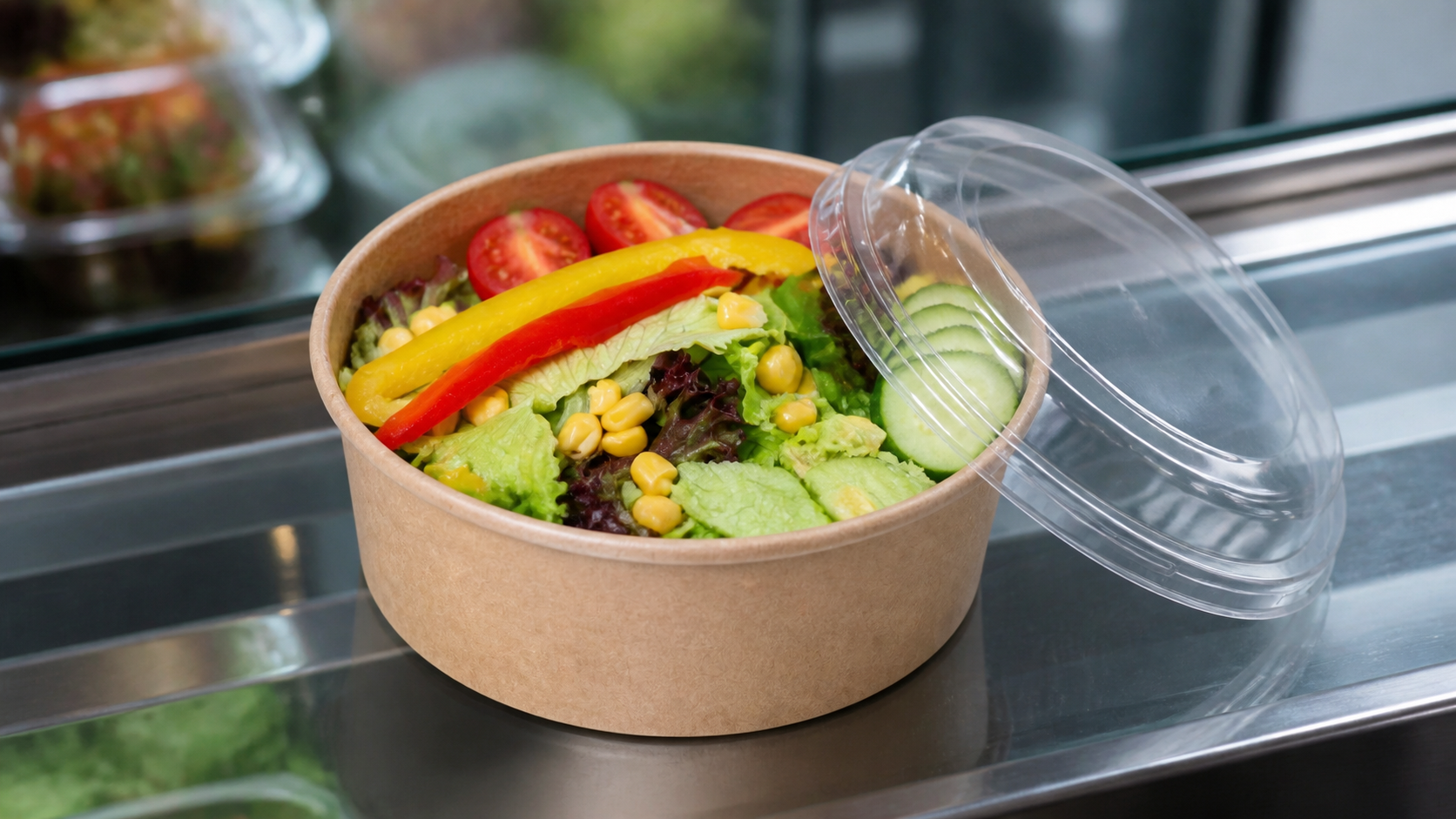
For many grab-and-go cold meals, the customer needs to see the food before purchase. A clear lid or viewing window may help present the portion, colour, and arrangement.
Visibility is only one requirement. The selected format still needs to suit the food, the closure, and the route it will take.
Keep Components Deliberately Organised
Dressing, croutons, fruit, and other additions can change the condition of a salad when they meet too early. Decide whether they belong inside the main pack, in a separate component, or in a divided layout.
The answer should follow the recipe and service method. A format that works for a dressed salad may not be the right starting point for a build-your-own bowl.
Evaluate Moisture, Fogging, and Closure Together
Cold ingredients can create visible moisture inside a closed pack. That can affect presentation and make it harder to judge the meal through a clear surface.
Instead of treating fogging as a lid-only issue, review the food temperature at packing, the time before display, the amount of headspace, and the proposed closure together.
Test the Proposed Pack With the Real Fill
Use the intended recipe, fill level, and dressing quantity when reviewing samples. Close the pack as it would be closed in normal service.
Check it after the expected holding and transport stages. Look for displaced components, visible moisture, closure problems, and changes in how the meal presents.
Balance Airflow and Spill Risk
A cold pack may need a different approach depending on whether it will be collected quickly, carried in a delivery bag, or held for display. More airflow is not automatically better, and a more closed format is not automatically better either.
Record the trade-off in the brief. The goal is to choose a configuration that fits the stated service conditions, then confirm it with samples.
Choose Shape and Volume Around the Menu
A shallow format can make a composed salad easy to view. A deeper format may suit bulkier toppings or a larger meal. Neither is universally better.
State the target portion and the presentation goal before comparing shapes. Include the expected lid, because the bowl-and-lid pairing is part of the working pack.
Plan for Display and Delivery Handling
If packs will be stacked in a cold case or placed in delivery bags, document the expected orientation and handling. This turns a general request for “salad packaging” into a usable evaluation brief.
Review the complete filled configuration rather than the empty base alone. A pack should be assessed in the form customers and staff will actually handle.
Avoid Common Shortcuts
Do not select a format only because it looks clear in an empty product image. The filled meal, cold conditions, and closure can change the result.
Do not assume one salad format suits sandwiches, fruit cups, and grain bowls. These foods can differ in moisture, height, component separation, and customer expectations.
Do not make a final choice without checking samples against the defined use case. A documented trial is more useful than a generic packaging claim.
Build a Practical Supplier Conversation
Bring a short project brief to the supplier discussion. Include the food type, portion, ingredient layout, dressing plan, packing temperature, expected holding period, display method, route, and proposed bowl-and-lid or box-and-lid configuration.
Ask for the relevant product information for that configuration. Keep questions about performance tied to the actual food and handling scenario instead of treating a general category description as a result for every use.
A Relevant Starting Point From TakeawayPack
TakeawayPack’s catalogue includes a kraft paper salad bowl described for salads, fruit, grain bowls, and other fresh takeaway foods. It also includes kraft paper salad boxes with a clear window described for salads and takeaway food.
Those formats can provide a useful starting point for a cold-menu discussion. The final selection should still be reviewed against the intended recipe, lid or closure, display plan, and handling conditions.
Conclusion
Good cold salad packaging begins with a clear operating brief. Define the meal, separate components where needed, consider visibility and moisture together, and test the filled pack through its intended journey.
For a discussion of salad bowls or windowed salad-box formats for a defined cold-food project, visit
https://takeawaypack.com