Combo Meal Packaging: How to Reduce Order Errors with Smart Container Design
Multi-item combo meals — a main dish, two sides, three sauces, and a beverage — are the most error-prone orders in food delivery. New packers, tight timelines, and visually identical containers produce missing items, swapped sauces, and wrong sides.
2026-09-07 - 13 min read
Summary: Multi-item combo meals — a main dish, two sides, three sauces, and a beverage — are the most error-prone orders in food delivery. New packers, tight timelines, and visually identical containers produce missing items, swapped sauces, and wrong sides. The fix is a structured packaging system using different-sized containers, color-coded lids, clear labeling, and a standardized bag layout so every order checks itself. This article covers container sizing, visual coding, seal workflows, bag organization rules, and training that reduces combo errors without slowing down packing.
Why Combo Meals Create the Most Packing Errors
Combo and set meals are a top revenue driver for restaurants, ghost kitchens, and food trucks. A typical two-person combo includes a main protein, two sides, three sauces, and two beverages — seven or more individual items per order. During a rush, those seven items become seven opportunities for error.
The root causes are predictable. New packers cannot visually distinguish containers that look the same. Sauce cups stored in a single bin get grabbed in the wrong combination. The bag has no designated positions, so items are placed arbitrarily. There is no physical checklist at the station, and no final verification step that catches a missing item before the bag is sealed.
These problems compound. A missing sauce costs pennies in product, but it triggers a refund, a negative review, or a re-delivery. For a kitchen processing 200 delivery orders per day, even a 5% error rate means roughly 10 disappointed customers every shift.
The fix is not hiring more experienced packers. The fix is designing a packaging system that guides the packer to the correct decision at every step — using container size, color, labels, and physical layout as built-in error prevention.
Container Sizing Strategy: One Size Does Not Fit All
The most common mistake in combo packaging is using one container size for everything. When a 120 ml sauce cup and a 30 ml cup share the same diameter, the packer must read a label to tell them apart — and under time pressure, labels get skipped.
Match container size to portion size. Each item should have a distinct container volume that signals what it holds. The main dish gets the largest container — typically a 750 ml to 1000 ml bowl. Each side goes into a medium container, 350 ml to 500 ml. Each sauce gets a clearly differentiated cup size or shape.
The principle is simple: the packer should be able to grab the correct container by feel and visual recognition alone, without reading a label. That turns identification into pattern matching rather than text reading — which is far more reliable under time pressure.
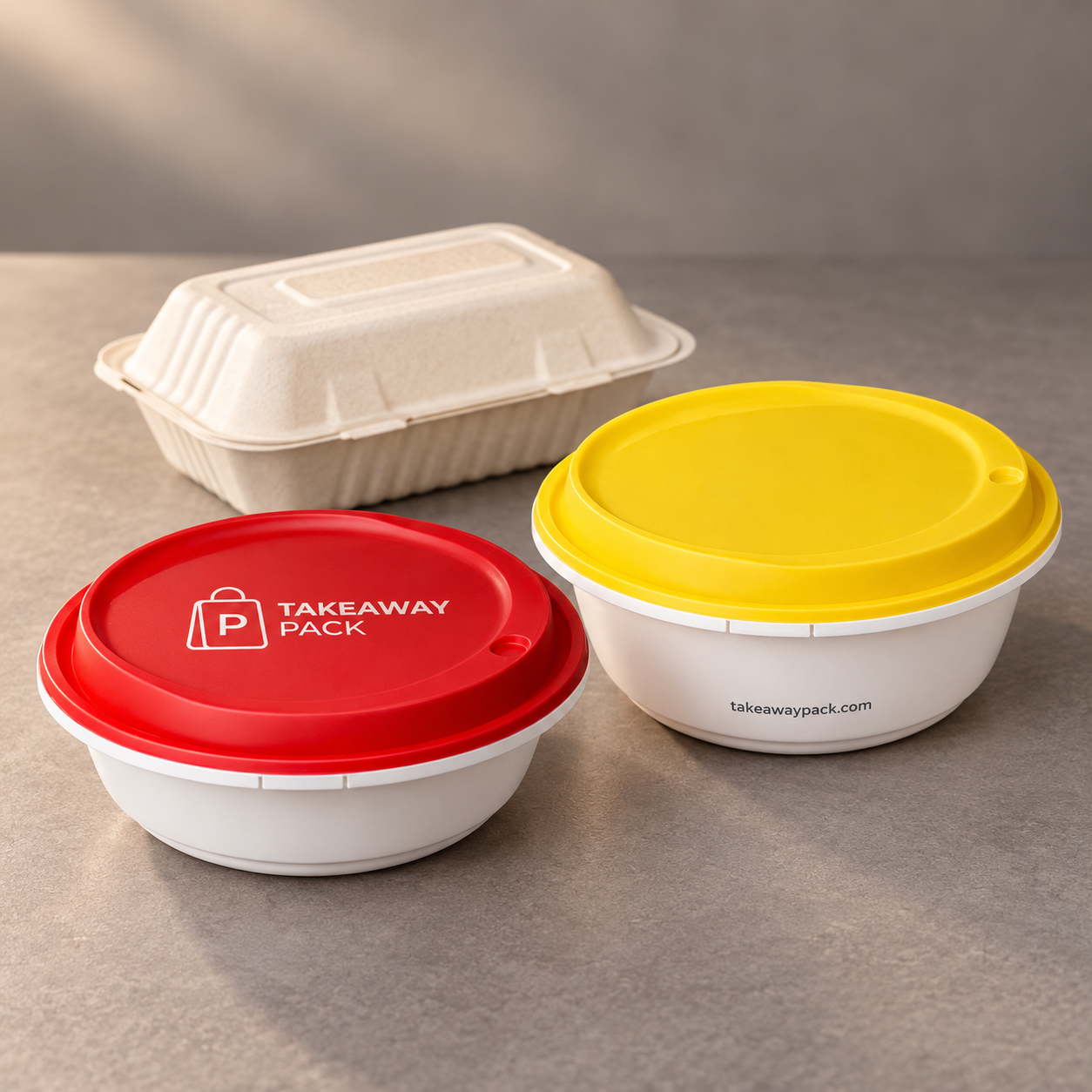
Custom container sizing for combo menus. A restaurant running a standard two-person combo can order containers matched to those exact portions. A supplier like takeawaypack.com carries lock-lid PP bowls from 750 ml to 2000 ml, kraft soup tubs with PP lids, compartment trays, and sauce cups in multiple sizes. Instead of generic containers that are too large (wasted material) or too small (spills), match each item to its ideal volume.
For example, a fried chicken combo with two sides might use:
- Main: 1000 ml lock-lid PP bowl (holds a full breast, thigh, and wing portion)
- Side 1 (coleslaw): 500 ml kraft tub with clear domed lid
- Side 2 (fries): 750 ml vented compartment tray to let steam escape
- Sauce 1 (BBQ): 60 ml round cup with foil seal
- Sauce 2 (ranch): 45 ml square cup — different shape, no confusion
- Sauce 3 (honey mustard): 30 ml round cup, noticeably smaller
Every item is now identifiable by its container alone. The packer never needs to pause and read.
Color Coding: The Visual Language of Accuracy
Color is the fastest communication channel available at a packing station, because recognizing a color is quicker and less error-prone than reading text. Colored lids, colored containers, or colored stickers create a visual system that prevents errors rather than catching them afterward.
Lid color coding. Assign a lid color to each item category. Black lids for the main dish. White lids for sides. Red lids for spicy sauces. Green for mild sauces. Blue for beverages. The packer grabs by color, not by reading. This works best with clear or translucent container bodies so the food inside stays visible. Custom-colored lids typically require a minimum order of 500 to 1000 units — feasible for any restaurant with steady delivery volume.
Color-coded sauce cups. Sauce errors are the most common combo meal mistake because sauce cups are small, numerous, and often identical. Using different cup colors for each sauce type eliminates the need to read labels. A red cup always means buffalo sauce. A yellow cup always means honey mustard. A green cup always means herb ranch. The packer fills cups by color, checks by color, and bags by color.
Color-coded stickers as a fallback. For restaurants that cannot switch container colors, adhesive color dots applied to the lid serve the same function. The packer applies a red dot to the buffalo sauce lid, a yellow dot to the honey mustard lid, and so on. While this adds a step, it is faster than reading labels and works with existing container inventory.
Tamper-Evident Seals and Stickers: Accuracy and Trust
Tamper-evident seals serve two purposes. They provide visible proof the package was not opened during transit, and they act as a verification step — applying a seal to every container creates a natural moment to count and confirm.
Seal-as-you-go workflow. The most error-prone method is assembling all items, then sealing all items, then bagging all items. A better workflow is sequential: fill one container, seal it, place it in the bag, repeat. This forces the packer to account for each item as it is sealed.
Branded seals. Custom-printed tamper-evident stickers carrying your logo serve as both a seal and a brand touchpoint. The sticker bridges the lid and the container body; if it is intact at delivery, the customer knows the food has not been accessed.
Takeawaypack.com offers custom-printed stickers and seals with minimum order quantities as low as 500 units, which puts branded sealing within reach of a single-location restaurant or food truck. Ask for pricing at your actual monthly volume — seals are among the lowest-cost accuracy tools available.
Beverage seals. Beverages are often forgotten or swapped. A seal over the beverage lid provides a visible cue that the drink has been accounted for. Using a distinct seal color for beverages — blue on drinks, amber on food — lets the packer confirm at a glance that both food and drink are present.
Standardized Bag Layout: Every Item Has a Home
The arrangement of items inside the delivery bag is the final layer of error prevention. When every item has a designated position, the packer spots a missing item by the empty space it leaves behind.
Zone-based bag layout. Divide the bag into four zones, one per item category. Main dish in the center. Sides on the left. Sauces on the right. Beverages at the front, closest to the opening where they are least likely to be crushed. The layout stays identical across every combo order, so the packer follows it automatically.
Compartments and dividers. Compartment trays or bags with internal dividers enforce the zone layout physically. A four-section tray separates the main, two sides, and sauce grouping. The packer fills each compartment in sequence, and an empty compartment at closing time signals a missing item.
Combo-specific packaging inserts. Some restaurants use a cardboard insert or tray that fits inside the delivery bag and holds each item in its assigned position. This is common in the fast-casual segment for large combo orders. The insert adds cost per order but sharply reduces item-level errors, and at meaningful order volume the reduction in refunds typically outweighs the added material cost.
Beverage positioning. Beverages are frequently the missed item in combo meals because they are often prepared at a separate station. A dedicated beverage slot — a single or double cup carrier, a built-in cup holder, or a designated tray position — ensures the drink is not forgotten. The packer fills the beverage slot last, so the empty slot acts as a visible reminder that the drink is still pending.
Training New Packers: The System Does the Teaching
Packaging systems built on container size, color, and layout reduce the training burden on new staff, because the system itself guides the packer.
The twelve-hour training path. A new packer can learn the whole system in about twelve hours of supervised packing: container identification by size and color first, then the sauce cup color system, then the bag layout zones, then seal application and the self-check. After that the packer works independently, relying on the reference card rather than memory.
Printed reference cards. A laminated reference card at the packing station shows the combo meal layout with photos of each container, its color code, and its bag position. The packer glances at the card, not at a paper order ticket. The card is faster than reading and eliminates language barriers among a multilingual packing staff.
The four-zone self-check. Before closing the bag, the packer runs a quick visual scan. Zone one: main dish present. Zone two: sides present. Zone three: sauces present. Zone four: beverage present. It takes only a few seconds and catches most errors that would otherwise reach the customer. Kitchens that adopt this scan typically see a marked drop in missing-item complaints within weeks.
Cost Analysis: Weighing Packaging Spend Against Error Cost
A structured packaging system costs more per order than buying one generic container size for everything. The question is whether the added cost is smaller than the cost of the errors it prevents. For most delivery operations, it is — and the math is easy to run with your own numbers.
Build the cost side from real quotes. List every component in one combo order: main container, two side containers, three sauce cups, lids, seals, and the bag. Ask your supplier to quote each item at your actual monthly volume, then add the incremental cost of colored lids or stickers over plain ones. That gives you one number: added packaging cost per combo order.
Build the savings side from your own error log. Track missing-item and wrong-item complaints for two weeks. For each incident, record what you actually refunded or re-sent, including driver cost. That gives you your current monthly error cost.
Compare the two. The added packaging cost per order is measured in cents, while a single missing-item incident costs the full order value plus a courtesy credit and often a second delivery. That asymmetry is why a system that cuts errors even modestly usually pays for itself quickly.
Do not ignore the intangible return. Accurate orders improve review scores, cut driver wait time from re-packing, and lower kitchen stress at peak. Review scores drive platform ranking and repeat orders, so this return often exceeds the direct refund savings.
Sustainability Without Sacrificing Accuracy
Color coding and structured packaging are compatible with sustainable materials, but the two goals need to be checked against each other rather than assumed to align.
Verify material performance first. Molded pulp and kraft containers work well for dry sides, baked goods, and room-temperature items. They handle saucy or high-moisture items less reliably than sealed PP or PET. A compostable container that softens or leaks in transit creates a new failure mode, defeating the purpose of an accuracy system.
Ask for certification per SKU, not per catalog. Select lines matter here: certain kraft and molded-pulp product lines are available with compostable or recyclable certification, while other lines in the same catalog are not. Do not assume a supplier's entire range carries the same status. When you request a quote, ask for the certification document tied to the specific item you are ordering, and confirm what standard it covers and where it applies.
Match the material to local waste infrastructure. Compostable, recyclable, and biodegradable are not interchangeable. Compostable containers generally require commercial composting facilities; recyclable materials need a municipal stream that actually accepts that resin or fiber. Choose based on what your city can process, not what the label implies.
Tell customers what you chose. A short printed line on the bag or seal explaining your packaging choices turns a material cost into a brand asset with environmentally conscious customers.
Frequently Asked Questions
How many container sizes do I need for a two-person combo?
Four to five: one large main container (750–1000 ml), two medium side containers (350–500 ml), three differentiated sauce cups (30–60 ml, ideally different shapes), and one beverage holder. A compartment tray can reduce the number of separate containers.
Can I use color-coded stickers instead of colored lids?
Yes. Colored adhesive dots applied to the lid are a low-cost alternative that works with existing container inventory. The trade-off is an additional step in the packing process. For high-volume operations, colored lids are faster because the packer grabs by lid color directly.
What is the minimum order quantity for custom-printed packaging?
Suppliers vary. Takeawaypack.com offers custom printing with minimum order quantities as low as 500 to 1000 units, which puts branded containers, bags, and seals within reach of a single-location restaurant or food truck rather than only large chains.
How do I train new packers on this system?
Plan roughly twelve hours of supervised packing. Provide a laminated reference card at the station showing color codes, container sizes, and bag zone layout. The first block focuses on container identification, the second on sauce cup color coding, and the third on bag layout plus the closing self-check.
Do compartment trays work for all food types?
Compartment trays work best for items that do not share liquids. A tray with separate sections for a main dish, a dry side, and sauce cups is ideal. For saucy items, use lock-lid containers within the tray compartments or separate sealed containers placed in assigned bag positions.
What is the biggest mistake restaurants make with combo meal packaging?
Using identical containers for every item. When all containers look the same, the packer must read labels or rely on memory. Under time pressure, memory fails and labels get skipped. Differentiating containers by size, color, or shape is the single most effective error-reduction step.
Build Your Combo Meal Packaging System
Reducing order errors in combo meals does not require hiring more experienced packers or installing expensive verification technology. It requires a packaging system that makes the correct choice the obvious choice — by matching container size to portion, using color as a visual language, applying seals as confirmation steps, and organizing the bag so every item has a designated place.
Start with the item that causes the most complaints. If it is sauces, differentiate the cups first. If it is beverages, add a dedicated carrier and a bag zone. Each change is independent, and each removes a category of error permanently.
Takeawaypack.com supplies custom-sized lock-lid PP bowls from 750 ml to 2000 ml, compartment trays, kraft soup tubs with PP lids, tamper-evident bowls, sauce cups, single and double cup carriers, clear PET containers, molded pulp and clamshell boxes, paper bags, and custom-printed stickers and seals — with custom printing available from as few as 500 to 1000 units. Whether you are packing one combo menu or rolling out a system across multiple locations, browse the range at takeawaypack.com or reach the team at takeawaypack.com/contact to work through your specific combo layout and quantities.