Compostable Containers vs Recyclable Plastic for Food Delivery: How to Balance Cost and Environmental Claims
Compare compostable containers and recyclable plastic by local end-of-life access, complete-pack acceptance, real delivery performance, cost per usable order, and the evidence behind every public claim.
2026-08-13 - 7 min read
Summary
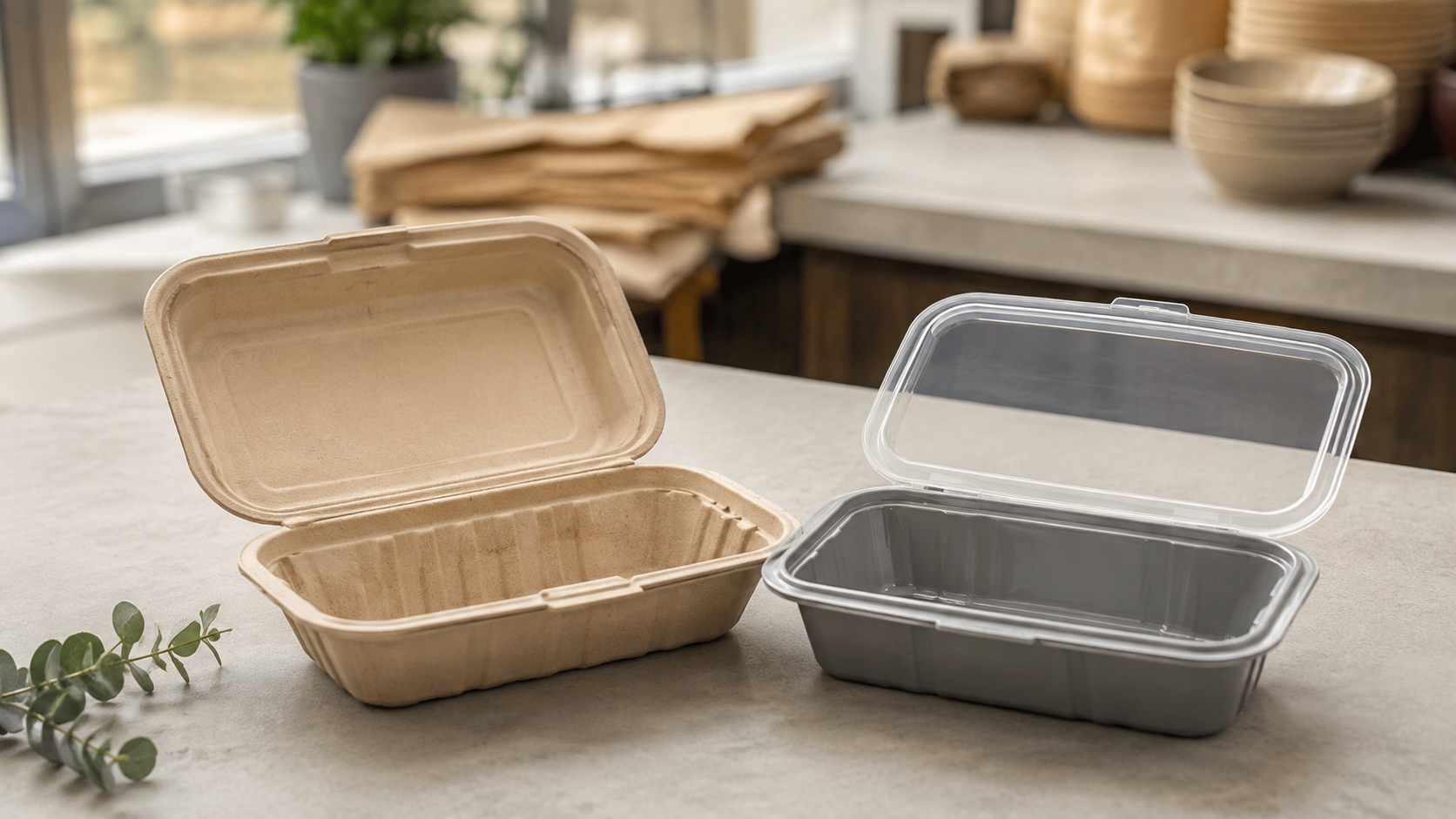
Compostable containers and recyclable plastic can both be reasonable food-delivery choices, but neither label alone can promise better platform ratings or repeat orders. Start with the destination: the local end-of-life route, the collector’s acceptance rules, and whether diners can separate the pack correctly.
Then validate the pack for the actual menu, including heat, grease, moisture, travel time, lids, and the risk of mixed materials. Compare the cost per usable order, not only the unit price. Finally, make only the environmental claim that the specific SKU, order, and destination documentation supports.
Can eco packaging increase ratings and repeat orders?
It may be worth testing, but it should not be sold internally as a guaranteed ratings or retention lever. Customer responses, platform-ranking systems, and repeat-order behavior vary by market, menu, price, delivery experience, and the clarity of the packaging message.
A more reliable approach is to treat packaging as one part of the delivered experience:
- Does the meal arrive intact and usable?
- Is the disposal instruction clear enough to follow?
- Is the claim specific and supportable?
- Does the added packaging cost fit the contribution margin for that order?
Run a controlled local test before making a commercial claim. Keep the menu, fulfillment process, and customer message as consistent as possible; track the measures your business is permitted to use, such as packaging cost per order, complaint themes, ratings, and repeat-order indicators. Do not infer that a change caused an outcome without a meaningful comparison.
Start with the end-of-life route, not the material label
A compostable pack only has its intended route when the local collection program and its receiving facility accept that specific kind of item. A recyclable plastic pack only has its intended route when the local system accepts, sorts, and processes the relevant material format.
Before choosing either option, ask the waste provider, venue, or local program:
- 1. Is there a collection route available to the customer?
- 2. Does it accept this exact item category, not merely “compostables” or “plastics” in general?
- 3. Are food residues accepted, and what preparation is required?
- 4. Are lids, labels, cutlery, seals, and bags handled separately?
- 5. What instruction should appear on the pack or in the delivery message?
If those answers are unavailable, do not present the pack as having a guaranteed environmental outcome. Choose a route that your operation can explain accurately, or use a neutral disposal instruction while you obtain local confirmation.
Match Food, Grease, and Delivery Conditions Before Choosing a Format
A sustainable claim does not replace functional testing. Hot foods, oily sauces, steam, condensation, liquids, cold items, stacking, rider handling, and delivery duration can all change how a container performs in real use.
Use the menu’s hardest conditions as the starting point. Test the selected SKU with the food temperature at packing, expected holding time, grease and moisture exposure, the matched lid, and a representative delivery journey. Confirm that the container, closure, and any secondary components work together.
Avoid a mixed-pack blind spot
The usable end-of-life route applies to the full customer-facing pack, not only the base container. A container, lid, label, sauce cup, cutlery, and carry bag may need different instructions. Where practical, simplify the component set and make separation intuitive.
Do not assume a material claim applies to every part of a pack. Confirm the relevant documentation for each SKU and order before stating that an item is compostable, recyclable, recycled-content, food-contact suitable, or free of a particular substance.
Compare cost per usable order—not the container price alone
The lower purchase price is not always the lower operating cost, and the higher unit price is not automatically a sustainability investment. Build the comparison around one usable delivered order.
Include these cost lines
- Container and matched lid
- Secondary components, labels, seals, and bags
- Packing time and separation steps
- Damage, leakage, replacement, and refund exposure
- Storage and handling complexity
- Waste-service requirements, where applicable
- Any order-level cost of customer instructions or education
Use your own quoted price, order volume, and operational data. Avoid generic price premiums, minimum order quantities, delivery times, or savings claims unless they are supported by the exact supplier quotation and order terms.
A Decision Tree for Delivery Buyers
- Yes: Continue to the menu and operations checks.
- No: Do not promise the claimed end-of-life outcome. Consider a different pack architecture or pause the environmental claim until local acceptance is verified.
2. Does the receiving program accept the complete pack and the likely food residue?
- Yes: Document the accepted components and the disposal instruction.
- No: Redesign the component mix, simplify separation, or select an option that has a clearer local route.
3. Has the exact SKU passed your hot, greasy, wet, and delivery-use test?
- Yes: Continue to the cost comparison.
- No: Change the SKU or pack design. Do not let a material label override delivery performance.
4. Is the total cost per usable order acceptable?
- Yes: Pilot the choice and measure operational and customer outcomes.
- No: Rework the specification, component count, or sourcing plan. Do not offset a cost gap with unsupported claims about ratings or repeat orders.
5. Can every public claim be supported for this SKU, order, and destination?
- Yes: Use precise, conditional language and provide a simple disposal instruction.
- No: Remove or narrow the claim until documentation is available.
Write customer instructions that people can use
The best message is short, local, and action-oriented. Avoid broad “eco-friendly” language that does not tell the diner what to do next.
A practical instruction should state the action, the relevant components, and any local limitation. For example:
Check your local program before placing this item in an organics or recycling bin. Separate components where your local guidance requires it.
This is intentionally cautious. Replace it with a verified, location-specific instruction only after confirming the program’s current acceptance rules.
Make packaging claims that survive scrutiny
Words such as “compostable,” “recyclable,” “recycled content,” and “food-contact suitable” require evidence that matches the item being sold. Marketing language should not outrun the specification, documentation, or destination requirements.
For each claim, retain the corresponding SKU details, material information, order documents, and destination-specific requirements. A certification or document associated with one material, production entity, order, or market should not be expanded into a claim about every product.
Choosing a TakeawayPack sourcing conversation
TakeawayPack is a foodservice-packaging brand whose online catalog includes cups, bowls, boxes, containers, trays, lids, bags, and cutlery. For an RFQ, buyers can provide the product category, material, dimensions or capacity, expected quantity, printing or logo requirements, and destination country or port.
For order-specific projects, the discussion can cover structure, coating, capacity, printing, lid matching, and carton packing. Any material, certification, food-contact, compostability, recyclability, recycled-content, MOQ, availability, or delivery statement should be confirmed for the relevant SKU, order, and destination—not assumed from a general category.
Legal and claims disclaimer
This article is general procurement guidance, not legal, waste-management, environmental, certification, food-contact, or regulatory advice. Collection and acceptance rules vary by location and can change. Obtain current written confirmation from the applicable waste program, supplier, and relevant advisor before using an environmental or compliance claim.
Bottom line: choose compostable packaging when its verified local route, tested delivery performance, and order economics work together. Choose recyclable plastic when its verified local route and delivery fit are stronger. In either case, measure customer and platform outcomes rather than promising them, and let documented facts—not labels—drive the claim. For a fact-bounded packaging RFQ conversation, visit takeawaypack.com.