
Container and Lid Matching for Entrées, Sides, and Sauces in Delivery Meals
Specify each entrée base, side pack, and sauce cup with its matched lid—and confirm the complete meal through menu-specific delivery trials.
2026-08-07 - 6 min read
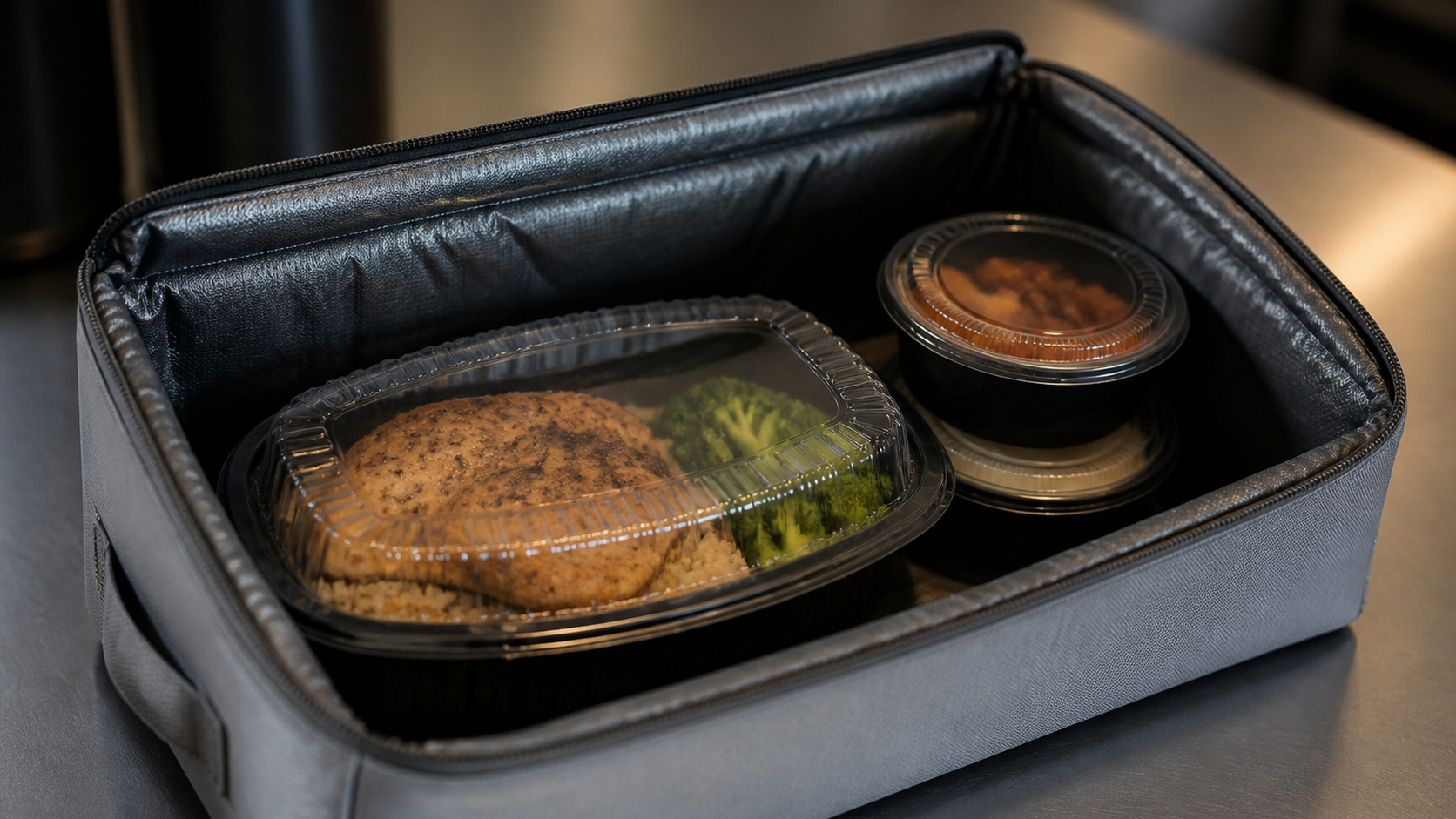
The direct answer: specify three matched packaging systems
A delivery meal should not rely on one closure strategy for every component. Match each food’s moisture, movement, and temperature profile to a dedicated container-and-lid pair: use controlled ventilation for crisp hot entrées, isolate sides in separate containers or sealed compartments, and place sauces in purpose-sized cups with securely matched lids.
This approach can help reduce condensation, odor transfer, and spill exposure without assuming that one package can optimize every food at once. Document the final packaging set as matched pairs—entrée base plus lid, side container plus lid, and sauce cup plus lid—rather than as a list of interchangeable components.
Start with the food, not the container
A hot-food packaging system can combine ventilation through the closure, airflow channels in the base, and venting in an anti-fog lid to manage moisture around fried food. Product information may also present capacity, dimensions, material, temperature applications, case configuration, and sustainability statements together because the base and lid need to be considered as one system.
That architecture should not be copied indiscriminately. Venting that benefits fried food may be a poor choice for sauce, while a tight seal that protects a liquid side can trap steam around a crisp entrée. Selection therefore begins by separating the meal into distinct packaging jobs.
Match the entrée base and lid to steam and movement
For fried, breaded, or otherwise crisp hot entrées, evaluate a rigid container with a lid designed for controlled vapor release. Vents and internal airflow features can give steam an exit path instead of allowing it to condense and fall back onto the food. A clear anti-fog lid can also support presentation and order checking when it is actually matched to the base.
For saucy, oily, or high-liquid entrées, prioritize containment and base–lid fit over aggressive venting. A deep container, suitable headspace, and a closure that remains seated through handling are more relevant than moisture-release features intended for crisp foods.
Do not assume that claims such as microwavable, reusable, or recyclable apply to a package unless the specific supplier documentation supports the claim for the exact construction.
Give each side its own moisture and odor strategy
Package sides according to their own behavior rather than placing them beside the entrée by default. A crisp side such as fries may need controlled ventilation. A moist side such as vegetables, rice, or pasta may need a more closed lid to limit leakage and retain moisture. Keep cold sides physically separate from hot components when temperature and condensation could affect either item.
Separate containers usually provide the clearest control over odor and moisture transfer. If a compartmented format is considered, evaluate its divider geometry and closure with the actual menu: a divided base does not guarantee vapor or liquid isolation under movement.
Use dedicated sauce cups with their specified lids
Place sauces, dressings, and dips in dedicated cups sized to the portion, with lids specified for those cups. The closure should seat evenly around the rim and remain secure after filling, packing, and delivery movement. Leave appropriate headspace so sauce is not forced into the closure area.
Keep sauce cups upright and away from direct compression. Do not place a loose cup where it can overturn into the entrée compartment. If a sauce is hot, oily, acidic, or intended for reheating, confirm the material and use conditions for the exact cup-and-lid combination rather than relying on a general material statement.
A component-pairing matrix for the shortlist
Use this matrix to define the packaging job for each meal component. It is a shortlist tool, not proof of suitability for any product; confirm every direction with exact product information and a menu-specific delivery trial.
| Meal component | Behavior to manage | Container direction | Closure direction |
|---|---|---|---|
| Crisp hot entrée | Steam and texture change | Rigid base with suitable capacity and headspace | Matched lid with controlled vapor release where the trial supports it |
| Saucy, oily, or high-liquid entrée | Movement, leakage, and rim contamination | Deep base with suitable headspace | Secure matched lid that remains seated through handling |
| Crisp side | Steam and moisture transfer | Separate pack where practical | Matched lid with controlled ventilation where validated |
| Moist side | Leakage and moisture retention | Dedicated container or evaluated compartment | More closed matched lid selected through testing |
| Cold side | Heat and condensation from hot components | Physically separate pack | Matched lid for the exact side container |
| Sauce, dressing, or dip | Tipping, compression, and leakage | Purpose-sized cup with appropriate headspace | Lid specified for that exact cup |
Validate the complete meal before rollout
Test the complete packed meal, not an empty container, through the intended hold and delivery period. Use the actual entrée, sides, sauces, fill temperatures, portion sizes, delivery route, and handling sequence.
Check lid engagement, visible leakage, condensation, food texture, odor transfer, cup orientation, stacking, bag movement, and ease of packing. Move a format to broader rollout only after the chain has reviewed results for its own menu and operating conditions.
Record the specification for every matched pair
For every meal component, keep the food type, portion size, fill temperature, and expected contact time with the packaging record. Add the container material and construction; usable capacity, dimensions, and headspace; lid type, venting approach, and exact base compatibility; intended hot, cold, refrigerated, warming, or microwave conditions; pack count, case dimensions, and replenishment requirements; available specifications, drawings, samples, and applicable documentation; and the results of menu-specific packing and delivery trials.
The record should make the entrée pair, side pair, and sauce-cup pair unambiguous for procurement, packing, and any future substitution review.
Build a testable shortlist with TakeawayPack
TakeawayPack is a foodservice-packaging brand and sourcing coordinator that works with multiple packaging manufacturers. Its online categories include cups, bowls, boxes, containers, trays, lids, bags, and cutlery. An RFQ for a meal-component project can identify the product category, material, size or capacity, estimated quantity, printing or logo requirements, and destination country or port.
Project discussions can cover structure, coating, capacity, printing, lid matching, and carton packing. Samples, drawings or print-file alignment, packaging, and export handoff communication can also be coordinated where applicable. Some stock items may support trial orders, while custom minimum order quantities depend on the product and production method.
Share a component-by-component RFQ with the intended foods, portions, use conditions, matched-pair requirements, and delivery-trial plan. A proposed shortlist should still be confirmed against exact product documentation and the restaurant chain’s own complete-meal trial.