Smart Food Delivery Packaging: How to Serve Single, Double, and Family Meals Without Overcomplicating Your Packaging System
The right food delivery packaging does more than hold food — it keeps meals at the right temperature, prevents leaks, reinforces your brand, and makes packing faster for your staff.
2026-09-07 - 12 min read
Summary: The right food delivery packaging does more than hold food — it keeps meals at the right temperature, prevents leaks, reinforces your brand, and makes packing faster for your staff. For small-to-medium restaurants, food trucks, and cafes expanding into combo meals, the challenge is covering single, double, and family-size orders with a limited set of boxes, cup carriers, and bags. This guide shows how to choose versatile packaging formats that work across portion sizes, simplify staff training, and keep every order looking professional.
Why delivery packaging strategy matters more than ever
Food delivery packaging shapes a customer's first impression before they take a bite. It affects how easy the food is to carry, how well it travels, and whether they remember your brand afterward. For delivery-first businesses, packaging is part of the product, not an afterthought.
When you add single-serve, double, and family meal options, packaging strategy becomes critical. A different box for every portion size balloons your inventory, confuses staff, and raises costs. The smarter approach: a small set of flexible formats that work across multiple order types.
It shapes first impressions before the food is opened
Before a customer tastes the food, they notice the packaging. A clean, sturdy bag, a well-sealed box, and a neat label instantly signal that your business is professional and trustworthy. Studies show that packaging quality directly influences consumer trust — and a poorly packed order can lower a customer's opinion of a brand.
For restaurants adding combo meals, this matters even more. A family meal that arrives in a mismatched set of containers looks chaotic. A single lunch rattling around in an oversized box feels careless. The right packaging communicates that you've thought through the full experience.
Small upgrades make a big difference. Branded stickers, custom-printed paper bags, or coordinated labels can make your food delivery packaging feel intentional without a huge budget. Suppliers like takeawaypack.com offer custom-printed packaging with MOQs as low as 500–1,000 units, making it achievable for growing businesses.
It protects food quality during transport
The practical side of food delivery packaging is just as important. Good packaging helps food arrive at the right temperature, prevents leaks, manages steam and moisture, and keeps delicate textures intact during transit. But different foods need different solutions.
A crisp fried item needs ventilation. A hot rice bowl needs insulation and structure. A chilled dessert needs a secure lid that handles condensation without turning messy. And when packing a multi-person order, each component may have different requirements.
This is where a limited but well-chosen packaging set shines. Two or three bowl sizes, one or two cup-carrier configurations, and a single paper bag size with a reinforced bottom let your staff pack any combination — single, double, or family — without second-guessing.
How to maintain food temperature during delivery
The golden rule for maintaining food temperature during delivery is simple: match the packaging to the food, the travel time, and the texture you want to preserve. Use insulating materials for heat retention, secure lidded designs for cold items, and include ventilation where steam could damage crispness.
For small businesses, the best approach is practical. Test a few combinations after 15, 30, and 45 minutes in transit — real-world testing beats any spec sheet.
Quick rules of thumb for food temperature during delivery:
- Use double-walled paperboard, corrugated cardboard, or insulated liners for hot food.
- Use vented packaging for fried or crisp foods so steam can escape.
- Use secure lidded containers and insulated sleeves for cold items and chilled desserts.
- Add grease-resistant linings or moisture barriers for foods with sauces or oil.
- Test packaging in real delivery conditions based on travel time, temperature, and menu item.
Best materials for hot food
For hot food, the best materials combine insulation, structure, and ease of transport. Structure matters as much as material — a container that closes securely and holds its shape will outperform a weaker format made from a similar base material.
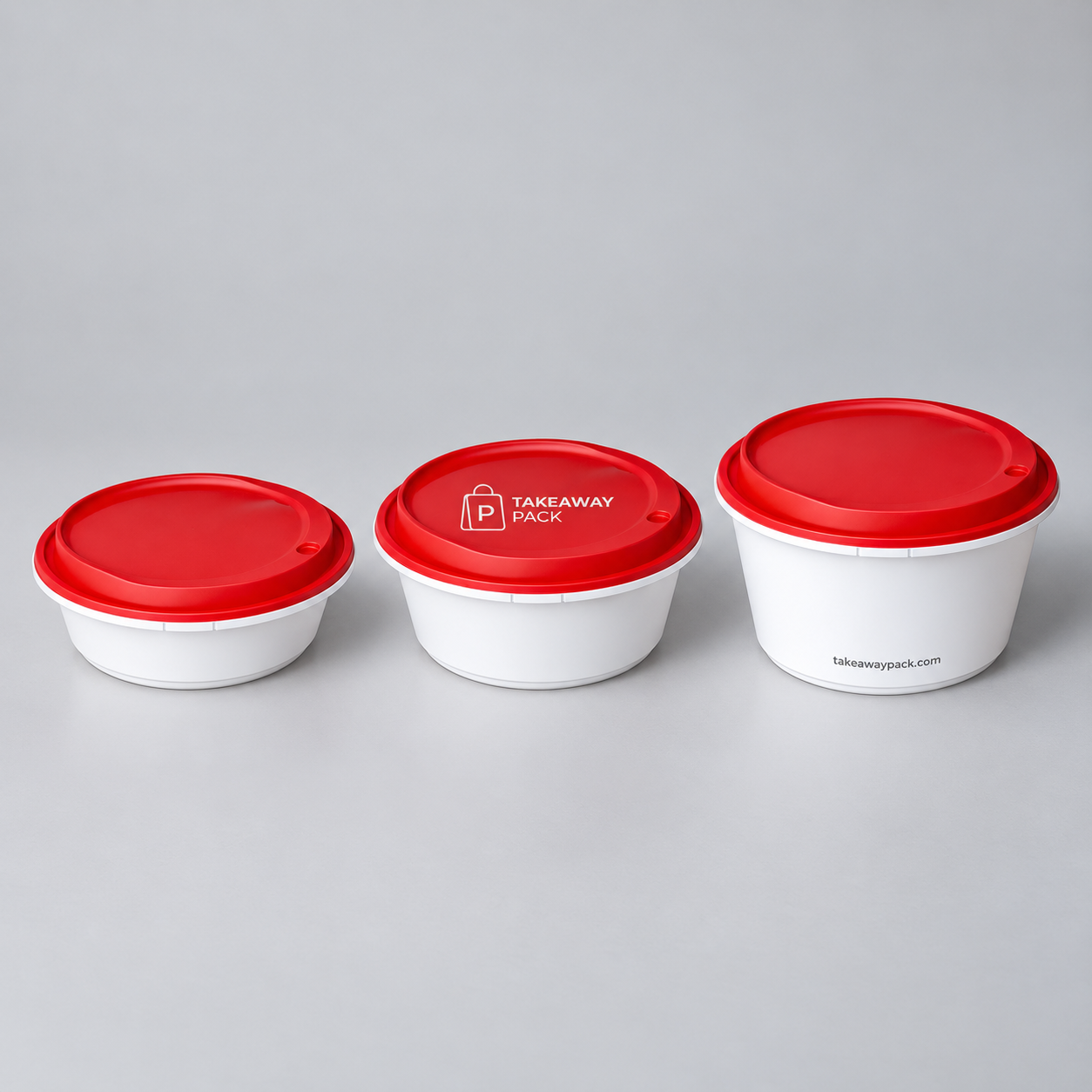
- Lock-lid PP bowls (available in 750ml, 1000ml, 1500ml, and 2000ml from takeawaypack.com) are excellent for hot meals. They seal tightly, stack neatly, and the same bowl can serve a single portion or a larger family portion depending on fill level.
- Kraft soup tubs with PP lids work well for soups, stews, and saucy noodle dishes.
- Compartment trays keep different food components separate — ideal for combo meals where sides should stay dry and mains should stay saucy.
- Double-walled paperboard cartons help retain heat while keeping packaging lightweight.
Best materials for cold food and chilled desserts
Cold items need packaging that manages both temperature and moisture while protecting presentation. The key is preventing condensation from damaging the product experience. Damp labels, peeling stickers, and smudged printing can make even a premium item feel less polished.
- Clear PET containers are excellent for chilled desserts, salads, and fruit cups — customers can see the product, and the secure lids handle condensation well.
- Molded pulp or clamshell boxes offer sturdy, eco-friendly options for cold items.
- Secure lidded containers are essential for parfaits, puddings, and layered desserts.
- Anti-fog lids help maintain visibility for chilled items where presentation matters.
How to reduce sogginess, leaks, and spills
Sogginess, leaks, and spills are among the most common delivery problems. They often come from choosing packaging based on appearance rather than how the food behaves in transit. The best food delivery packaging is chosen for how the food travels, not just how it looks on the shelf.
- Grease-resistant linings for burgers, pastries, and fried foods.
- Moisture barriers for items with sauce, steam, or oil.
- Compartmentalized packaging for meals that combine crisp, soft, and saucy elements.
- Secure lids for noodle bowls, curries, and rice dishes.
- Separate sauce containers when dressings or toppings could make the main item soggy.
- Tamper-evident seals to prevent leaks and reassure customers.
Choose the right delivery packaging for your menu
The right packaging format depends on what you sell. A useful way to narrow your options is to think about format, temperature, moisture, portability, and brand presentation all at once. Boxes, clamshells, bowls, cups, and bags each solve different problems.
Quick guide to food delivery packaging by menu type:
| Menu Type | Recommended Packaging |
|---|---|
| Hot meals and meal prep | Lock-lid PP bowls, clamshells, cartons, handled paper bags |
| Baked goods and snacks | Window boxes, pastry boxes, deli paper, paper bags |
| Drinks and chilled desserts | PET cups, sleeves, cup carriers, tamper stickers |
| Saucy or heavy dishes | Deep bowls, secure lids, compartment trays |
| Sushi and delicate items | Sushi trays, clear PET boxes, custom inserts |
| Catering / family meals | Large compartment trays, molded pulp boxes, sturdy bags |
For hot meals and meal prep
For hot meals and meal prep, lock-lid PP bowls (750ml–2000ml) are a workhorse choice. They handle single servings, double portions, and family-size helpings with the same lid design — staff just pick the bowl size that fits.
- Lock-lid PP bowls: Excellent for full meals, rice bowls, pasta, and layered dishes. The tamper-evident lid gives customers confidence.
- Compartment trays: Ideal for combo meals where protein, starch, and vegetables stay separate.
- Kraft soup tubs with PP lids: A practical choice for soups, curries, and noodle dishes.
- Handled paper bags: Helpful for carrying multi-item orders. A single reinforced-bottom bag size can hold one bowl or three.
Stackability matters. Neat-stacking packaging means more orders in less space and easier carrying for drivers. When you use the same bowl line across portion sizes, stacking is automatic.
For baked goods, snacks, and grab-and-go items
Baked goods, snacks, and grab-and-go items need packaging that balances freshness and visibility. Cookies, pastries, and decorated bakes benefit from being seen; delicate or stacked items do better in an enclosed package.
- Window boxes: Let customers see the product while keeping it fresh.
- Paper bags with custom printing: A practical choice for lighter snacks. A single paper bag SKU with your logo does double duty as packaging and marketing.
- Pastry boxes: Better for delicate or stacked baked goods.
- Clear PET containers: Great for grab-and-go salads, fruit cups, and single-serve desserts.
Branded touches go a long way here. A custom sticker or belly band turns a simple paper bag into something that feels thoughtfully branded.
For drinks, desserts, and specialty items
Drinks, desserts, and specialty items need a more detailed approach, since spills, condensation, and movement affect both function and appearance.
- Single and double cup carriers (available from takeawaypack.com) let you carry one or two drinks in the same carrier format. This is a perfect example of using one SKU to cover multiple order types.
- Tamper stickers add security and reassure customers.
- Anti-fog lids keep chilled desserts, layered drinks, and toppings visible.
- Durable labels that stay readable even when containers get damp.
A QR code on a dessert label or drink sleeve can link to a loyalty reward, menu, or reorder page — a small digital touchpoint that turns a one-off order into a repeat customer.
Functional features that matter most for delivery-first packaging
The most effective delivery-first packaging performs well in real conditions while still looking good. For small teams, the best features are the ones that save time, reduce mistakes, and improve the customer experience consistently.
Tamper-evident seals and customer confidence
Tamper-evident labels, folded closures, and secure stickers reassure customers that their food arrived safely and hasn't been opened in transit. This matters for trust, especially when orders go through third-party platforms or are received in shared spaces like offices and apartment lobbies.
Tamper-evident bowls from takeawaypack.com serve double duty: the seal keeps food secure, and the same lid can carry your logo or a thank-you message.
Ventilation, insulation, and easy-carry design
Steam release, heat retention, and carry strength all need to work together. Too much insulation without ventilation makes crispy food go soft. Too much airflow cools hot meals too quickly. Good packaging finds the balance based on the menu item.
Easy-carry design matters too. Strong handles, secure closures, and packaging that sits neatly in a delivery bag all make a difference. Even small details, like a cup carrier that fits both single and double orders, improve the handover experience.
Portion control, stacking, and delivery efficiency
Portion control isn't just about kitchen consistency — it affects which packaging size makes sense, how much movement happens in transit, and how well items stack. Oversized packaging lets food shift around. Too-tight packaging pops lids off or damages toppings.
For small teams, efficiency is critical. Packaging that is simple to assemble, consistent to stock, and easy to stack speeds up prep during busy periods. When you use the same lock-lid bowl family across single, double, and family portions, staff can grab any size without thinking: same lid design, same stacking pattern, minimal training.
Design packaging that feels branded and professional
You can create good packaging design without expensive custom production runs. The goal is to make your food delivery packaging feel consistent, memorable, and appropriate for your brand. Small businesses can get there through a few well-chosen elements rather than a full redesign.
Use color, typography, and packaging texture strategically
Kraft, bagasse, molded fiber, and clean paper finishes each communicate something different before a customer reads a word. Kraft feels earthy and handmade. Smooth white paperboard feels modern and minimal. Molded fiber suggests practicality and eco-consciousness.
Typography and color do the rest. A bright label feels energetic; a muted palette with clean type feels premium. The key is consistency — when the bag, box, and sticker all feel like they belong to the same business, the brand experience is much stronger.
Add branded elements without overcomplicating production
You don't need every element to be fully custom-printed. Stickers, labels, custom-printed paper bags, and seals can all create a branded experience in manageable steps. For many small businesses, custom-printed paper bags and stickers are the easiest starting point — they're flexible, affordable, and easy to update.
Takeawaypack.com offers custom printing on paper bags, boxes, and seals with MOQs starting at 500–1,000 units. That means you can get a branded paper bag that works for single, double, and family orders in one order. One bag SKU, one design, multiple uses.
Is eco-friendly food delivery packaging worth it?
Eco-friendly food delivery packaging can be worth the investment when it supports both the performance of your product and your brand values. Customers increasingly notice packaging choices, but they also notice when sustainable formats don't hold up in real-world conditions. A compostable container that leaks is not a good customer experience.
When sustainable packaging adds real value
Sustainable packaging adds real value when your customers actively care about recyclable, compostable, or reduced-ink packaging. It can also reinforce a premium or values-led brand identity. If sustainability is already part of your product story, packaging is a natural place to make that visible.
Molded pulp boxes, kraft paper bags, and bagasse containers are practical eco-friendly options that perform well in delivery conditions. Select lines — particularly certain kraft and molded-pulp formats — are available with compostable or recyclable certification, so if you plan to make a sustainability claim on your menu or labels, request the certificate for the specific item you're quoting rather than assuming it applies across a whole catalog.
A short printed note or icon explaining the material choice helps customers understand the value instead of overlooking it.
How to balance cost, performance, and brand goals
Test before committing. Check how the packaging performs with heat, moisture, and delivery time, and whether it still feels functional after the average journey. Compare added cost against the benefit to customer experience.
In many cases, the best solution is a partial shift. A business might move to recyclable kraft paper bags first, then trial compostable meal containers later. Practical progress usually works better than forcing a full change before the packaging is ready.
Practical packaging for real results
The right packaging supports customer retention, stronger brand recognition, and smoother operations. It helps food travel better and makes your brand easier to remember.
For restaurants expanding into single, double, and family meals, the winning approach is to choose a limited set of versatile packaging formats that work across portion sizes. Lock-lid bowls in a few sizes, a single cup carrier design, and a sturdy custom-printed paper bag can cover your entire menu. Your staff learns one system. Your inventory stays lean. And every order looks consistent and professional.
Ready to simplify your packaging system? Check out takeawaypack.com for a wide selection of lock-lid PP bowls, cup carriers, compartment trays, custom-printed paper bags, and more — all designed to help US restaurants, food trucks, and cafes deliver better takeout experiences. Visit takeawaypack.com/contact to get started.
Frequently asked questions about food delivery packaging
How does custom food delivery packaging improve customer retention?
Custom packaging makes orders feel more consistent, professional, and memorable. When packaging keeps food in good condition and reflects your brand clearly, customers associate the meal with quality and care, making repeat orders more likely.
What are the most important functional features for delivery-first packaging?
Heat retention, moisture control, tamper evidence, leak resistance, and portability. The right combination depends on your food, travel time, and the eating experience you want to preserve.
Is eco-friendly packaging worth the investment for my brand?
It can be, especially if sustainability matters to your audience and the packaging still performs well during delivery. Start with a partial shift — eco-friendly bags first, then test compostable containers — and scale up based on real-world results.
How do I make packing easy for my staff?
Standardize packaging across portion sizes. Use the same lid family for all bowl sizes. Stock one bag size and one cup carrier type. When staff only need to learn a few packaging formats, packing speed improves and mistakes drop.