Best Disposable Soup Cups with Leak-Proof Lids for Winter Delivery
For winter soup delivery, treat “leak-proof” as a procurement and test target, not an untested product promise. The practical choice is a complete cup-and-closure system that fits the menu, the packing workflow, and the real delivery route.
2026-09-09 - 4 min read
Summary
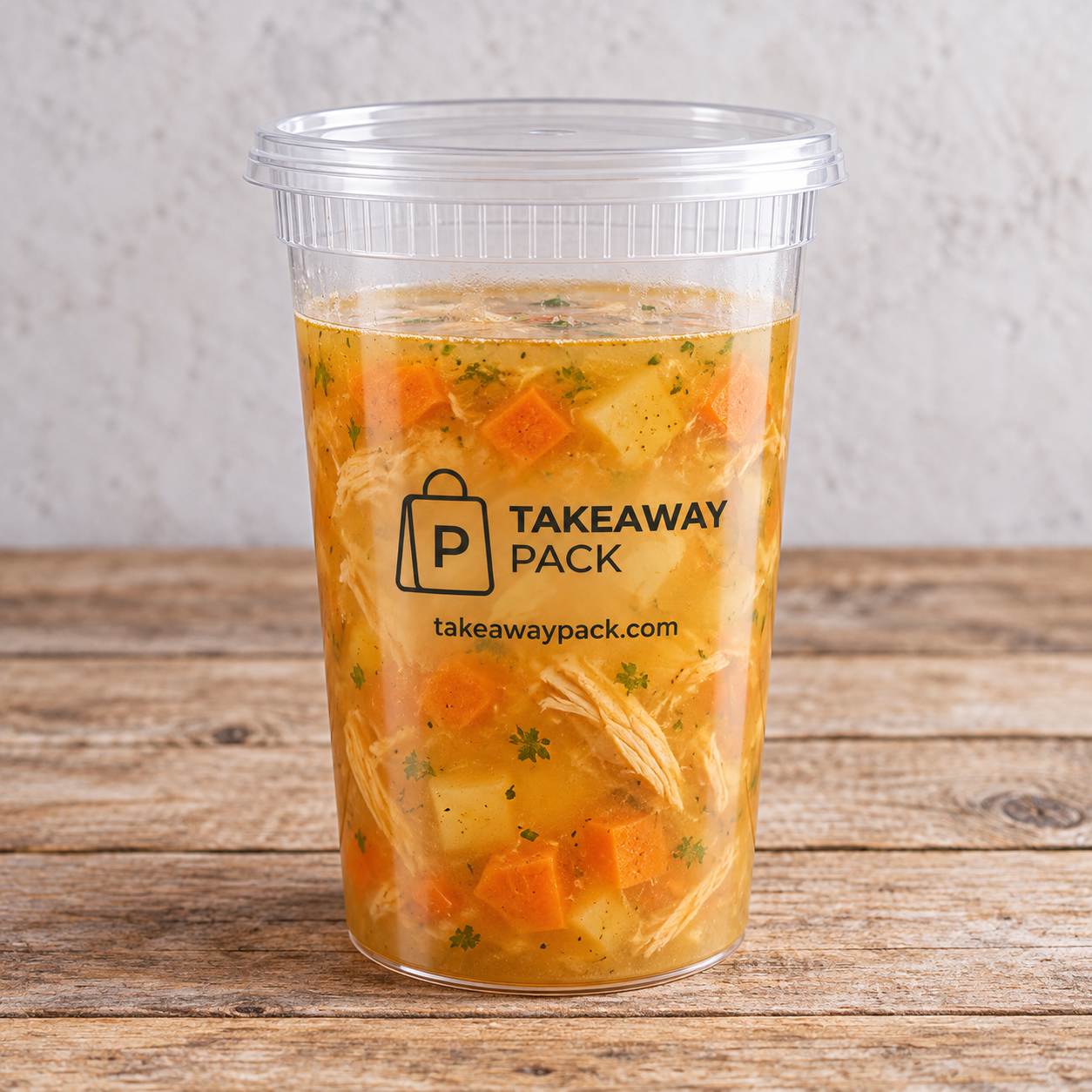
For winter soup delivery, treat “leak-proof” as a procurement and test target, not an untested product promise. The practical choice is a complete cup-and-closure system that fits the menu, the packing workflow, and the real delivery route. Compare heat-seal film, snap-on lids, and press-on lids only with their intended cups, then validate the chosen configuration with filled samples before committing to a larger purchase.
Estimated reading time: 4 minutes
What is the best lid for winter soup delivery?
Question: Is there one lid design that is always best for soup delivery?
Answer: No. The right choice depends on the cup, the closure method, the packing line, and the route conditions. A lid should not be described as leak-proof until the exact cup-and-lid combination has passed your own delivery test. The key purchasing question is not “Which lid sounds strongest?” but “Which complete system stays closed and clean in our actual workflow?”
For a delivery-only kitchen, that means testing the cup, lid or film, fill level, bag arrangement, and handling conditions together. A closure that appears secure on an empty cup can behave differently once the cup is filled, stacked, carried, or moved through a normal delivery route.
Should we shortlist heat-seal film, a snap-on lid, or a press-on lid?
Question: What should each closure option be considered for?
Answer: Start with the operating model rather than a universal ranking.
- Heat-seal film is a candidate when the operation can use a compatible cup, matching film, and sealing equipment. Review how the seal is made, how staff will check it, and how the customer will open it. Test the applied seal on the exact cup and film you plan to buy.
- Snap-on lids are a candidate when the lid is made and supplied for the exact cup rim. They can suit teams that need hand application, but the specific fit and customer-opening experience still need to be checked in use.
- Press-on lids may be appropriate for a defined use case, but they should not be assumed suitable for a moving soup order merely because they fit at the packing bench. Test them under the same conditions as the other options.
Do not mix lids and cups based only on a stated diameter. Rim profile, wall shape, lid channel, material behavior, and manufacturing variation can all affect the result. Confirm the intended pairing with the supplier, then test physical samples.
What does “matched cup and lid” mean in practice?
Question: Is a nominal rim size enough to confirm compatibility?
Answer: No. A nominal size is a starting point for sourcing, not a proof of a working closure. Ask for the cup-and-lid pairing to be identified in the supplier’s product information. Keep the cup SKU, lid or film SKU, rim size, and application method together in the purchasing record.
Before selecting a system, check these practical points:
- The cup and closure are specified as an intended pair.
- Staff can apply the closure consistently in the normal packing workflow.
- The opening method is clear for the customer.
- The system can be packed in the delivery bag without forcing the cup onto its side.
- The trial uses the soup, stew, broth, or hot drink you actually sell.
This is also where a simple sample log helps. Record the selected components, fill level, route setup, observed result, and any change needed. That turns a general packaging claim into a purchase decision you can repeat.
How should a restaurant test a soup-cup system?
Question: What should be included in a delivery test?
Answer: Use a filled sample and a realistic packing routine. Test the intended cup and closure with the menu item at the normal fill level. Place it in the delivery bag or carrier you use, include any stacking that normally occurs, and move it through representative handling and transport conditions.
Inspect the cup rim, lid-to-rim contact area, side seam, bottom, and the outside of the bag after the trial. Repeat the test after staff have applied the closure in the normal workflow, not only under ideal demonstration conditions. If a result changes when the cup is filled differently, stacked differently, or placed in another bag position, document that result before placing a larger order.
This approach also avoids treating a single packaging feature as the whole answer. Closure design, cup shape, fill practice, bag support, and staff application all belong to the same delivery system.
Which Takeawaypack soup-cup options can be reviewed?
Question: Are there documented Takeawaypack product options for a soup-cup evaluation?
Answer: Takeawaypack’s ERP product table currently lists 21 products in the Soup Tub / Soup Cup shape category. The listed range includes Kraft Paper Soup Bucket products from 8 oz to 32 oz, with 90 mm, 97 mm, or 115 mm rims, and PP soup-cup products listed at 8 oz, 10 oz, 12 oz, 16 oz, 20 oz, 24 oz, and 32 oz.
Those listings help a buyer form a sample shortlist, but they do not prove that any specific cup is compatible with every lid, film, or sealing method. Confirm the exact pairing and run the delivery test before making a performance claim.
Do “insulated” soup cups remove the need for a delivery test?
Question: Can insulation alone solve a winter-delivery packaging decision?
Answer: No. No temperature-retention duration or thermal performance for a specific Takeawaypack configuration has been verified in this evidence set. Treat insulation, outer bags, carriers, closure selection, and route conditions as separate parts of the evaluation. Ask for product-specific documentation where it is needed, and test the exact configuration you intend to use.
What should procurement request before buying?
Question: What information should be requested with samples?
Answer: Request the product identifiers for the cup and the matching lid or film, the intended application method, the available sample configuration, and any product-specific documentation that applies to that exact configuration. Keep the request focused on the products being evaluated rather than relying on a general category description.
Choose and Test a Soup-Cup System
Visit Takeawaypack to discuss a soup-cup sample shortlist built around your menu, closure method, and delivery-test conditions.