Environmental Claims in Food Packaging: A Practical Guide for Restaurant Buyers
As restaurant customers increasingly ask about sustainability, restaurant owners and food service operators face the challenge of evaluating environmental claims made by packaging suppliers.
2026-09-07 - 13 min read
Summary: As restaurant customers increasingly ask about sustainability, restaurant owners and food service operators face the challenge of evaluating environmental claims made by packaging suppliers. This guide translates the FTC's Green Guides framework into practical buying decisions for small-to-medium restaurants, food trucks, and cafes. It covers what "compostable," "recyclable," "recycled content," and other common claims actually mean under US regulations, how to verify supplier assertions, and how to avoid overstating environmental benefits when local recycling or composting infrastructure is limited. The goal is to help you make informed purchasing decisions that are honest, defensible, and aligned with your customers' expectations.
General Environmental Benefit Claims: Look Beyond the Buzzwords
When a packaging supplier says their product is "green," "eco-friendly," or "sustainable," those broad claims are nearly impossible to substantiate on their own. The FTC's Green Guides make clear that unqualified general environmental benefit claims are difficult to defend — if not impossible — because they imply an overall environmental superiority that no single product can easily prove.
For restaurant buyers, this means you should treat broad claims as a starting point, not a conclusion. When a supplier leads with "eco-friendly packaging," ask for specifics. What exactly makes it environmentally preferable? Is it the material source, the manufacturing process, the end-of-life disposal, or the reduced weight? A qualified claim — such as "made with 30% post-consumer recycled content" — is far more meaningful than a vague label.
The Green Guides also note that when a marketer qualifies a general claim with a specific benefit, consumers understand that benefit to be significant. So suppliers should not highlight small or unimportant attributes. If a packaging supplier emphasizes a minor recycled component while the rest of the product has a larger environmental footprint, that claim could be deceptive.
When evaluating packaging for your restaurant, write down the specific environmental attributes that matter to you: recyclability in your area, recycled content percentage, compostability certification, or source reduction. Then ask each supplier to substantiate those specific claims. A supplier who can provide clear, third-party-verified data on specific attributes is more reliable than one who relies on general buzzwords.
Carbon Offsets: What They Mean for Your Packaging
Carbon offset claims are less common in food packaging, but they are appearing more frequently. A supplier might claim that their packaging is "carbon neutral" because they purchase carbon offsets to compensate for the emissions generated during production.
Under the Green Guides, marketers making carbon offset claims must have competent and reliable scientific evidence to support them. They must use appropriate accounting methods to ensure emission reductions are measured properly and are not sold more than once. Additionally, if the offset pays for emission reductions that won't occur for at least two years, that must be disclosed. And if the activity that generates the offset is already required by law, the supplier cannot advertise it as an offset.
For restaurant buyers, carbon offset claims should be treated as a secondary consideration. The primary environmental impact of your packaging comes from the materials themselves, their recyclability, and their end-of-life disposal. If a supplier offers carbon-neutral packaging, ask for a third-party verification report and details about the offset projects they fund. Treat this as a bonus, not a substitute for material-level environmental improvements.
Certifications and Seals of Approval: What They Actually Guarantee
Restaurant owners are bombarded with packaging certifications: BPI compostable, FSC certified, FDA approved, and many others. But not all certifications carry the same weight, and some can be misleading if their basis is unclear.
The FTC's Green Guides treat certifications and seals as endorsements. Under the FTC's Endorsement Guides, suppliers must disclose any material connections to the certifying organization. If a packaging company creates its own "eco-certification" label, that connection should be transparent.
More importantly, environmental certifications or seals that do not clearly convey the basis for the certification are likely to convey a general environmental benefit — which, as discussed above, is difficult to substantiate. If a seal just says "eco-friendly" without explaining what it certifies, it may be deceptive.
What this means for restaurant buyers: look for certifications that clearly state what they certify. For example:
- BPI (Biodegradable Products Institute) certification means the product is certified compostable in commercial composting facilities.
- FSC (Forest Stewardship Council) certification means the paper or wood fiber comes from responsibly managed forests.
- TUV Austria / OK Compost is another recognized compostability certification.
If a supplier uses a seal you do not recognize, ask them to explain what it certifies and how it was verified. A third-party certification does not relieve the supplier of the obligation to substantiate all express and implied claims. You should still verify that the certified claim matches your local disposal options.
Compostable Claims: What Restaurants Need to Know
"Compostable" is one of the most common environmental claims in food packaging, and also one of the most misunderstood. When a supplier claims a product or package is compostable, the Green Guides require that they have competent and reliable scientific evidence that all materials in the product or package will break down into — or become part of — usable compost safely and in about the same time as the materials with which it is composted.
For restaurant buyers, there are two critical questions to ask about any compostable claim:
1. Can it be composted at home? Many compostable food packaging items require the high heat and controlled conditions of commercial composting facilities. If the product cannot be composted at home safely or in a timely way, that limitation must be stated clearly.
2. Are commercial composting facilities available in your area? This is the most common pitfall. Even if a product is certified compostable in a commercial facility, those facilities are not available to a substantial majority of consumers in many parts of the United States. If your local waste management does not offer commercial composting, selling "compostable" packaging to your customers could create the impression that it will compost in their backyard bin or in a landfill — which it will not.
The Green Guides require that suppliers qualify compostable claims if the appropriate facilities are not available to a substantial majority of consumers. If you are buying compostable packaging, check with your local waste hauler first. If commercial composting is not available in your area, consider whether compostable packaging is the right choice, or whether recyclable or recycled-content options would be more environmentally effective.
Degradable vs. Compostable: A Critical Distinction
The term "degradable" or "biodegradable" is often confused with "compostable," but the Green Guides draw a sharp distinction. An unqualified degradable claim requires proof that the entire product or package will completely break down and return to nature within a reasonably short period of time after customary disposal. The FTC defines "reasonably short period" as one year.
The practical reality is that items destined for landfills, incinerators, or recycling facilities will not degrade within a year. Modern landfills are designed to be dry and anaerobic — conditions that inhibit decomposition. As a result, unqualified biodegradable claims for products that are likely to be landfilled are deceptive under the Green Guides.
For restaurant owners, this means that "biodegradable" plastic cups, utensils, or containers are almost certainly not biodegrading in a landfill. If a supplier makes a biodegradable claim about products that will be disposed of in the regular trash, that claim is likely misleading. Stick with claims that are verifiable under your local disposal conditions: recyclable where facilities exist, or compostable where commercial composting is available.
Free-Of Claims: What They Do and Don't Mean
Some packaging suppliers promote their products as "free of" certain substances — BPA-free, PFAS-free, or phthalate-free. These claims can be valid, but they also have limitations that restaurant buyers should understand.
Under the Green Guides, a free-of claim is acceptable if:
- The product does not contain more than trace amounts or background levels of the substance.
- The amount present does not cause harm that consumers typically associate with the substance.
- The substance was not intentionally added to the product.
However, it would be deceptive to claim that a product is "free of" one substance if it contains another substance that poses a similar environmental risk. For example, claiming a container is "BPA-free" while it contains bisphenol S (BPS), which has similar health concerns, could be misleading.
Additionally, if a product category has never been associated with a particular substance, claiming the product is free of that substance can be deceptive. Claiming that paper bags are "BPA-free" may imply that BPA is a concern for paper bags when it generally is not.
For restaurant buyers, free-of claims are most useful when they address a genuine concern for your specific product type. If you are buying polypropylene (PP) bowls, asking whether they are BPA-free is reasonable. But do not rely on free-of claims as a substitute for broader environmental qualifications.
Non-Toxic Claims: What the Science Says
A supplier claiming that their packaging is "non-toxic" must have competent and reliable scientific evidence that the product is safe for both people and the environment. This is a high bar. The claim implies that the product poses no health or environmental risk, which is difficult to prove comprehensively.
For restaurant buyers, a non-toxic claim is less useful than specific, verifiable statements about material safety. If you are concerned about food contact safety, look for FDA food-contact compliance documentation rather than a general non-toxic label. Many suppliers provide material safety data sheets (MSDS) or FDA compliance letters that address specific regulatory requirements.
Recyclable Claims: The 60% Rule and Your Local Reality
Recyclability is one of the most important claims for restaurant packaging, but it is also one of the most variable based on geography. The Green Guides establish a clear threshold: marketers should qualify recyclable claims when recycling facilities are not available to at least 60 percent of the consumers or communities where the product is sold.
What this means for restaurant buyers: the recyclability of a package depends on your location, not just the material. Polypropylene (PP) containers, for example, are technically recyclable, but not all municipal recycling programs accept them. Clear PET containers are widely recycled, but even that varies by jurisdiction.
The lower the level of local access to appropriate recycling facilities, the more a supplier should emphasize the limited availability of recycling for the product. If recycling facilities are not available to at least 60 percent of consumers, the supplier should state, "This product may not be recyclable in your area." If facilities are available to only a few consumers, the supplier should use stronger language: "This product is recyclable only in the few communities that have appropriate recycling programs."
As a restaurant buyer, you should verify the recycling acceptance of any packaging material with your local waste hauler before making claims to your customers. If you are in an area where PP bowls are not accepted in curbside recycling, do not label them as recyclable in your marketing.
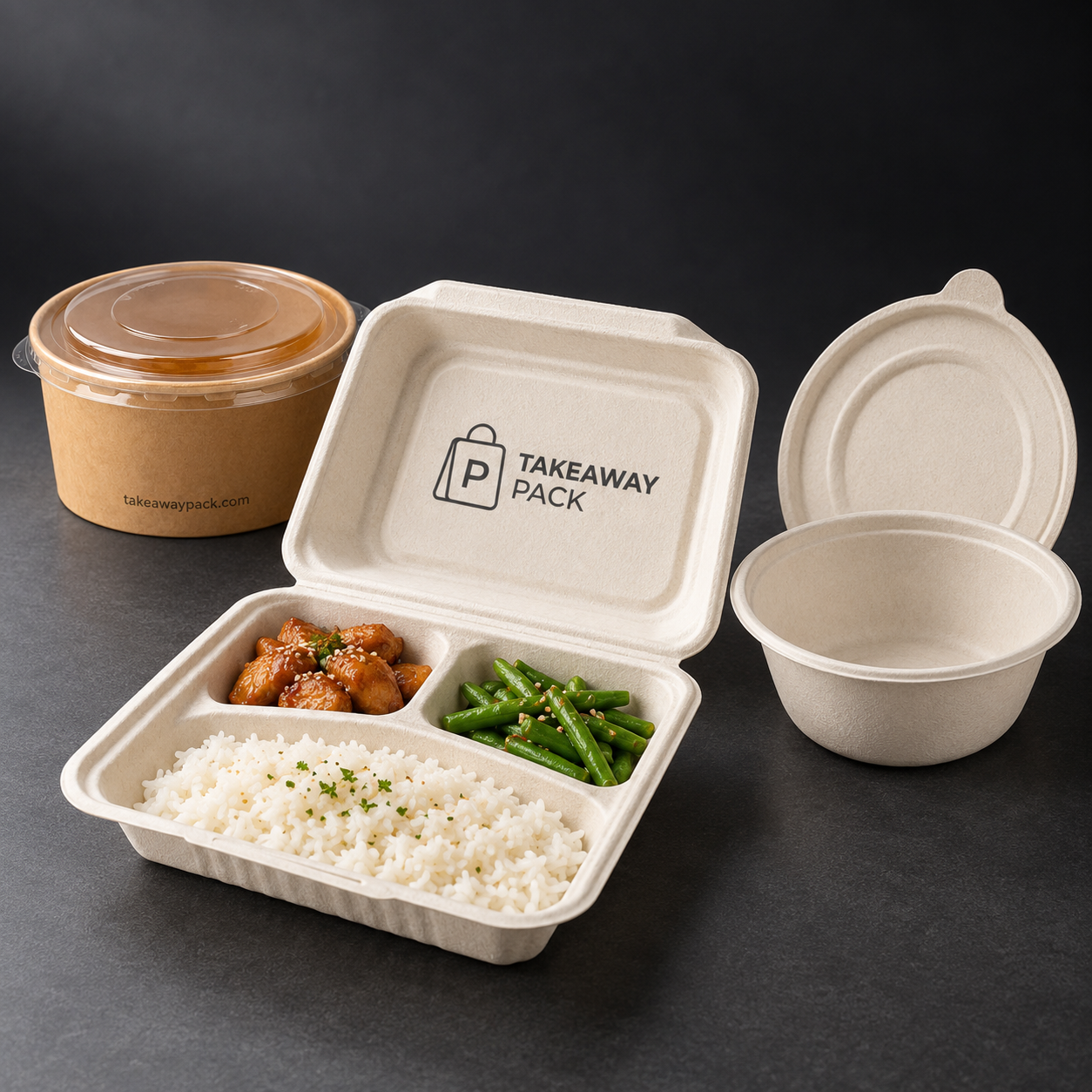
This is also where your supplier choice matters. Select lines at takeawaypack.com — particularly kraft paper and molded-pulp formats — are available with compostable or recyclable certification, while other lines in the same catalog are not. That distinction is the point: certification attaches to a specific product and a specific material, never to a supplier's whole catalog. When you request a quote, ask for the certificate covering the exact item you are ordering, in writing, and check that the certificate scope matches the item code on your purchase order. A supplier who can produce that document per item is one you can safely quote in your own customer-facing language; a supplier who answers with a general "our packaging is eco-friendly" is not.
Recycled Content: What the Percentage Actually Means
Recycled content claims are among the most straightforward environmental claims, but they still require careful evaluation. The Green Guides require that recycled content claims apply only to materials that have been recovered or diverted from the waste stream during the manufacturing process (pre-consumer) or after consumer use (post-consumer).
For restaurant buyers, the key distinction is between pre-consumer and post-consumer recycled content. Post-consumer recycled content — material that was used by consumers and then recycled — is generally considered more environmentally beneficial because it diverts waste from landfills. Pre-consumer recycled content is material that was recycled during manufacturing, which is valuable but does not have the same waste-diversion benefit.
If a package is "made from 30% recycled material," ask what that 30% consists of. Is it post-consumer or pre-consumer? Is it mixed? The Green Guides require that suppliers making recycled content claims for products made partly from recycled material should qualify the claim clearly — for example, "Made from 30% recycled material."
If the product contains used, reconditioned, or re-manufactured components, those should also be clearly qualified to avoid deception.
Source Reduction: Less Material, Same Function
Source reduction means using less material to achieve the same packaging function. The Green Guides require that marketers qualify source reduction claims clearly and prominently to avoid deception about the amount of reduction and the basis for comparison.
For example, rather than saying a product generates "10 percent less waste," the supplier should say "10 percent less waste than our previous product." The comparison must be specific and meaningful.
For restaurant buyers, source reduction is a practical way to reduce both environmental impact and cost. A lighter-weight container uses less material, costs less to transport, and generates less waste. When evaluating packaging options, ask your supplier whether they offer lightweight versions of the containers you use. Many suppliers now offer thin-wall designs that maintain structural integrity while using less plastic or paper.
Made with Renewable Energy and Renewable Materials
Claims about renewable energy and renewable materials are becoming more common in packaging. The Green Guides provide specific requirements for both.
Renewable energy claims: An unqualified claim that a product is "made with renewable energy" may be misleading unless all, or virtually all, of the significant manufacturing processes involved in making the product or package are powered with renewable energy or non-renewable energy matched by renewable energy certificates (RECs). Suppliers should specify the source clearly — "wind energy" or "solar energy" rather than a vague "renewable" label.
Renewable materials claims: An unqualified claim about renewable materials may imply that the product is recyclable, made with recycled content, or biodegradable. To minimize that risk, the supplier should identify the material used clearly and prominently and explain why it is renewable. For example, "This package is made from 50% plant-based renewable materials. Because we turn fast-growing plants into bio-plastics, only half of our product is made from petroleum-based materials."
For restaurant buyers, renewable materials claims are most valuable when they are specific and verifiable. A claim like "made from plant-based materials" should be backed by information about what plant material is used, how it is sourced, and what percentage of the product it represents.
Making Confident, Honest Environmental Claims for Your Restaurant
The bottom line for restaurant owners, food truck operators, and cafe managers is this: the best environmental claim is the one you can substantiate with evidence and local context. Before you tell customers that your packaging is "recyclable," "compostable," or "made from recycled materials," take these steps:
- Ask your supplier for specific documentation — third-party certifications, material composition data, and recycling or composting availability information.
- Verify local infrastructure — call your waste hauler or check local recycling guidelines to confirm what is actually accepted in your area.
- Qualify your claims — if recycling is not universally available, say "recyclable where facilities exist" rather than just "recyclable."
- Avoid broad claims — "eco-friendly" and "green" are too vague to be meaningful or defensible.
- Focus on what you can prove — recycled content percentages, source reduction, and specific certifications are more credible than general environmental benefit statements.
When evaluating packaging suppliers, look for companies that are transparent about their materials, their certifications, and the limitations of each claim. A supplier who acknowledges that "compostable in commercial facilities only" or "recyclable in communities with PP recycling programs" is more trustworthy than one who makes unqualified claims.
For more information on choosing the right packaging for your restaurant, or to discuss your specific needs with a supplier that understands the US food service market, visit takeawaypack.com or contact their team at info@takeawaypack.com. They can help you navigate the material options, verify environmental claims, and find packaging that works for your menu, your customers, and your local waste management infrastructure.