EU Food Contact Materials for Hot Food Takeaway Bowls: EC 1935/2004 and EU 10/2011
EU food-contact rules are relevant when hot-food takeaway bowls, lids, or other packaging articles are placed on the EU market.
2026-08-07 - 5 min read
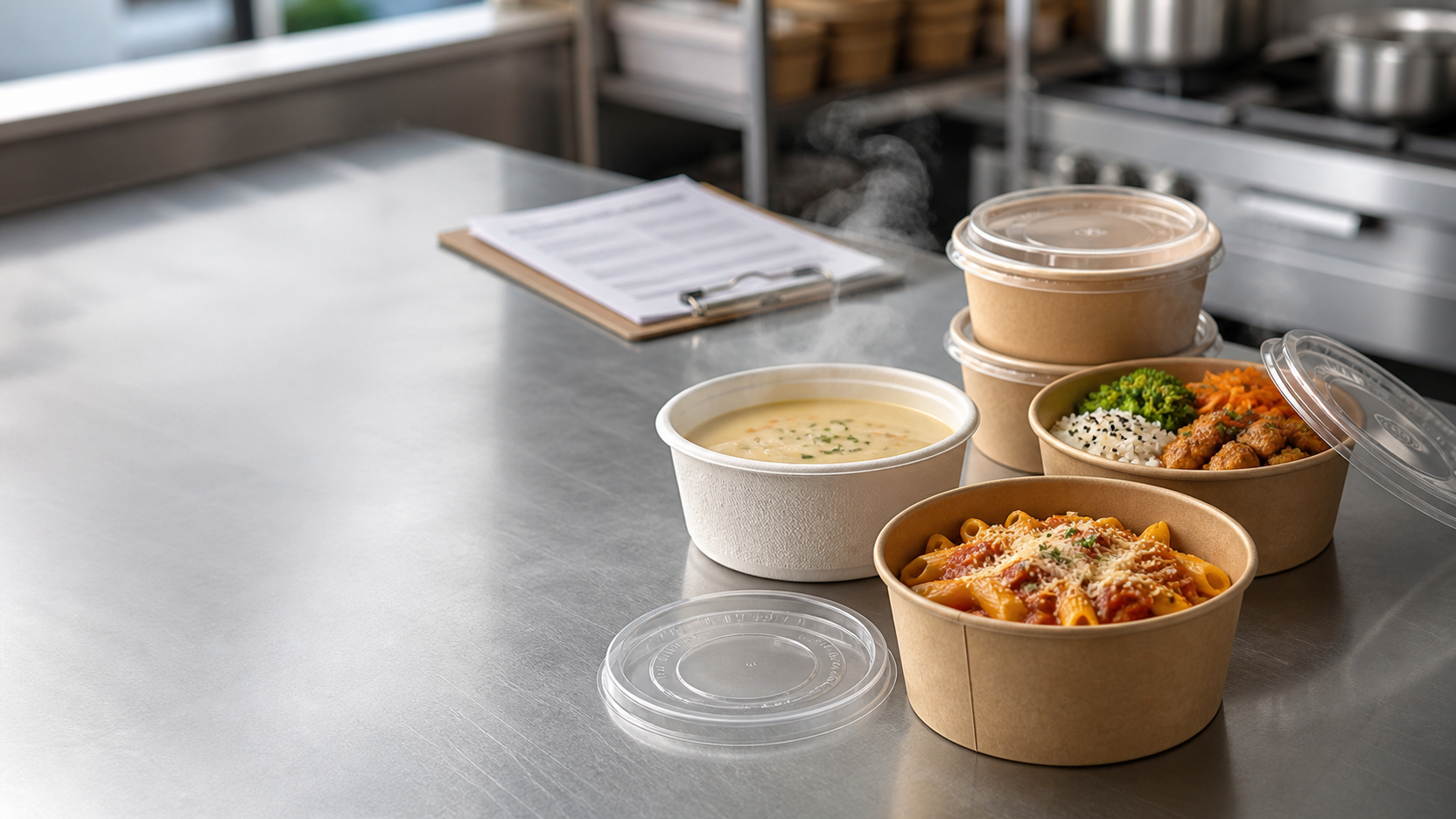
EU food-contact rules are relevant when hot-food takeaway bowls, lids, or other packaging articles are placed on the EU market. Food contact materials (FCMs) must be suitable for their intended food-contact use and must not transfer constituents into food at levels that could endanger health, change the food’s composition unacceptably, or affect its taste or odour. For a buyer comparing bowl-and-lid suppliers, the practical action is to define the finished configuration and intended use, then request documentation and, where relevant, migration evidence that can be related to that scope. This is an EU-market screening framework; it does not establish that a particular TakeawayPack or other supplier item is suitable for every food, condition of use, or destination.
Food contact materials cover more than one packaging material. Plastic bowls and lids, paper-based bowls with coatings or liners, metal components, glass articles, and multi-material constructions may all require review under the applicable framework. Regulation (EC) No 1935/2004 provides the harmonised EU framework for materials and articles intended to come into contact with food. Regulation (EU) No 10/2011 sets additional technical requirements for plastic food-contact materials and articles, including plastic layers in multi-material articles.
Regulation (EC) No 1935/2004
This framework regulation applies to food-contact materials and articles placed on the EU market, including packaging, kitchenware, utensils, and foodservice articles such as takeaway bowls and lids. Its purpose is to ensure that the article is safe for human health in its intended food-contact application.
Key requirements include:
- Materials and articles must not transfer constituents into food in quantities that could endanger human health, bring about an unacceptable change in food composition, or deteriorate taste or odour.
- Good Manufacturing Practice (GMP) must be followed.
- Some material groups, including plastics and ceramics, can be subject to additional EU or national rules.
- Food-contact labelling or appropriate use instructions may be required where the intended use is not evident.
- Where required by applicable measures, businesses need a Declaration of Compliance (DoC) supported by appropriate documentation.
For a hot-food takeaway project, this means the buyer should not treat a generic material description as the complete review. The scope should identify the bowl, lid, any food-contact coating or liner, relevant inks or adhesives where applicable, the intended foods, and the anticipated contact conditions.
Regulation (EU) No 10/2011 for Plastic Food-Contact Articles
Regulation (EU) No 10/2011 supplements the framework regulation for plastic materials and articles intended for food contact. It also covers plastic layers in multi-material articles. For plastic takeaway bowls, lids, or plastic food-contact layers, the regulation provides more detailed controls over permitted substances, migration limits, and testing conditions.
Key requirements include:
Union List
The Union List identifies substances authorised for use in plastic food-contact materials, with specific migration limits (SMLs) for certain substances. A buyer reviewing a plastic component should ask what plastic food-contact layer or component is being assessed and what supporting records are relied on for that intended use.
Migration Limits
Migration limits set the maximum amount of substances that may transfer from a food-contact material into food. They are used to assess whether migration under the relevant conditions could pose a risk to human health.
The Overall Migration Limit (OML) addresses the total migration of non-volatile substances from the plastic material into food simulants under the applicable test conditions. Specific Migration Limits (SMLs) apply to individual substances based on toxicological assessment. Depending on the article and materials involved, the review may need to consider substances such as metals or primary aromatic amines where they are relevant to the construction and applicable requirements.
Migration Testing
Migration testing is used to assess compliance under standardised conditions. The test plan should reflect the intended article and use conditions rather than an unrelated sample or generic company statement.
Food simulants represent different food types, such as aqueous, acidic, and fatty foods. For hot-food takeaway packaging, selecting the relevant simulant matters because soups, sauces, oily meals, and acidic foods can present different food-contact conditions.
Time and temperature conditions are also part of the assessment. They should reflect the intended contact scenario, which can include filling, hot holding, delivery, refrigeration, or other relevant stages. A document for a short, cool-contact condition should not be assumed to answer a different hot-food use without checking its scope.
Declaration of Compliance
For plastic food-contact materials and articles within the scope of Regulation (EU) No 10/2011, the DoC is supported by documentation such as the substances used, the applicable migration assessment, and the intended food-contact conditions. It should be reviewed against the finished bowl, lid, or bowl-and-lid configuration under consideration.
Manufacturers, importers, and downstream users have responsibilities to ensure the applicable requirements are met, maintain traceability, and provide documentation where required. A mismatch between the proposed configuration and the documentation should be resolved before the item is retained on an EU-market shortlist. Non-compliance can result in market restrictions, fines, or recalls.
Other food-contact materials, such as paper, metal, rubber, or ceramics, may be governed by national measures or material-specific EU measures. A plastic DoC or test report should therefore not be used as a substitute for reviewing non-plastic food-contact components in a mixed-material takeaway pack.
How to Build an EU Food-Contact Evidence Request
Before asking a supplier for EU food-contact documentation, prepare a defined request for the reviewed item. Identify the bowl and lid configuration, all relevant food-contact materials and layers, the intended food types, expected temperature and contact duration, whether the article is single-use or repeated-use, and the EU destination market.
Then request records that can be traced to that scope. Depending on the material and construction, this may include the applicable DoC, supporting migration evidence, material identification, the test conditions and food simulants used, and the production or traceability information needed to relate the documentation to the proposed supply. For plastic articles, the evidence should be assessed against the requirements and intended use under Regulation (EU) No 10/2011; for other materials, confirm whether EU-specific or Member State requirements apply.
Do not move forward on the basis of a document that does not identify the component or construction being quoted, does not state relevant use conditions, or cannot be connected to the finished food-contact configuration. The next step is to provide the defined bowl-and-lid specification and intended food-contact scenario to the supplier or qualified reviewer, so the requested evidence can be assessed for that specific EU-market use.