Evaluating a Custom Food Packaging Supplier in China: A Buyer Checklist
Use this practical checklist to compare custom food packaging suppliers on product fit, MOQ, artwork approval, available documentation, and the process behind the quote.
2026-07-23 - 6 min read
Start with the food and delivery use case
For restaurant groups and distributors sourcing custom takeaway packaging, a reliable supplier is one that can match the packaging to the food, explain its order requirements clearly, manage artwork approval carefully, and provide available documentation for the destination market. The right choice depends on the product type, order volume, customisation requirements, and where the packaging will be used—not simply on the lowest quoted price.
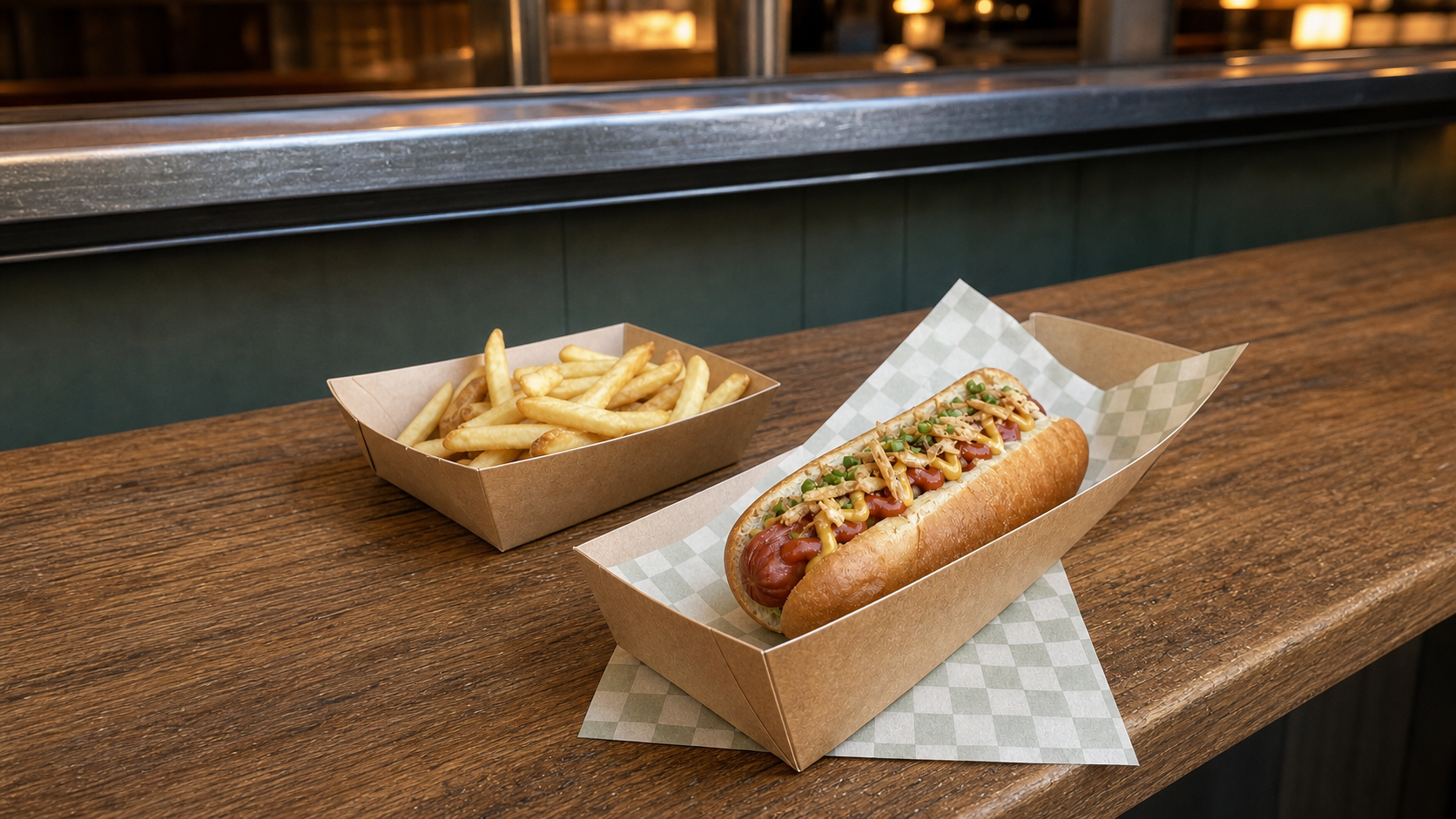
The supplier should first understand what the package needs to hold, how long the food will travel, and which conditions it must handle. Hot, greasy, cold, saucy, and display-led foods can require different container formats, lids, barrier properties, or pack sizes.
Before requesting a quotation, prepare a short product brief covering the food type and serving temperature; portion size and desired dimensions; whether food will be eaten on-site, collected, or delivered; any lid, venting, grease-resistance, or visibility needs; expected order quantity and repeat-order frequency; and the destination country or region.
A supplier that asks these questions early is usually in a better position to recommend a suitable packaging format. A quote based only on a product photo may overlook leakage risk, stacking, or the fit between a lid and a container.
Check whether the MOQ fits the way you buy
MOQ should be evaluated by product type and customisation method, not treated as one universal number. A practical MOQ needs to match your expected demand, storage capacity, and willingness to hold inventory.
Stock items may be available for smaller trial quantities, while custom-printed orders depend on the specific product and production method. Confirm the MOQ against the exact material, size, print design, and product format before placing an order.
| What to confirm | Why it matters |
|---|---|
| MOQ by SKU | Boxes, cups, containers, and bags can have different thresholds. |
| MOQ for a printed design | Printing, material, size, and finish can change the minimum order. |
| MOQ for repeat orders | Repeat ordering may use a different process from a first custom order. |
| Mixed-SKU options | Important for menus that need several packaging formats. |
| Packaging and shipping configuration | Carton quantities affect storage, freight planning, and stock control. |
Make artwork approval a defined stage, not an assumption
Custom packaging is easier to manage when artwork approval has a clear owner and a clear record. The supplier should explain the artwork format required, what happens after files are received, and when production can begin.
A useful approval process normally covers four steps: the buyer provides the logo, artwork, size, and product specification; the supplier checks that the file and design can be applied to the selected packaging; the buyer reviews the artwork proof and confirms any revisions; and production begins only after final approval is recorded.
Ask whether a digital proof, physical sample, or both are appropriate for the order. Printed colour, logo position, and a dieline can look different from an on-screen design, especially when the packaging material or print area changes.
Ask for documents that match the destination market
The documents needed for food packaging depend on the product and the destination market. A reliable supplier should be able to explain which product documents it can provide and which compliance requirements the buyer needs to verify locally.
Ask the supplier to clarify which documents are available for the specific item and material; whether they match the intended food-contact use; the country or region to which the information applies; whether the design, ink, coating, lid, or material choice changes the documentation needed; and who is responsible for confirming the final regulatory requirement in the destination market.
Do not assume that a document for one material, country, or product format automatically covers every custom order. If an order involves a regulated market, unusual food-contact condition, or environmental claim, confirm applicable requirements with the relevant professional or local authority before placing the order.
Compare the supplier’s process, not only its unit price
The lowest unit price can become less useful if it leaves gaps around specifications, approvals, shipping information, or issue handling. A better comparison uses the same brief for every supplier and records the answers in one place.
For distributors, the comparison should also include product consistency, SKU management, and the ability to support a repeat-order process. For restaurant groups, include menu fit, store-level usability, and packaging standardisation across locations.
| Comparison area | Question to ask |
|---|---|
| Product suitability | Which format do you recommend for this food and delivery condition, and why? |
| MOQ | What is the MOQ for this exact SKU and printed design? |
| Customisation | What artwork files, print area, and approval steps are required? |
| Documentation | What item-specific documents can you provide for the destination market? |
| Order planning | What information do you need before confirming an order? |
| Communication | Who will handle specification questions and approval changes? |
When this guide applies—and when it does not
This guide applies when you are evaluating a supplier for custom takeaway packaging for an ongoing restaurant, foodservice, or distribution requirement. It is designed to help you create a clearer supplier brief and compare responses consistently.
It does not replace product testing, legal compliance review, or destination-market advice. Additional verification may be needed for highly acidic, oily, unusually hot, frozen, or long-distance-delivery foods; a specific environmental claim; or a local regulation with product-specific conditions.
Frequently Asked Questions
Is a supplier reliable if it offers a low MOQ?
A low MOQ can be useful, but it is only one purchasing factor. Confirm whether it applies to the exact material, size, print design, and product format you need, and whether the order quantity works with your storage and repeat-order plan.
What information should I send when asking for a quote?
Send the product type, food use case, dimensions or capacity, material preference if known, lid or feature requirements, artwork status, expected quantity, and destination market. A complete brief makes supplier quotations easier to compare.
Should I choose a supplier based on price alone?
Compare price alongside product fit, MOQ, artwork approval, available documentation, communication process, and the cost implications of packaging and shipping. A lower quotation may not cover the same specification or service scope.
Can one supplier cover every type of takeaway packaging?
Some suppliers can support a broad range of packaging needs, but confirm product suitability item by item. Different foods and formats can have different requirements for material, lids, print areas, and order quantities.
What should I confirm before approving custom artwork?
Confirm the product size, print area, dieline, logo placement, text, colour references, and final file version. Ask how approval is recorded and whether a sample or proof is appropriate before production.
Plan your custom packaging requirement with TakeawayPack
Prepare your product brief first, then discuss the appropriate format, MOQ, and artwork process for your order. Contact TakeawayPack to start the conversation.
Related guides: How to source food packaging in 2026; From design to delivery: a B2B buyer’s guide to custom printed packaging; and Verify Chinese packaging supplier factory claims: a 5-step playbook.