Food Delivery Packaging Design: Build a System for Food Quality, Clear Handoffs and Brand Presentation
Food delivery packaging works best as a connected system rather than as a container chosen in isolation. Start with the menu and the delivery journey, then define the container, closure, carry bag, label, and handoff information as one configuration. A restaurant can use route-based trials to compare how complete orders are prepared, packed, carried, transferred, and received. This approach helps teams identify questions that must be resolved before ordering; it does not establish that a particular material, package, vent pattern, insulation approach, or supplier configuration will achieve a stated temperature, moisture, security, compliance, or cost result.
2026-08-16 - 7 min read
Summary
Food delivery packaging works best as a connected system rather than as a container chosen in isolation. Start with the menu and the delivery journey, then define the container, closure, carry bag, label, and handoff information as one configuration. A restaurant can use route-based trials to compare how complete orders are prepared, packed, carried, transferred, and received. This approach helps teams identify questions that must be resolved before ordering; it does not establish that a particular material, package, vent pattern, insulation approach, or supplier configuration will achieve a stated temperature, moisture, security, compliance, or cost result.
Why Delivery Packaging Needs a System Design
A delivery order changes hands several times. It may be assembled at a kitchen pass, staged for collection, carried to a vehicle, moved through a route, and handed to a guest. Packaging has to support the information flow as well as the food flow.
When a menu item, container, external bag, label, and handoff routine are selected separately, important assumptions can remain invisible. For example, the team may not have agreed on whether sauces travel separately, which items share a bag, how an order is identified at pickup, or what a driver needs to know at the door.
A system brief makes those assumptions visible. It gives operations, purchasing, and packaging contacts the same starting point before they compare options or request a quotation.
Start With the Menu and the Delivery Journey
The first design input is not a product name. It is the actual order.
Map food components, not only menu categories
Break a representative order into components such as a main dish, side, sauce, cold item, drink, garnish, and cutlery. Record which components are combined, separated, packed last, or added at the handoff point.
This exercise can reveal decisions that a general label such as “hot food” cannot answer. A team may need to consider liquid content, surface texture, portion format, sauce placement, order assembly sequence, and whether the guest is expected to open or finish the item immediately.
Define the route as a working condition
Map the planned journey from filling to receipt. Include the expected staging period, collection method, vehicle handling, transfer points, delivery window, and intended receiving scenario. If different service areas or dayparts create different routes, treat them as separate test conditions rather than assuming one configuration represents all deliveries.
The goal is to create a practical test brief. It is not to assume that a stated route duration proves temperature retention, moisture control, leakage resistance, or food suitability.
Assign a Job to Each Packaging Layer
A clear design separates the purpose of each layer while keeping the full order in view.
Primary container and closure
The primary container and its closure should be reviewed as a matched configuration for the specific food and packing workflow. Note the intended fill level, orientation, closure step, component separation, and any handling instructions used by the kitchen.
If a design includes a feature intended to manage airflow or moisture, specify the feature and the scenario that needs testing. Do not treat the presence of a feature as proof of a delivery outcome. The selected configuration still needs review under the defined food, filling, handling, and delivery conditions.
External bag and order grouping
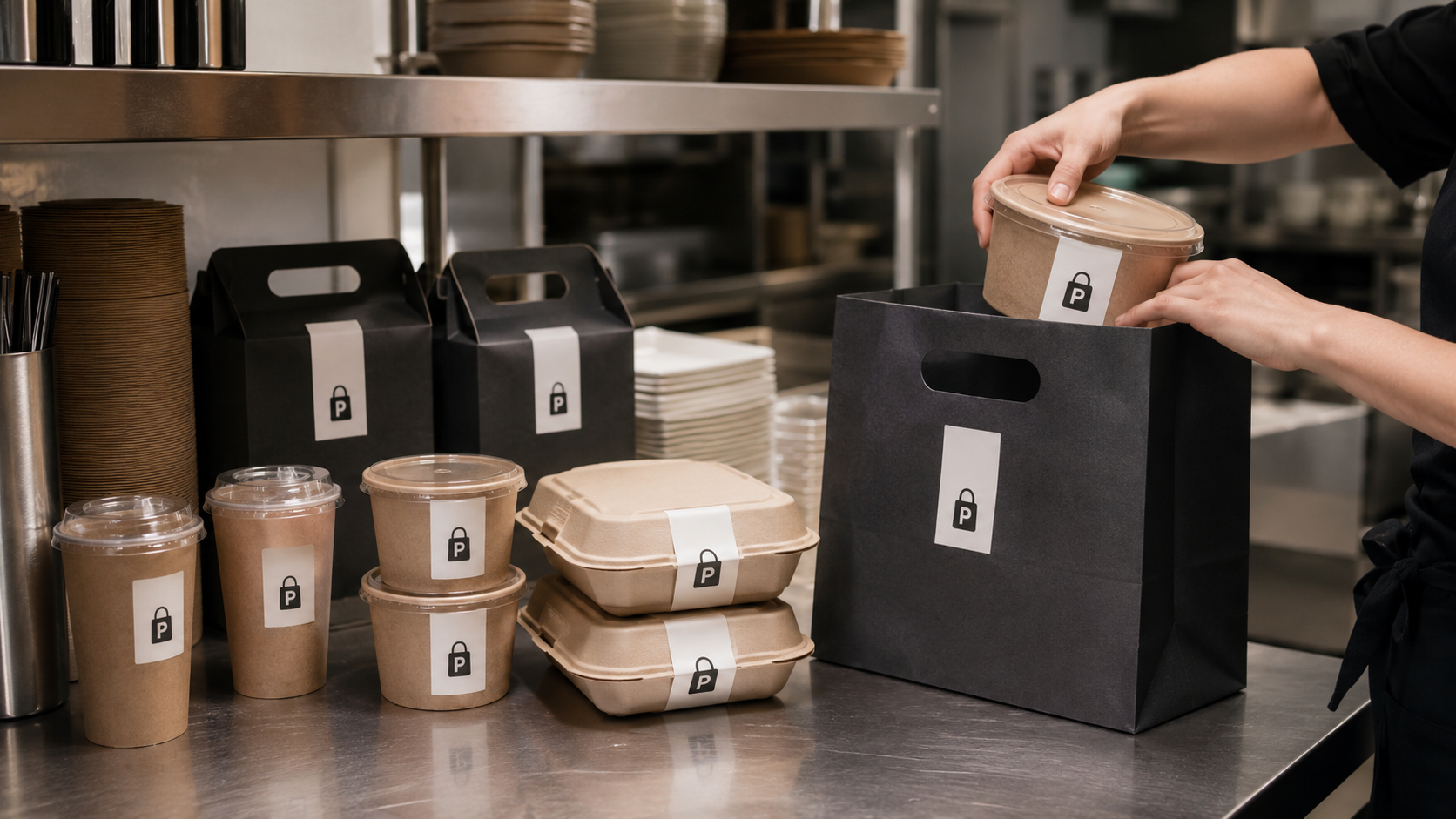
The external bag is where individual components become one order. Define what may share a bag, what must remain separate, how the bag is carried, and where drinks or other non-food components fit in the process.
This layer can also support a more orderly pickup and transfer process. A consistent grouping rule gives staff a way to check whether an order is complete before it leaves the site.
Label and handoff information
A label should help the next person make the right decision quickly. Depending on the workflow, useful fields may include the order identifier, customer or pickup name, item count, bag count, preparation time, and concise handling or separation notes.
Keep wording operational. A label that is too crowded can be harder to scan at the pass, collection point, or door. Test the information hierarchy with the people who assemble, collect, and hand over the order.
Make Brand Presentation Part of the Operating Routine
Brand presentation in delivery packaging is not limited to printed graphics. It also includes whether the order arrives as an organized, recognizable set of items.
Use a repeatable visual hierarchy
Decide where the brand name, order identifier, and any customer-facing message belong. The order identifier should remain easy for staff to find even when brand artwork is present. Use one hierarchy across the label, bag, and any insert so the order looks deliberate without obscuring operational information.
Match customization to a defined configuration
Before requesting custom printing, color, logo placement, or other design work, document the package configuration and the order use case. That record should identify the parts to be customized, the artwork version, the estimated quantity, and the destination relevant to the request.
Custom appearance does not confirm the performance, availability, compliance status, lead time, minimum order quantity, or cost of any configuration. Those points require a supplier response tied to the actual request.
Use Route Testing to Turn Assumptions Into Decisions
A route test is a controlled way to observe the chosen system under conditions that resemble the intended service. It should compare complete orders, not a container on its own.
Create a simple test record
For each run, record the menu components, selected container and closure, bag arrangement, labeling method, preparation sequence, collection time, route scenario, and receiving observations. Photos can help the team compare packing consistency, provided they are handled according to the business's own privacy and operating rules.
Avoid translating a single observation into a broad product claim. A useful test record describes the conditions, the configuration, and what the team observed so that the next decision is traceable.
Change one variable at a time where practical
If a team is considering different closures, bag arrangements, labels, or handling steps, change one defined element at a time where the workflow allows. This makes it easier to identify which assumption needs more investigation.
For example, a test may compare two order-grouping methods while keeping the menu, filling process, and route scenario consistent. The result should guide the next test or supplier question, not serve as a blanket statement about a material or feature.
Build a Supplier Brief That Can Be Answered Clearly
A supplier inquiry is more useful when it describes the delivery system rather than asking whether packaging is “good for delivery.” Include:
- the food components and expected order composition;
- the intended container-and-closure configuration, if known;
- filling, staging, handling, and route conditions to be evaluated;
- the external bag and labeling requirements;
- estimated quantity and customization needs; and
- the destination market and any documentation questions that apply to the project.
Ask for responses, product information, drawings, samples, and documentation in a form that can be connected to the configuration under review. Review any resulting information against the named SKU or configuration, order conditions, quantity, and destination. Do not extend a general catalogue statement or a document for one project into a conclusion about every product or delivery use.
A Practical Delivery-Packaging Review Checklist
Before finalizing a delivery-packaging direction, confirm that the team can answer these questions:
- Which food components travel together, and which remain separate?
- What is the actual journey from filling through customer receipt?
- What container, closure, bag, and label configuration is being reviewed?
- What information must be visible at pickup and at handoff?
- Which aspects of the configuration need route-based validation?
- What supplier information is needed before a purchasing decision?
- Which proposed claims must remain unmade until SKU-, condition-, order-, and destination-specific evidence is reviewed?
Takeaway: Design the Whole Handoff, Then Validate It
The strongest delivery packaging programs make the menu, packing routine, handoff details, and brand presentation work together. Begin with a defined order and route, assign a clear job to each packaging layer, and use structured trials to decide what needs refinement. When the configuration is ready for supplier discussion, contact TakeawayPack for an RFQ or customization conversation. Provide the project details needed for a scoped discussion, and confirm all product, documentation, performance, commercial, and destination-specific questions for the exact configuration before making claims or commitments.