The 5-Step Packing Protocol That Keeps Fried Food Crispy in Takeout Containers
Keeping fries and fried chicken crispy during a 30–45 minute delivery is a packing-protocol problem as much as it is a packaging problem. Two separate mechanisms make fried food soggy in a closed container: trapped steam that condenses back onto the crust, and oil that migrates outward from the coating as the food cools. Ventilation alone fixes only one of them. The practical approach is a five-step protocol — rest the food on a wire rack before sealing, use a vented hot-food-rated container, line the base, avoid crowding, and pack sauces separately — and then validate the whole setup against your real menu and delivery route.
2026-08-11 - 7 min read
Summary
Keeping fries and fried chicken crispy during a 30–45 minute delivery is a packing-protocol problem as much as it is a packaging problem. Two separate mechanisms make fried food soggy in a closed container: trapped steam that condenses back onto the crust, and oil that migrates outward from the coating as the food cools. Ventilation alone fixes only one of them. The practical approach is a five-step protocol — rest the food on a wire rack before sealing, use a vented hot-food-rated container, line the base, avoid crowding, and pack sauces separately — and then validate the whole setup against your real menu and delivery route.
Why fried food turns soggy inside a sealed container
Two things happen the moment fried food goes into a closed box. The first is the **steam trap**. Food straight from the fryer is still releasing water vapor from its hot interior. Inside a sealed container, that steam hits the cooler walls and lid, condenses into droplets, and falls back directly onto the crust.
The second is **oil migration**. Hot oil in the breading does not stay locked in place as the food cools. It moves toward the surface, softens the coating from the inside, and no amount of airflow can reverse it. This is why operators who switch to a vented container but skip the pre-pack rest still end up with soggy food: both mechanisms have to be managed separately.
Give fried food a pre-pack rest on a wire rack
Rest fried food uncovered on a wire rack for two to three minutes before sealing. This clears the initial and heaviest wave of surface steam before it enters and condenses inside the container.
The rack matters. Placing food directly on a flat tray traps steam underneath the crust while more steam builds above it. A rack lets air move around all sides and releases the first moisture load into the open air rather than into the sealed box.
The exact rest time should be tested through real pickup and delivery runs on your own menu. Rushing this step to speed up service is one of the most common packing errors. A short wait sacrifices minimal temperature while protecting the texture that customers actually review.
Understand what ventilation can and cannot do
Ventilation manages ongoing steam during transit, but it does not eliminate the initial steam load. A vented container gives escaping steam a release path and slows condensation buildup on the lid and interior walls. For a typical delivery window, that difference preserves meaningful crust texture.
The trap to avoid is the "just buy vented containers" assumption. Ventilation buys time; the pre-pack rest removes the first wave of steam at the source. Neither step is sufficient on its own.
When you source containers for fried food, three practical features matter:
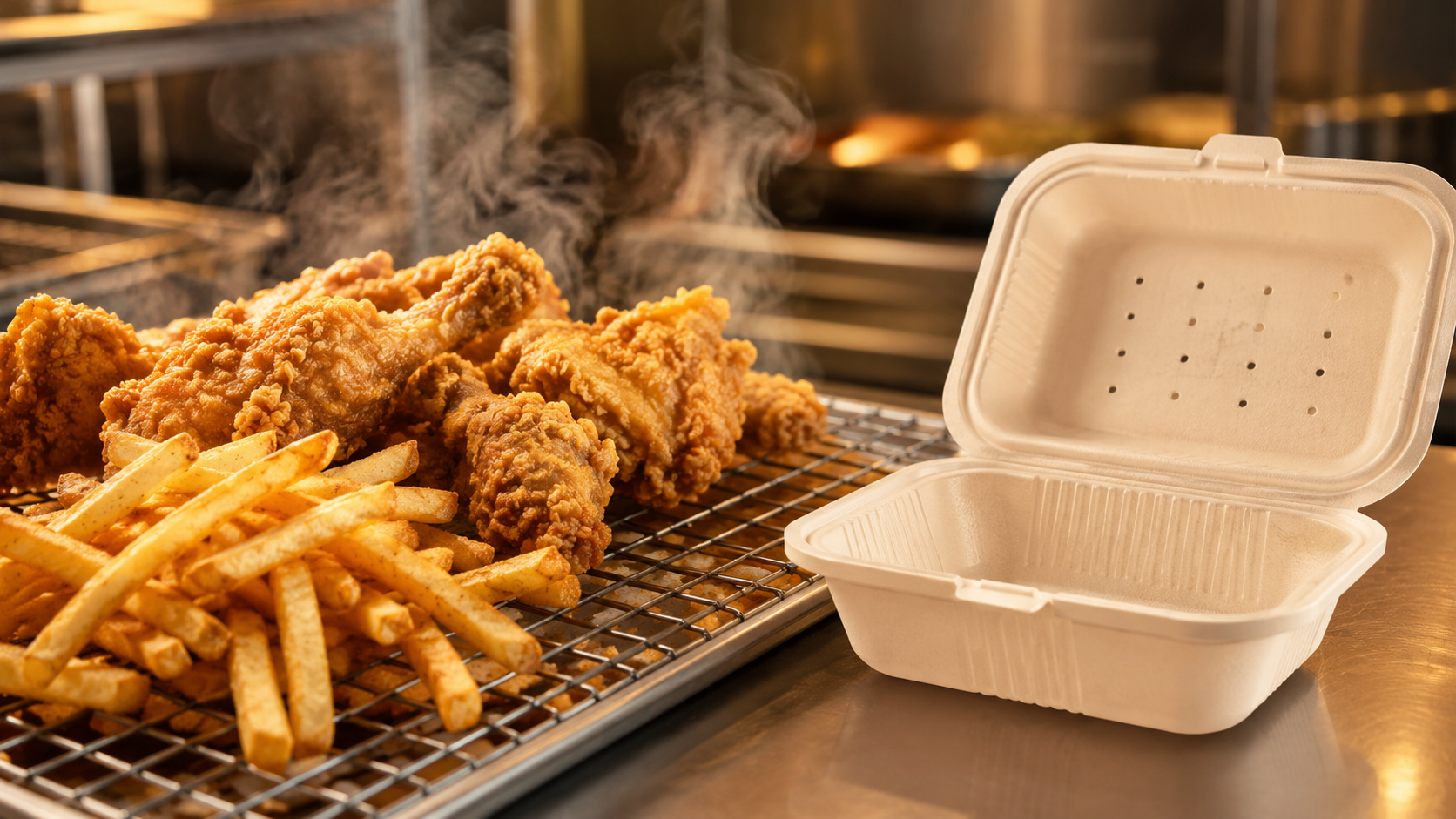
- **Upper corner or side vents**, positioned so they stay above the food line and remain unobstructed when containers are stacked.
- **Raised base channels**, a ribbed interior that lifts the food slightly off the floor so the crust does not sit in condensation.
- **Through-closure lid venting**, where openings run through the hinge so steam can still escape when the lid is fully sealed.
Choose a hot-food-rated container and line the base
Polypropylene (resin code #5) is the common sensible choice for hot fried food. It holds its shape at serving temperatures, keeps vent geometry intact during a delivery run, and does not transfer off-flavors. Some plastics distort above about 140°F, so any container used for fryer-hot food should be confirmed hot-food rated before purchase. A distorted lid removes the vent geometry the container was designed with, which traps steam and lets the lid press onto the crust.
A single parchment layer at the base absorbs condensation that collects at the floor during transit. Paper towels work for very short runs but saturate quickly; parchment holds up longer and does not stick to a crisp crust the way a wet towel can.
Follow the five steps in order
The order matters as much as the container. Skipping any single step undoes the benefit of the others:
- 1. **Rest** the food on a wire rack for two to three minutes before sealing.
- 2. **Choose a vented, hot-food-rated container** so residual steam can escape during transit.
- 3. **Line the base** with parchment paper to absorb condensation.
- 4. **Do not crowd** the container — every piece needs clear space so steam can move.
- 5. **Pack sauces separately** in portion cups rather than pre-saucing the fried item.
Even a well-chosen box can perform poorly if the rest of the line does not support it. Packing too early, overfilling, or covering the vents with labels or tightly wrapped bags all reintroduce the moisture problem.
Keep fryer-hot items out of non-vented options
A non-vented container is fine for cold sandwiches, baked goods, and dry items, but it is the wrong choice for any hot fried food. Likewise, a clear PET container works well for salads and cold grab-and-go items but should not be used for fryer-hot food unless the supplier confirms it is hot-food rated.
For a mixed order, the practical approach is to match the packaging to each component rather than forcing everything into one box. The hot, crisp item gets a vented, hot-food-rated pack; soups, sauces, and wet sides travel in properly sealed containers so they do not add moisture to the crust.
Approach long holds and catering differently
Short delivery windows and long catering holds are different problems. For farmers markets, food trucks, and catering events where food may sit for 45 to 90 minutes or more, extend the pre-pack rest so the surface temperature drops before sealing, hold food open and seal to order where the format allows, and avoid insulated bags during the hold — use them only for the transit leg once the food is sealed. A brief re-crisp in an oven or air fryer between serves restores the exterior without drying the interior.
Build a packing brief and test it against your route
The container is only half the answer. Document the box, lid, vent configuration, closure, tamper feature, and outer delivery bag, then test the complete setup with your actual menu item, portion size, and route. Reproduce the real journey — stacking, turns, stops, and ambient conditions — and score heat and crispness separately.
For operators who need guidance on the packaging side of this protocol, reviewing a clear enquiry brief with a packaging coordinator can help translate a menu into workable container choices. A brief that covers the product category, material, size or capacity, expected quantity, and any printing or lid requirements gives a supplier the information needed to recommend a suitable option and, where relevant, provide samples or a digital proof before production.
How TakeawayPack supports crispy fried-food packing
TakeawayPack is a food-service packaging brand and sourcing coordinator that works with multiple packaging manufacturing partners. Its categories include containers, boxes, lids, trays, and bags, and its request-for-quote (RFQ) flow can collect the product category, material, size or capacity, expected quantity, printing or colour and logo customization, and the destination country or port. During an enquiry, TakeawayPack can discuss structure, coating, capacity, lid matching, and carton packing, and for custom printing it prepares a digital proof from your files and only proceeds to production after your written confirmation.
If you are building a packing protocol for fried food and want to translate it into the right vented containers, visit https://takeawaypack.com and submit an RFQ with your menu format, delivery window, pack size, and branding needs.