Hot Food Delivery Packaging for 30–45 Minute Routes: A Practical Testing Framework
For hot food delivery, the useful question is not whether one box, liner, or vent design will work for every order. The better question is which complete packaging configuration should be tested for a specific menu item, portion, pack-out, and 30–45 minute route.
2026-08-16 - 5 min read
Summary
For hot food delivery, the useful question is not whether one box, liner, or vent design will work for every order. The better question is which complete packaging configuration should be tested for a specific menu item, portion, pack-out, and 30–45 minute route.
Start with the food’s main delivery risk. Crisp items need a controlled comparison for steam and moisture. Soups and sauces need a careful review of fill level and closure. Mixed meals need a test of component placement, lid contact, and bagging sequence. Record the exact configuration and delivered condition before expanding a change across the menu.
Start With the Food and the Delivery Journey
A hot meal changes after it leaves the kitchen. Steam can collect inside the pack, sauces can move during transport, and a stacked order can handle differently from a single container on a counter. Packaging should therefore be evaluated with the food and the journey it is expected to make.
Create a short test brief for each menu item or menu group. Include the cooked portion, fill level, sauce placement, packing time, expected route duration, outer bag, order stacking, and the delivered condition the team wants to assess. The condition may be appearance, texture, closure position, spill control, or ease of opening.
Separate crisp foods from liquid-heavy foods
Fried foods, toasted sandwiches, and other crisp items may create a steam-management question after packing. Soup, curry, noodles with sauce, and other liquid-heavy dishes instead begin with a closure and handling question. A single container format should not be treated as interchangeable across these food types without a representative trial.
Define the 30–45 minute route as a test condition
A 30–45 minute window is a useful route condition to include in a pilot. It is not a promise about temperature, texture, leakage, or customer experience. Use a route that reflects normal pickup delays, carrying, stacking, and handoff, then document what occurred during the test.
Evaluate Packaging as a Complete System
The food container is only one part of delivery packaging. The closure, any venting feature, insert or liner, secondary bag, packing order, and courier handling can all affect the delivered order.
Test the base and closure together
Assess a container with its intended lid or closure after normal hot filling. Record the portion, fill line, closing method, and any change in lid position after the packed order is moved or stacked. If multiple lids, seals, or inserts are being considered, evaluate each configuration separately.
An empty-sample check can identify a basic fit issue, but it does not replace a filled-order test. The test should reflect how staff actually close, label, bag, and hand off the order during service.
Use venting as a comparison, not a default
For steam-sensitive food, a controlled-venting configuration can be compared with an appropriately closed alternative. Keep the food, portion, recipe, bag, and route as consistent as possible so the team can observe differences in condensation, food position, closure behavior, and presentation.
Venting is not automatically appropriate for liquid-heavy dishes. An opening changes the balance between moisture management and spill control. Begin with the food’s specific risks rather than assigning one feature to every hot-food order.
Include the outer bag and pack-out sequence
A closed bag, tightly packed multi-item order, or separate cold item can change the environment around the food container. During the trial, document when the order is bagged, where liquids and crisp items are placed, whether items are stacked, and how the carrier receives the order.
Run a Controlled Delivery Trial
A short, repeatable trial can help a restaurant compare candidates without turning a single observation into a menu-wide claim.
1. Choose a defined comparison
Select one candidate configuration and one relevant alternative. Keep the recipe, portion, fill time, sauce placement, labels, secondary packaging, and route as consistent as practical. Change one key variable at a time where possible.
2. Pack real menu items through normal operations
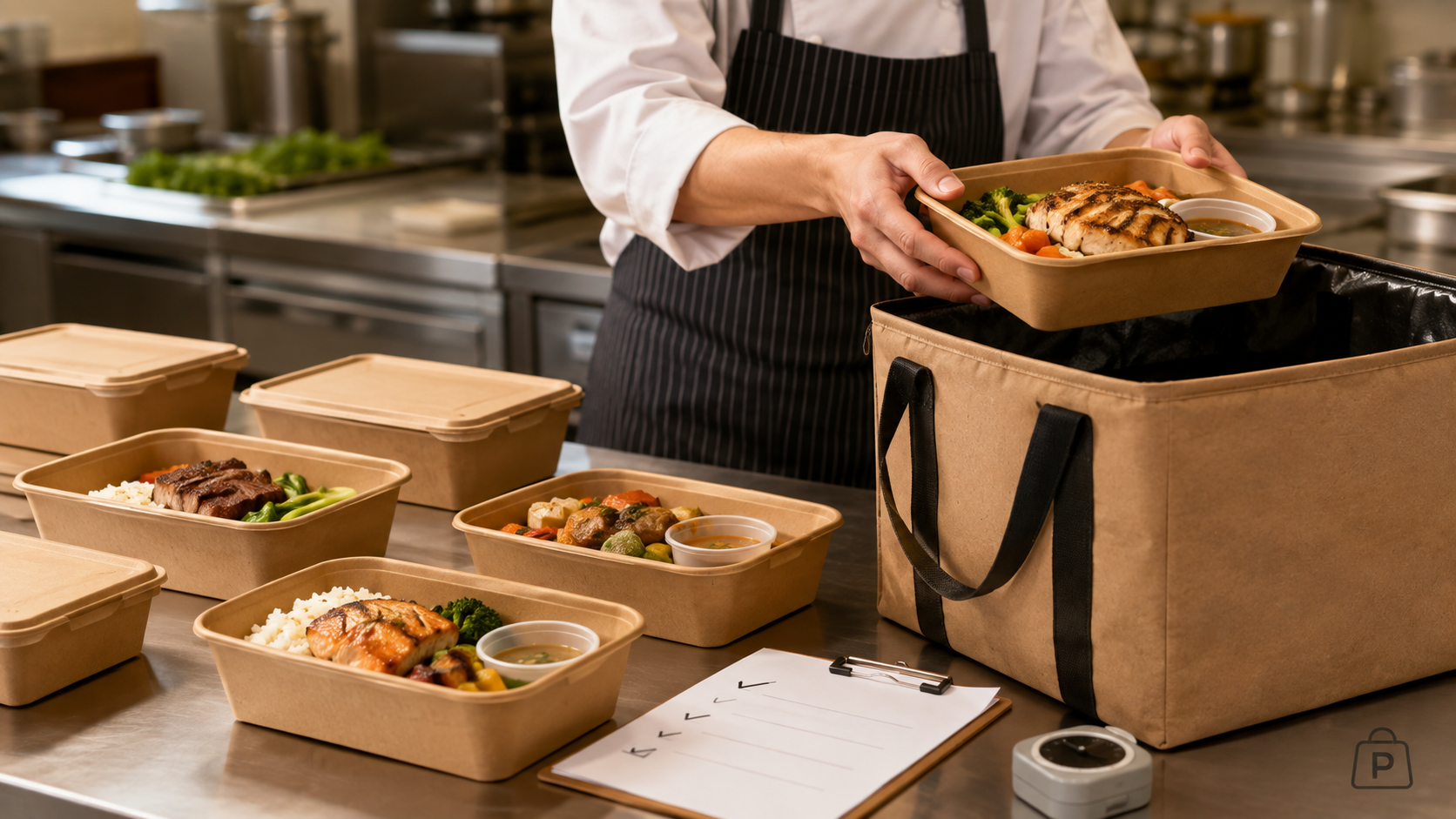
Use food prepared by the usual kitchen process. Include the sides, condiment cups, labels, bags, and stacking arrangement that the order would normally receive. This makes the trial useful for both the packaging choice and the staff workflow.
3. Recreate representative transport and handoff
Run the defined route or a representative equivalent. Record elapsed time, pickup delay, noticeable tilt, stops, stacking, and any unusual handling event. If routes differ substantially, repeat the test instead of treating one journey as proof for every delivery area.
4. Score the delivered order
Use a simple scorecard tied to the menu item. Review the appearance and position of the food, visible condensation, closure alignment, signs of leakage, container exterior, bag condition, and opening experience. Add photographs and short notes so later decisions can be traced to the tested conditions.
The restaurant should apply its own food-safety procedures when assessing food after delivery. A packaging trial does not establish a compliance conclusion, food-contact approval, or performance guarantee.
Compare Cost and Workflow Without Assumptions
Cost should be reviewed alongside the packaging trial rather than assumed from unit price alone. Record the components used, packing time, storage needs, added inserts or bags, SKU complexity, and any observed handling or remake issues.
Ask what problem the configuration solves
A delivery issue may arise from the container, lid, bagging sequence, component separation, route profile, or a combination of these factors. The purpose of the comparison is to identify the configuration that addresses a defined menu problem under the conditions tested.
Re-test when the operating conditions change
Repeat the review if the recipe, portion, container size, closure, outer bag, holding period, carrier, or delivery route changes. A result belongs to the configuration and conditions under which it was observed.
Questions to Include in a Packaging Inquiry
A clear inquiry helps move a sourcing discussion toward a testable proposal. Provide the food type, portion or capacity, fill level, closure preference, expected route window, pack-out, estimated quantity, destination, and customization requirements.
Ask to discuss a named SKU or configuration for the intended application. Before making a sourcing decision, confirm the product details, documentation, and suitability needed for the specific order, food, use conditions, and destination.
Takeaway
Hot food delivery packaging for a 30–45 minute route should be selected through a defined menu-and-route trial. Match the test to the food’s moisture and handling risks, evaluate the container with its closure and outer packaging, and document the delivered condition before expanding a configuration.
For help preparing an RFQ or discussing a packaging configuration, contact TakeawayPack with the food type, container category, size or capacity, estimated quantity, customization needs, destination, and delivery conditions.